In another thread we started talking about cutting different materials with a PE knife and SE knife side by side and sharing our results.
I thought the idea warranted a thread of it's own.
So the premise of this thread will be simple.
Cut something with a serrated knife and a plain edged knife side by side and report your results here
Making short videos to demonstrate your findings is highly encouraged!
I would also suggest using a plain edged knife with an edge angle more comparable to your serrated edge knife.
Geometry has a massive influence on cutting ability, and in my experience most serrated spydercos come ground at about 20 degrees inclusive, while their plain edged knives are typically around 36 degrees inclusive.
It's a more fair comparison if we equalize the geometry between our test knives.
That said, go a head and compare using whichever edge angles you want.
Plain Edge VS Serrated Edge
Plain Edge VS Serrated Edge
Last edited by vivi on Sun Dec 14, 2025 9:06 am, edited 1 time in total.

Re: Plain Edge VS Serrated Edge
I'm going to start off with a pair of zcuts, both freshly sharpened. The plain edged one was reprofiled to be a little thinner, I'd estimate 12 degrees per side with a 15 degree microbevel. Serrated zcut is at the factory angle, which is a little thinner than the PE, which should give it an advantage.
----------------------------------------
I'm going to start us off with a material that made me switch back to plain edged pocket knives at work - plastic wrap.
Working as a kitchen manager / chef I deal with plastic wrap daily. Often times we use pocket knives or chef knives, because the cutter on the box goes missing.
I found serrated knives, particularly spikey factory edged ones, would shred the wrap into little pieces of times. This would result in little bits of plastic potentially contaminating prepped foods - something I couldn't allow.
Here's two attempts with each edge type:

----------------------------------------
Conclusion: Plain edge clearly wins. Both knives can make the cut, but plain edge does it with less fuss and less mess.
----------------------------------------
I've seen similar results cutting sheets of foil, so I'll try that next.

----------------------------------------
Conclusion: Tie. I've had SE knives get hung up on foil in the past, but in this test I felt they were dead even.
----------------------------------------
Lastly, lets quarter some pepperoni.
One of the things I dislike about serrated edges for kitchen use is they often require finishing a cut with a slice. With a plain edged knife a push cut can be sufficient with many types of food. There's also a much lower potential to damage the cutting board using plain edge.

----------------------------------------
Conclusion: Plain edge easily wins. Neater cuts with greater efficiency. There's a reason SE chef knives are a very rare breed.
----------------------------------------
----------------------------------------
I'm going to start us off with a material that made me switch back to plain edged pocket knives at work - plastic wrap.
Working as a kitchen manager / chef I deal with plastic wrap daily. Often times we use pocket knives or chef knives, because the cutter on the box goes missing.
I found serrated knives, particularly spikey factory edged ones, would shred the wrap into little pieces of times. This would result in little bits of plastic potentially contaminating prepped foods - something I couldn't allow.
Here's two attempts with each edge type:
----------------------------------------
Conclusion: Plain edge clearly wins. Both knives can make the cut, but plain edge does it with less fuss and less mess.
----------------------------------------
I've seen similar results cutting sheets of foil, so I'll try that next.
----------------------------------------
Conclusion: Tie. I've had SE knives get hung up on foil in the past, but in this test I felt they were dead even.
----------------------------------------
Lastly, lets quarter some pepperoni.
One of the things I dislike about serrated edges for kitchen use is they often require finishing a cut with a slice. With a plain edged knife a push cut can be sufficient with many types of food. There's also a much lower potential to damage the cutting board using plain edge.
----------------------------------------
Conclusion: Plain edge easily wins. Neater cuts with greater efficiency. There's a reason SE chef knives are a very rare breed.
----------------------------------------
Re: Plain Edge VS Serrated Edge
Next I'll try some utility work with two reprofiled Pacific Salts.
The plain edged one is about 8-10 degrees per side with a 15dps microbevel.
The serrated one was reprofiled to 15 degrees inclusive then given a 20 degree microbevel.
Both were freshly touched up on medium rods.
----------------------------------------
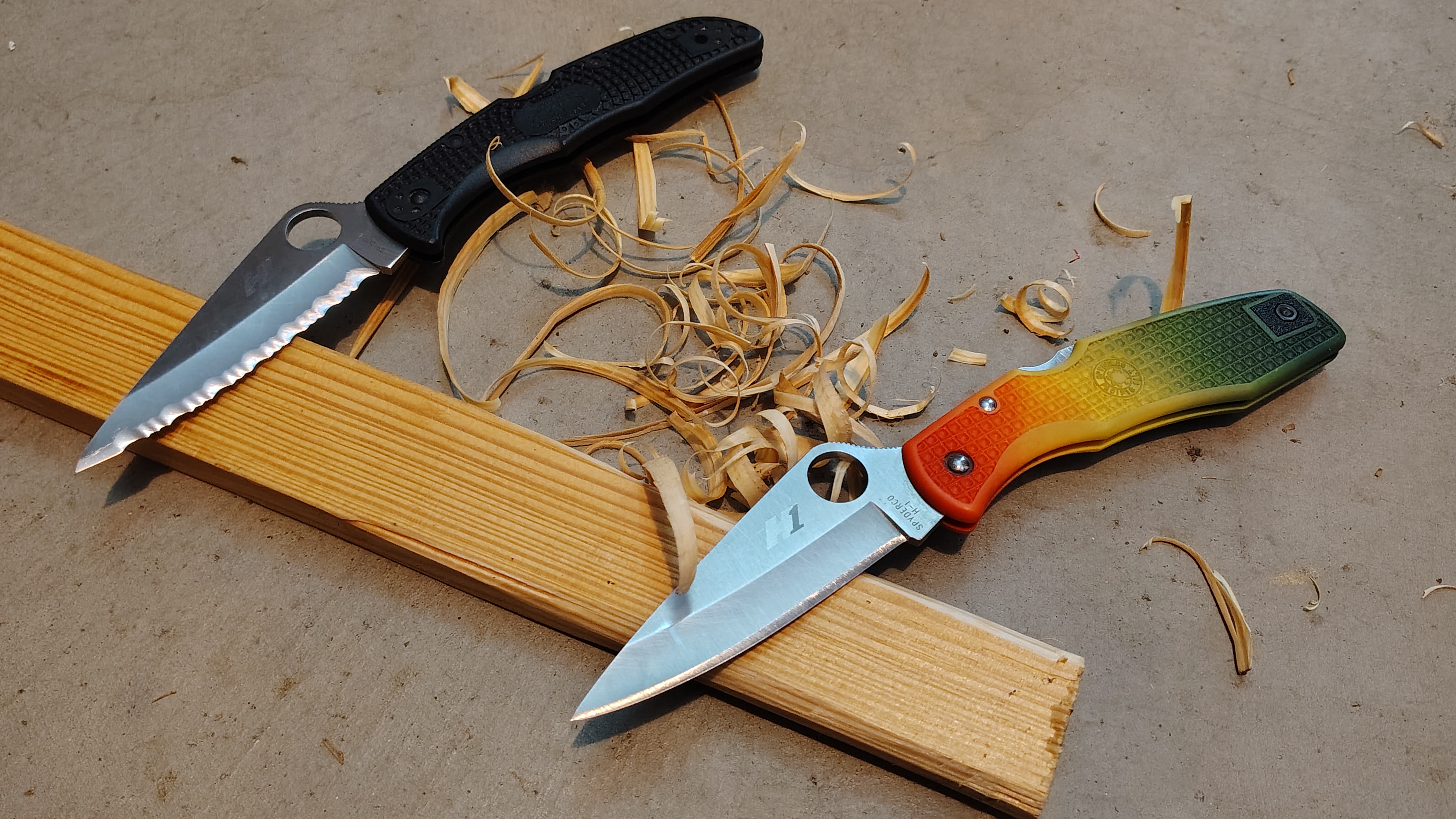
First, some simple wood cutting. Imagine wanting to point a stick to roast a hotdog, or make some thin shavings to use to help start a fire.
----------------------------------------
Conclusion: Tie. Both knives did well. If we compared factory edges the thinner geometry of the SE would likely win, but comparing two reprofiled knives made the test more fair. As wartstein has often pointed out, SE is no slouch for simple wood cutting tasks like this.
----------------------------------------
Next, cutting up an old shirt for rags. In the past I've experienced snagging on these types of materials with serrated edges, so I expect plain to win.

----------------------------------------
Conclusion: I'll call it a tie. I'd give a slight edge to plain. Factory serrated edges with their spikier profile snag bad here, but this reprofiled and heavily sharpened Pacific Salt did a good job of gliding through the fabric.
----------------------------------------
Finally, some double wall cardboard.
Lots of members here talk about how great SE is for this task, and I've never understood their perspective. Once a plain edge knife is thinned out to compare with factory serrated edges, I generally see no reason to choose SE over PE. Let's see if I'm right:

----------------------------------------
Conclusion: Plain edge clearly wins. Not even close. The serrated knife, despite being tested to be shaving sharp, had almost no push cutting ability. It experienced heavy snagging even while slicing. The plain edged knife completed the task faster and with less effort per cut.
----------------------------------------
The plain edged one is about 8-10 degrees per side with a 15dps microbevel.
The serrated one was reprofiled to 15 degrees inclusive then given a 20 degree microbevel.
Both were freshly touched up on medium rods.
----------------------------------------
First, some simple wood cutting. Imagine wanting to point a stick to roast a hotdog, or make some thin shavings to use to help start a fire.
----------------------------------------
Conclusion: Tie. Both knives did well. If we compared factory edges the thinner geometry of the SE would likely win, but comparing two reprofiled knives made the test more fair. As wartstein has often pointed out, SE is no slouch for simple wood cutting tasks like this.
----------------------------------------
Next, cutting up an old shirt for rags. In the past I've experienced snagging on these types of materials with serrated edges, so I expect plain to win.
----------------------------------------
Conclusion: I'll call it a tie. I'd give a slight edge to plain. Factory serrated edges with their spikier profile snag bad here, but this reprofiled and heavily sharpened Pacific Salt did a good job of gliding through the fabric.
----------------------------------------
Finally, some double wall cardboard.
Lots of members here talk about how great SE is for this task, and I've never understood their perspective. Once a plain edge knife is thinned out to compare with factory serrated edges, I generally see no reason to choose SE over PE. Let's see if I'm right:
----------------------------------------
Conclusion: Plain edge clearly wins. Not even close. The serrated knife, despite being tested to be shaving sharp, had almost no push cutting ability. It experienced heavy snagging even while slicing. The plain edged knife completed the task faster and with less effort per cut.
----------------------------------------

Re: Plain Edge VS Serrated Edge
For me, the distinction in their utility comes down to this:
If I care about the shape or appearance of the remaining workpiece then plain edge is better.
If I don't care about what the resulting cut(s) look like, but want to separate matter, serrations can outperform plain edge in some media and situations.
ETA: bread knives are one exception.
If I care about the shape or appearance of the remaining workpiece then plain edge is better.
If I don't care about what the resulting cut(s) look like, but want to separate matter, serrations can outperform plain edge in some media and situations.
ETA: bread knives are one exception.
-
raygixxer89
- Member
- Posts: 127
- Joined: Fri Dec 22, 2017 5:48 pm
Re: Plain Edge VS Serrated Edge
I like plain edge for fine "office environment" deployment. SE for difficult, rough cuts like rope, cardboard or other "outdoor" cuts. I carry both.
Re: Plain Edge VS Serrated Edge
@vivi Great idea for a thread, and thanks for posting your results! I'm guessing the answer is mostly "no", but do chefs ever use serrated knives for cutting meat? I have a couple "steak knives", with .090" thick Elmax, hollow-ground, and plain edges – they do very well cutting steak.
Re: Plain Edge VS Serrated Edge
No.gk4ever2 wrote: ↑Sun Dec 14, 2025 1:49 pm@vivi Great idea for a thread, and thanks for posting your results! I'm guessing the answer is mostly "no", but do chefs ever use serrated knives for cutting meat? I have a couple "steak knives", with .090" thick Elmax, hollow-ground, and plain edges – they do very well cutting steak.
The only tasks I have seen serrated knives used for in professional kitchens:
1. Breads
2. Cardboard
3. Tomatoes
Most people use PE for #3 as well, but when folks don't know how to maintain an edge they resort to SE.
I keep one of those 4 sided diamond harbor freight stones at work, and anytime I see someone use SE knives on tomatoes, I grab one of our house chef knives, give it a few passes on the 300 grit side, and have them use that instead.
Never slips at all - most instances of PE knives slipping on materials boil down to wrong edge finish for the job, wrong cutting technique, or dull knife.
Here are my steak knives at home:
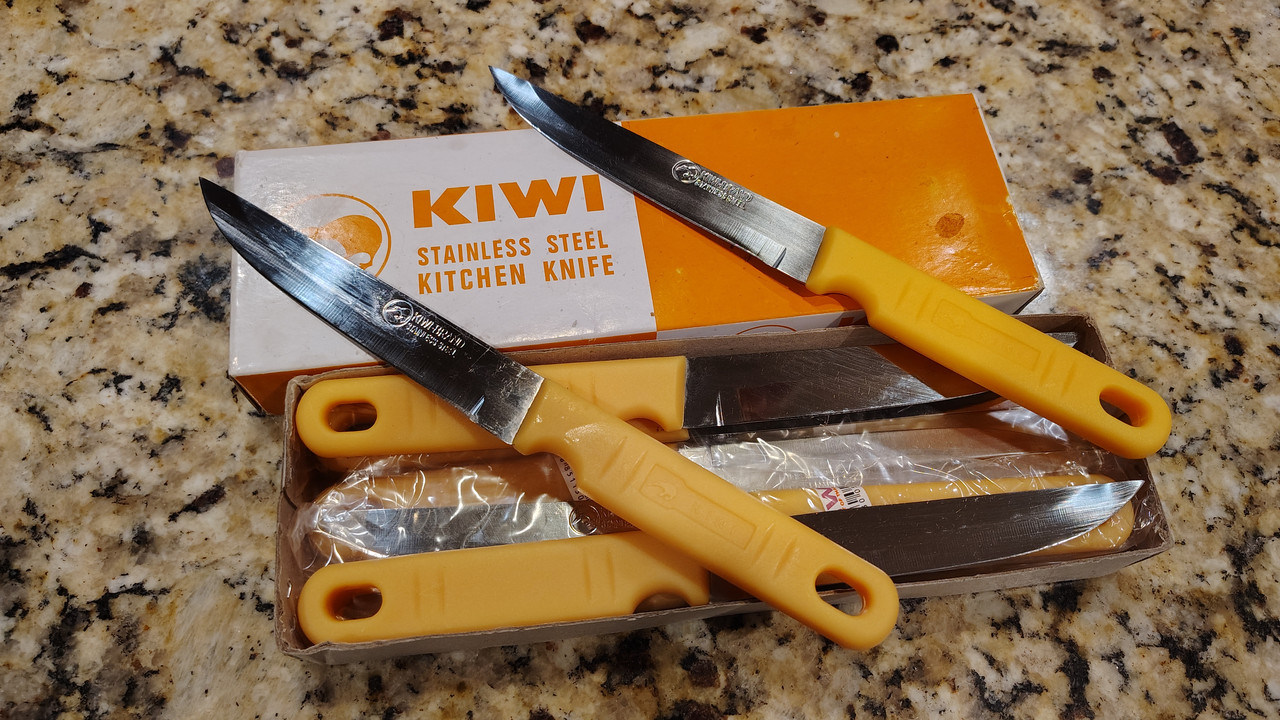
Kiwi 511's touched up at 20dps on the sharpmaker with diamond rods. They cut very well, people always remark how easily they slice steaks. Box of 12 was just under $20 shipped - hard to beat.
Anyways, my next test involves a serrated kitchen knife.
----------------------------------------
Now I want to start exploring the influence of changing the grit pattern on the PE knives.
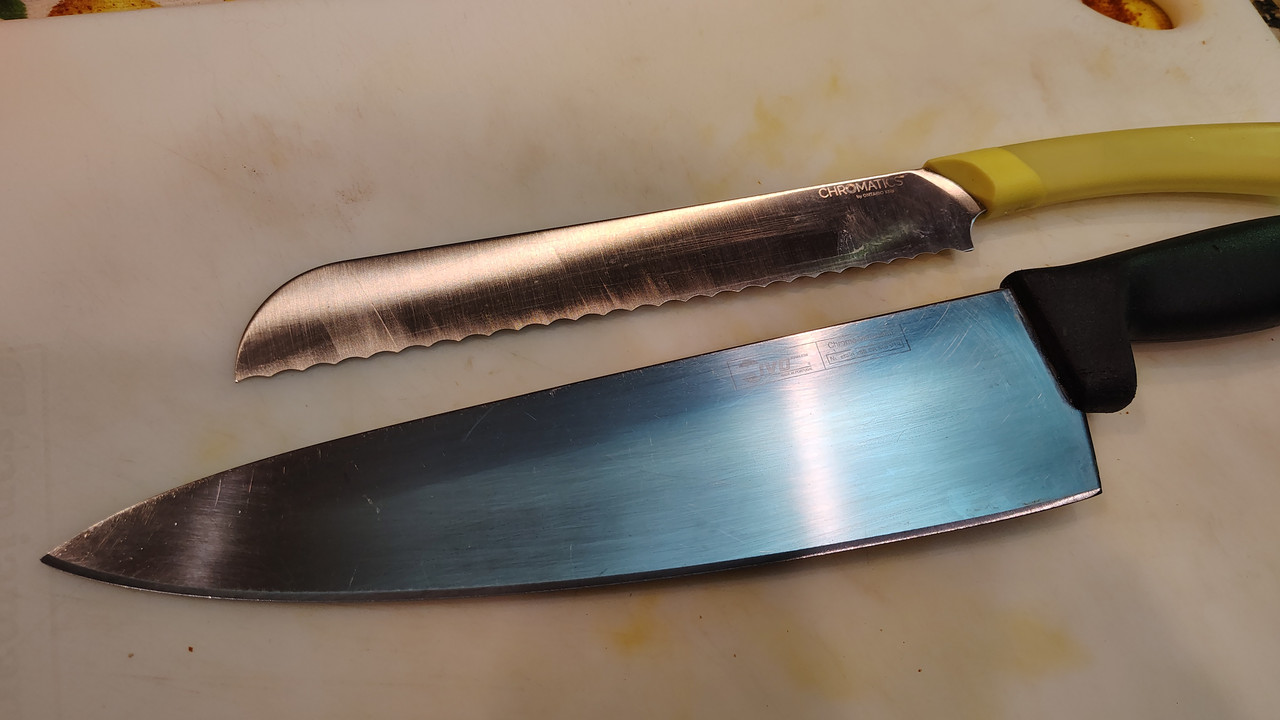
In this test I'm comparing an Ontario chromatics bread knife touched up on the fine rods until it cleanly push cuts paper, and an IVO chef knife with a 140 grit apex tested to be scrape shaving sharp.
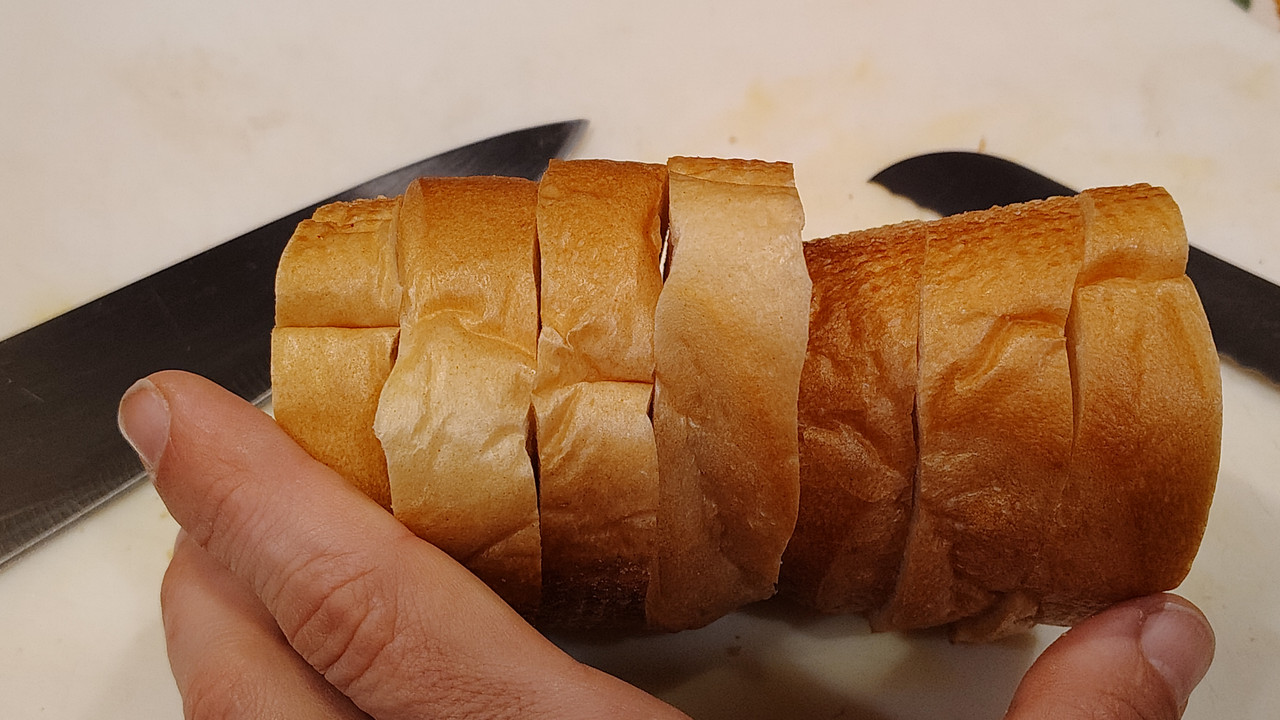
Both will be used to slice a loaf of bread. Keep in mind this is a soft loaf. Using a loaf of bread with a hard crust can absolutely change the results. I'll try to bake one later on and repeat this test.
Here are the test knives.
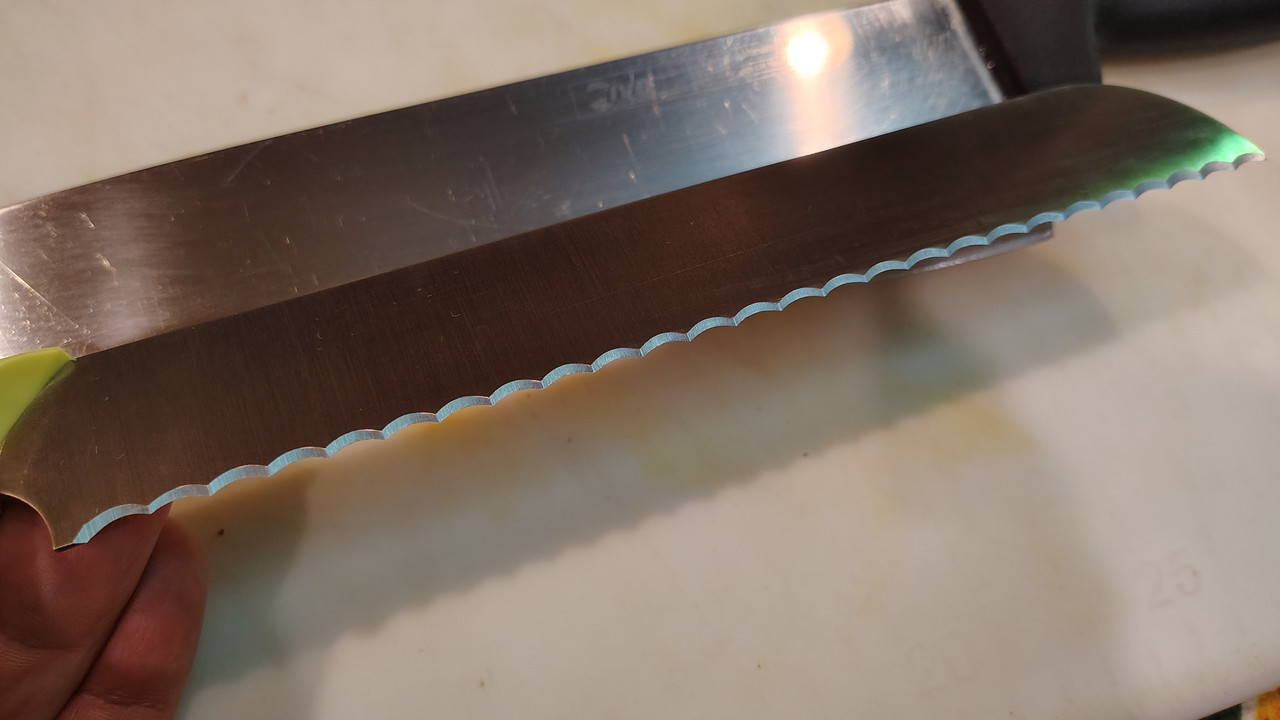
Close up of the serration pattern - pretty standard for a bread knife.
You can see the serrated knife had a tendency to veer off to the side in my test, resulting in slices less even in thickness. This can be an issue with serrated knives in general. Not a big deal for home cooking, but for a professional it can lead to additional food waste due to pieces of food being unpresentable.
----------------------------------------
Conclusion: Tie. Slight edge to the PE knife but not enough to get the nod over SE.
----------------------------------------
If I were at work, which would I choose?
I actually prefer the toothy PE knife for cutting soft breads, for the cleaner, more precise cuts. I typically prefer SE for working with breads that have a harder crust.
Re: Plain Edge VS Serrated Edge
Next up a utility comparison between three Pacific Salts:
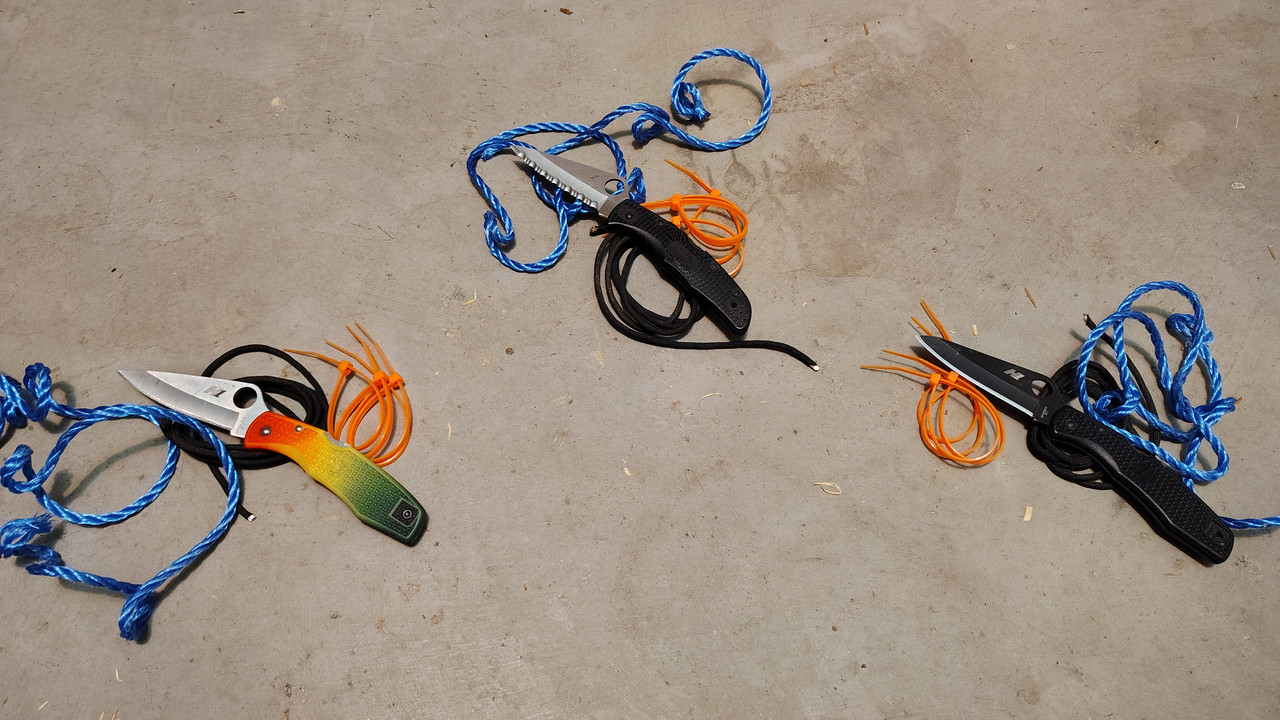
The plain edged rainbow Pacific Salt 1 is around 8-10dps and was polished an ultrafine, hair whittling sharp finish for this test.
The blacked out Pacific Salt 1 is around 7-9dps with a 140 grit scrape shaving finish.
The serrated Pacific Salt 2 is the one I reprofiled to 15 degrees inclusive then sharpened at 20 degrees on the medium rods. It has been touched up since the previous tests.
In these tests I'm using materials most people here say they would choose SE for.
----------------------------------------
First test is cutting four small zip ties with each knife. I will attempt two push cuts and two slicing cuts on the zip ties with all three edge types.
----------------------------------------
Conclusion: Slicing, coarse PE was the easiest for me. Least effort, smoothest cut. SE very close behind but took a bit more force, and polished PE not far behind SE and not slipping at all either. What surprised me were the push cuts. Coarse and polished PE showed pretty similar performance there, and the SE struggled noticeably more. I thought polished PE would do better push cutting them.
I've been saying for years, a coarse PE knife doesn't slip on zip ties.
----------------------------------------
Now I will cut paracord the same way. Two push cuts, two slices with each knife.
----------------------------------------
Conclusion: Coarse PE. They all made the cut without any difficulty, but the coarse PE did it with the least effort. SE took the most effort with either a push cut or a slice. I expected polished PE to be last on a slice, but it did well here. Again, I was surprised polished PE wasn't really any easier to push cut with VS the coarse PE.
----------------------------------------
Lastly, I will cut poly rope. 3/8" from the looks of it. Again, two push cuts, two slices.
----------------------------------------
Conclusion: Coarse PE. SE left messier cuts with more fraying at the ends, and ironically slipped around more than the coarse PE knife. The polished PE would slip a little if gentle force was used. Both the polished PE and the SE required more force before initiating the slicing motion to avoid slipping compared to the coarse PE.
----------------------------------------
If my job were to cut rope and zip ties 8 hours a day, for these tasks I would take the 140 grit plain edged Pacific Salt. It produced cleaner cuts than the SE, had no snagging on slicing motions, and zero slippage. All three knives could get the job done but this was the most efficient tool for these tasks.
The plain edged rainbow Pacific Salt 1 is around 8-10dps and was polished an ultrafine, hair whittling sharp finish for this test.
The blacked out Pacific Salt 1 is around 7-9dps with a 140 grit scrape shaving finish.
The serrated Pacific Salt 2 is the one I reprofiled to 15 degrees inclusive then sharpened at 20 degrees on the medium rods. It has been touched up since the previous tests.
In these tests I'm using materials most people here say they would choose SE for.
----------------------------------------
First test is cutting four small zip ties with each knife. I will attempt two push cuts and two slicing cuts on the zip ties with all three edge types.
----------------------------------------
Conclusion: Slicing, coarse PE was the easiest for me. Least effort, smoothest cut. SE very close behind but took a bit more force, and polished PE not far behind SE and not slipping at all either. What surprised me were the push cuts. Coarse and polished PE showed pretty similar performance there, and the SE struggled noticeably more. I thought polished PE would do better push cutting them.
I've been saying for years, a coarse PE knife doesn't slip on zip ties.
----------------------------------------
Now I will cut paracord the same way. Two push cuts, two slices with each knife.
----------------------------------------
Conclusion: Coarse PE. They all made the cut without any difficulty, but the coarse PE did it with the least effort. SE took the most effort with either a push cut or a slice. I expected polished PE to be last on a slice, but it did well here. Again, I was surprised polished PE wasn't really any easier to push cut with VS the coarse PE.
----------------------------------------
Lastly, I will cut poly rope. 3/8" from the looks of it. Again, two push cuts, two slices.
----------------------------------------
Conclusion: Coarse PE. SE left messier cuts with more fraying at the ends, and ironically slipped around more than the coarse PE knife. The polished PE would slip a little if gentle force was used. Both the polished PE and the SE required more force before initiating the slicing motion to avoid slipping compared to the coarse PE.
----------------------------------------
If my job were to cut rope and zip ties 8 hours a day, for these tasks I would take the 140 grit plain edged Pacific Salt. It produced cleaner cuts than the SE, had no snagging on slicing motions, and zero slippage. All three knives could get the job done but this was the most efficient tool for these tasks.
Re: Plain Edge VS Serrated Edge
Vivi, excellent comparisons. Thanks for the efforts, very interesting indeed.
Re: Plain Edge VS Serrated Edge
Thanks, it's been fun. Hope other members can find the time to shoot some short videos to share here too!
Here's something I didn't catch yesterday after the bread test. This is what that serrated bread knife did to one of my cutting boards:
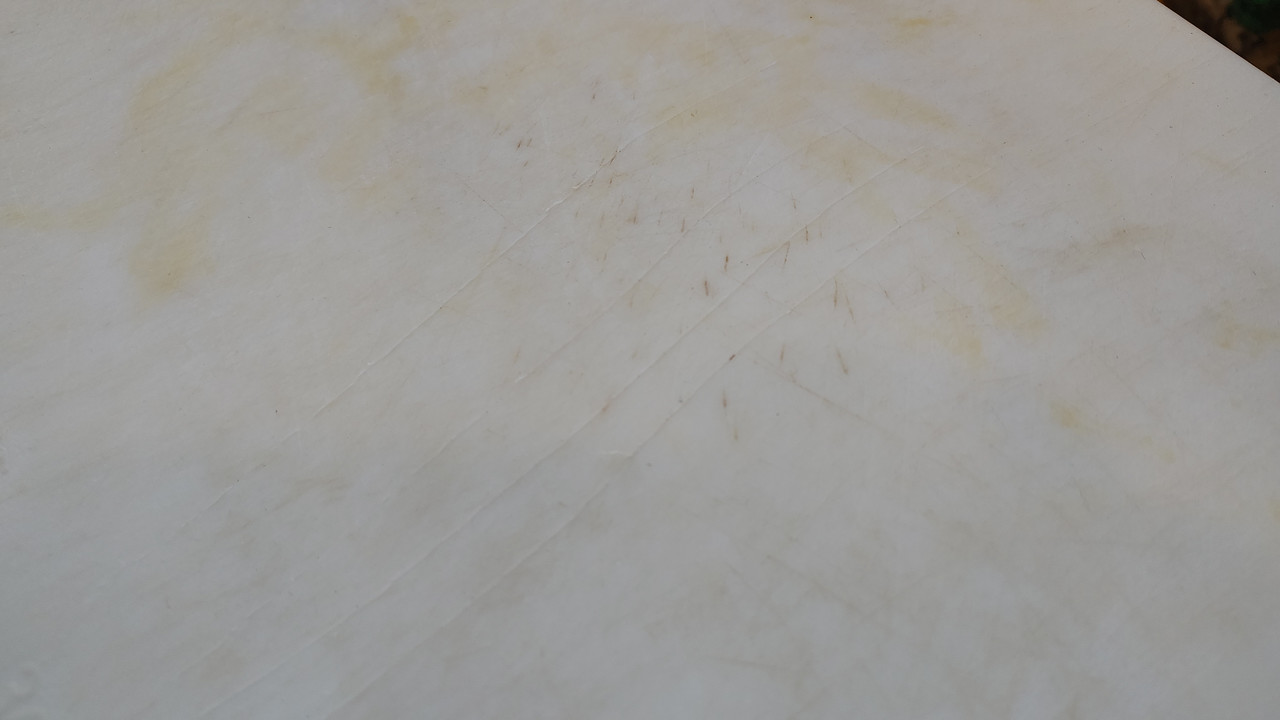
That's something I've brought up in the past. Serrated knives are way more prone to damaging cutting surfaces than plain edged knives. Not something that's going to be of much concern outside of the kitchen, but either way, another point in favor of the coarse PE chef knife.

Re: Plain Edge VS Serrated Edge
Pretty much my thoughts exactly. I've tried and tried and tried to get on the SE train, but am ALMOST always left disappointed. I've even reprofiled a Dragonfly SE and rounded the tips off so it was less snaggy. Certainly helped a bit, but still was not as good as a nicely sharpened PE blade.
I just honestly haven't encountered anything where an SE blade is better besides using my Matriarch on landscaping/gardening projects where a PE blade tends to slip and the SE grips and rips!
I just honestly haven't encountered anything where an SE blade is better besides using my Matriarch on landscaping/gardening projects where a PE blade tends to slip and the SE grips and rips!
Last edited by TkoK83Spy on Mon Dec 15, 2025 3:38 pm, edited 1 time in total.
-Rick
Re: Plain Edge VS Serrated Edge
@vivi
When I open a small shipping box, say like a small fixed rate box, I put it on the counter and use my serrated knife and just slice into one end, as if I wanted to cut off that end, but not that aggressive. I just cut barely cut through the cardboard, then rip off the end. My SE knives with belly seem to do this better than PE (or maybe I'm just more used to doing it this way because it's fun).
Whenever I want to open some sort of box where I'd use the tip of a PE knife, I usually prefer to drag serrations instead. As long as the SE knife has belly (ie not a wharncliffe), I prefer SE to PE here.
When I cut up a pizza box, i tend to cut off the lid, then use either the lid or bottom as a "cutting board" and cut up the parts with similar cuts as I did the other stuff above, stacking more pieces underneath and getting a bit more aggressive as I go. I've never considered doing this with a PE knife. I'd cut up a box like this with mostly perpendicular cuts if using a PE knife.
Though honestly, I really DO buy into the low grit, low angle PE edges that you're "selling". They do work so much better for lots and lots and lots of things than higher grit PE. I sincerely thank you for all of your posts about them.
When I open a small shipping box, say like a small fixed rate box, I put it on the counter and use my serrated knife and just slice into one end, as if I wanted to cut off that end, but not that aggressive. I just cut barely cut through the cardboard, then rip off the end. My SE knives with belly seem to do this better than PE (or maybe I'm just more used to doing it this way because it's fun).
Whenever I want to open some sort of box where I'd use the tip of a PE knife, I usually prefer to drag serrations instead. As long as the SE knife has belly (ie not a wharncliffe), I prefer SE to PE here.
When I cut up a pizza box, i tend to cut off the lid, then use either the lid or bottom as a "cutting board" and cut up the parts with similar cuts as I did the other stuff above, stacking more pieces underneath and getting a bit more aggressive as I go. I've never considered doing this with a PE knife. I'd cut up a box like this with mostly perpendicular cuts if using a PE knife.
Though honestly, I really DO buy into the low grit, low angle PE edges that you're "selling". They do work so much better for lots and lots and lots of things than higher grit PE. I sincerely thank you for all of your posts about them.
Re: Plain Edge VS Serrated Edge
Interesting technique.cjk wrote: ↑Mon Dec 15, 2025 3:23 pm@vivi
When I open a small shipping box, say like a small fixed rate box, I put it on the counter and use my serrated knife and just slice into one end, as if I wanted to cut off that end, but not that aggressive. I just cut barely cut through the cardboard, then rip off the end. My SE knives with belly seem to do this better than PE (or maybe I'm just more used to doing it this way because it's fun).
Whenever I want to open some sort of box where I'd use the tip of a PE knife, I usually prefer to drag serrations instead. As long as the SE knife has belly (ie not a wharncliffe), I prefer SE to PE here.
When I cut up a pizza box, i tend to cut off the lid, then use either the lid or bottom as a "cutting board" and cut up the parts with similar cuts as I did the other stuff above, stacking more pieces underneath and getting a bit more aggressive as I go. I've never considered doing this with a PE knife. I'd cut up a box like this with mostly perpendicular cuts if using a PE knife.
Though honestly, I really DO buy into the low grit, low angle PE edges that you're "selling". They do work so much better for lots and lots and lots of things than higher grit PE. I sincerely thank you for all of your posts about them.
What you cut isn't the only thing that matters, but also how you cut it.
For example, in this next test, none of the knives did great cutting straight into the material, but all showed improved penetration when slicing the material at an angle.
I've opened some boxes the way you describe and a toothier edge, whether SE or PE, definitely seems to help.
----------------------------------------
In the decline of serrations thread there was mention of slicing straight into plastic bottles. This can be a challenging cut for any edge type in my experience.
Like I mentioned above, slicing at a mild angle helps, or initiating a cut with the tip, or bunching up the material and starting at the folded edge.
I tried to do it the hard way though, to see how the edges would respond. Unfortunately the bottle was pretty mangled by the time I got to the third Pacific.
All three knives were freshly touched up before the test. Medium rods for the SE Pacific 2, ultrafine for the rainbow Pacific 1, and 140 grit diamond plate for the blacked out 1.
----------------------------------------
Conclusion: I'll call it a tie between SE and Coarse PE, with polished PE unsurprisingly last place. I think the coarse PE felt a little easier but it was too close to give it the win. Polished plain edges do poorly on most polymer based materials in my experience, so the results were as expected there. I'd like to do a similar test with one of my unused SE Pacific Salts, because I have a hunch the more aggressive spikes could put SE in the lead.

Re: Plain Edge VS Serrated Edge
Actually a thing I think about a lot and @Coastal touched on in another thread (viewtopic.php?p=1862056#p1862056):TkoK83Spy wrote: ↑Mon Dec 15, 2025 12:55 pmPretty much my thoughts exactly. I've tried and tried and tried to get on the SE train, but am ALMOST always left disappointed. I've even reprofiled a Dragonfly SE and rounded the tips off so it was less snaggy. Certainly helped a bit, but still was not as good as a nicely sharpened PE blade.
I just honestly haven't encountered anything where an SE blade is better besides using my Matriarch on landscaping/gardening projects where a PE blade tends to slip and the SE grips and rips!
How can it be that folks who undoubtedly absolutely know what they are talking about and definitely really and honestly use and compare their Spydies come to such different opinions and experiences when it comes to "PE vs SE" ? (See also for example how David @Evil D and @vivi obviously see and experience things differently when it comes to PE/SE... both definitely very experienced and very honest persons).
I honestly don´t know.
I just know that in my own case I really did not expect much of SE, I even was biased against it - so if I had a "dog in the race" at all then it was "pro PE":
Then I got my Endela SE, started to use it and just could not help but being almost blown away by how it did outcut PE for me in most tasks...it was only after that had already happened that I began to read up on SE on this forum and join the discussion with my own, honest impressions...
Top three going by pocket-time (update October 25):
- EDC: Endela SE (K390). Endela SE (VG10), Manix 2 LW (REX45)
- Mountains/outdoors: Pac.Salt 2 SE (LC200N), Salt 2 SE (LC200N), Pac.Salt 1 SE (H1)
- EDC: Endela SE (K390). Endela SE (VG10), Manix 2 LW (REX45)
- Mountains/outdoors: Pac.Salt 2 SE (LC200N), Salt 2 SE (LC200N), Pac.Salt 1 SE (H1)
Re: Plain Edge VS Serrated Edge
Everyone uses their knives a little different, with different hand sizes, in different temperature ranges, on slightly different materials, etc.Wartstein wrote: ↑Mon Dec 15, 2025 10:39 pmActually a thing I think about a lot and @Coastal touched on in another thread (viewtopic.php?p=1862056#p1862056):TkoK83Spy wrote: ↑Mon Dec 15, 2025 12:55 pmPretty much my thoughts exactly. I've tried and tried and tried to get on the SE train, but am ALMOST always left disappointed. I've even reprofiled a Dragonfly SE and rounded the tips off so it was less snaggy. Certainly helped a bit, but still was not as good as a nicely sharpened PE blade.
I just honestly haven't encountered anything where an SE blade is better besides using my Matriarch on landscaping/gardening projects where a PE blade tends to slip and the SE grips and rips!
How can it be that folks who undoubtedly absolutely know what they are talking about and definitely really and honestly use and compare their Spydies come to such different opinions and experiences when it comes to "PE vs SE" ? (See also for example how David @Evil D and @vivi obviously see and experience things differently when it comes to PE/SE... both definitely very experienced and very honest persons).
I honestly don´t know.
I just know that in my own case I really did not expect much of SE, I even was biased against it - so if I had a "dog in the race" at all then it was "pro PE":
Then I got my Endela SE, started to use it and just could not help but being almost blown away by how it did outcut PE for me in most tasks...it was only after that had already happened that I began to read up on SE on this forum and join the discussion with my own, honest impressions...
For example steep thumb ramps bother me because I like to put my thumb on the spine of the knife during regular cutting tasks, while they don't bother you because you use a different grip.
Some folks here are really bothered when Spyderco puts a 20 dps edge on a pocket knife they purchase, because for one reason or another they won't change the edge angle themselves. As you've correctly pointed out, Spydercos very acute SE factory edges pack a lot of benefits for this crowd.
You've talked about how at your job unloading supplies on mountains you're often cutting things quickly in adverse conditions. Meanwhile my most frequent work knife use is making presentation grade cuts on various foods being sold at $40-100 a plate.
I was biased against SE for a long time, then on a whim traded for a SE Pacific Salt 1, blacked out, and learned how to sharpen it pretty well. It really changed my perspective using a serrated knife that could cut arm hairs without touching my skin.
But then a few years later I really got into the coarse edged PE style and realized a lot of the benefits SE offered me could be obtained on PE knives too.
Now I understand not everyone wants to go to the trouble of taking a knife down to 10-12 dps and they prefer a more refined looking polished edge. But just like we have both told people using a really sharp SE knife can be eye opening, so can using a shaving sharp 150-300 grit PE knife.
While we each have developed our own preferences over the years I think it's always important to be willing to listen to other perspectives and be willing to try new things. Heck, I wrote off compression locks for years, and the Military 2 Salt ended up being my most carried knife in 2025 because I was willing to give them another try.
I still carry my CE C95 Manix a lot as a sort of on going experiment to see if I'm missing something. It has a coarse PE and polished SE section and I like trying both edges on the things I cut with that knife. My bias is still towards coarse PE, but it's still fun experimenting.
Re: Plain Edge VS Serrated Edge
Vivi touched on the difference in usage and differences in sharpening knowledge.
Also the people who know the most about these things may still not have perfect knowledge or any real data. Compared to a lot of us they may have the most viable opinions but that may be a ways from hard scientific findings.
And then some of us are just prone to unjustified conclusions. The H1 magical properties threads or the ones about how once you sharpen a Spyderco the good heat treated steel comes out and the edge lasts longer threads show that people just kind of like certain ideas and whether they can prove them or not. Which is fine, everybody enjoying their knives, it’s all good as long as we’re not talking about sci-fi nonsense.

Re: Plain Edge VS Serrated Edge
Wartstein wrote: ↑Mon Dec 15, 2025 10:39 pm
How can it be that folks who undoubtedly absolutely know what they are talking about and definitely really and honestly use and compare their Spydies come to such different opinions and experiences when it comes to "PE vs SE" ? (See also for example how David @Evil D and @vivi obviously see and experience things differently when it comes to PE/SE... both definitely very experienced and very honest persons).
Because 99% of this is just preferences being presented as facts. I completely support people's preferences, but just because something works a certain way for them (or for me) doesn't mean it must work that same way for everyone. This is something I became self aware of a couple years ago, that I had been pushing my ideals and preferences onto others because I was passionate about what I saw, and maybe that's exactly what other people are doing too but for me I just reached a point where I felt really strange about it, even very negatively about it, and I just don't want anything to do with debating or arguing this sort of thing anymore. I'm happy to share my opinions but by no means are my opinions the law or what everyone else should be experiencing. It's a fun discussion up until we start telling each other that you're wrong and I'm right, and that's when one of my favorite quotes comes to mind "bees don't waste their time explaining to flies why honey is better than ****", we all have our version of what honey is and I'm happy to let people enjoy theirs.
~David

Re: Plain Edge VS Serrated Edge
I carry this debate in my pocket every day since I picked up a Spy 27 Dyad.
-
Aladinsane

- Member
- Posts: 803
- Joined: Thu Oct 03, 2024 10:20 am
- Location: Western NC, USA
Re: Plain Edge VS Serrated Edge
Hahaha! Which one is better? Which one do I use????

-Jeff-
A falling knife has no handle!
A falling knife has no handle!