I just got my first stropping/polishing compound block. I have never applied this stuff to anything. How do you do it? I have a new buffing wheel to put in my drill and a naked leather strop. Also, Dremel buffing felt things. I bought it intending to use it for polishing scales, metal and stuff like that. Not necessarilly for stropping a knife edge. But, I have held scales in my hand and rubbed them on strops to polish them. So, applying this to a naked strop is ok with me. I left one I recently made bare for my razors but I don't care for whatever specific leather this is to be left bare. It seems to have no abrasive quality at all. If I don't put this compound on it I'll at least put some .1 micron spray on it. Some bare leathers make a nice strop. Bare kangaroo is awsome. This stuff is about useless without any diamond spray or something. I'm assuming I just rub the block on leather, turn the drill on (slowly) and let the spinning buffing wheel rub against the block and same with the Dremel felts. Since I'm assuming I figured I'd rather ask and LOOK stupid than prove it by doing something wrong and ruining something. :) Any help?
Jack
How do you apply compound that comes in a BLOCK?
-
jackknifeh

- Member
- Posts: 8412
- Joined: Fri Jul 09, 2010 6:01 am
- Location: Florida panhandle
-
sharpguitarist

- Member
- Posts: 1179
- Joined: Sat Mar 13, 2010 10:34 am
- Location: east tn.
Hey Jack,
Fwiw, that's how I've always seen people put it on floor mounted buffing machines.
I have a block of white and green, and I just rub it on my home made strops.
Seems to work just fine.
When I need to reapply, I take a flat scraper and scrape the surface of the leather. That removes old compound and raises the nap.
Hope that helps!
Hope you had a Merry Christmas, and have a Happy New Year!
Later,
Don
Fwiw, that's how I've always seen people put it on floor mounted buffing machines.
I have a block of white and green, and I just rub it on my home made strops.
Seems to work just fine.
When I need to reapply, I take a flat scraper and scrape the surface of the leather. That removes old compound and raises the nap.
Hope that helps!
Hope you had a Merry Christmas, and have a Happy New Year!
Later,
Don
Everyone's entitled to their own opinion, even if it is wrong.:rolleyes:
-
xceptnl

- Member
- Posts: 9009
- Joined: Mon Feb 21, 2011 6:48 pm
- Location: Tobacco Country, Virginia
- Contact:
Jack, I use the black and green compounds for polishing blade flats as well as some stropping. I have always used the rub technique like you and Don described. If the compound block is old I read once that heating lightly in short intervals under a lighter or candle can warm (not even soften) the compound and allow it to work into the nap better. Also like Don said, I scrape mine with a blade spine to clean out old compound when the color starts to change (YMMV). I purchased an extra block of each compound I use. After a year I have used about 25% of the first blocks. I never tried the polish on woods and phenolics though. I may have to try that.

*Landon*sal wrote: .... even today, we design a knife from the edge out!
-
jackknifeh
- Member
- Posts: 8412
- Joined: Fri Jul 09, 2010 6:01 am
- Location: Florida panhandle
Thanks guys. I put some on a Dremel 1" felt buffing wheel. It polished my Sage4 scales very nicely. Right now they are of c-tek material. I took a picture of one side after using this stuff and also the other side. Here is what I bought.
http://www.premiumknifesupply.com/servl ... ing/Detail
I had sanded the scales up to 1500 grit wet/dry sandpaper and buffed with sprays as low as .25 micron. This did a better job. The c-tek has a much more polished look now. I'll try to post the pics tomorrow am. I left the scales on the knife but I didn't see any improvement on any metal. Liners or anything. I also used it to try to polish an already shiny edge bevel (but not mirror) and it made no difference. It was 8Cr13MoV steel. I didn't put any on a strop but I used a piece of scrap leather and tried to apply it. I used my index finger to rub the block and hardly any compound came off. I may as brettunsville leather about the leather. I bought it from them. They sell leather for about anything I think but there is lots of mention of saddles and things like that. I only buy small pieces though. I've bought from them two other times and this leather is smoother and thinner than anything they've sent so far. I have really been happy with it on strops I have applied sprays to. I have .5 micron on one and .1 micron on another strop. I may put some 15 micron on the bare one, maybe. I don't think I'll use this compound though. I just held the leather and rubbed it on the block using a bit of pressure. Maybe I'll try holding the block and rubbing it on the leather on a table and use more pressure. I don't know. I also polished the scales on my Manbug and it helped them. They are shinnier than ever. They are red bone. So I'm happy with this stuff I guess. I will try using it with the Dremel at higher speeds. When using it on a buffing wheel should there be paste left behind on the scales? If so, I applied it right. I have scales of other material. G-10, micarta, kirinite. I think anything with a motor, even a small one will melt the kirinite. I have scrap though so I'll be trying it on what I have. I do wonder how what I got compares to the white and green everyone seems to use. I think this is like a finer grit but I'm not sure.
Jack
http://www.premiumknifesupply.com/servl ... ing/Detail
I had sanded the scales up to 1500 grit wet/dry sandpaper and buffed with sprays as low as .25 micron. This did a better job. The c-tek has a much more polished look now. I'll try to post the pics tomorrow am. I left the scales on the knife but I didn't see any improvement on any metal. Liners or anything. I also used it to try to polish an already shiny edge bevel (but not mirror) and it made no difference. It was 8Cr13MoV steel. I didn't put any on a strop but I used a piece of scrap leather and tried to apply it. I used my index finger to rub the block and hardly any compound came off. I may as brettunsville leather about the leather. I bought it from them. They sell leather for about anything I think but there is lots of mention of saddles and things like that. I only buy small pieces though. I've bought from them two other times and this leather is smoother and thinner than anything they've sent so far. I have really been happy with it on strops I have applied sprays to. I have .5 micron on one and .1 micron on another strop. I may put some 15 micron on the bare one, maybe. I don't think I'll use this compound though. I just held the leather and rubbed it on the block using a bit of pressure. Maybe I'll try holding the block and rubbing it on the leather on a table and use more pressure. I don't know. I also polished the scales on my Manbug and it helped them. They are shinnier than ever. They are red bone. So I'm happy with this stuff I guess. I will try using it with the Dremel at higher speeds. When using it on a buffing wheel should there be paste left behind on the scales? If so, I applied it right. I have scales of other material. G-10, micarta, kirinite. I think anything with a motor, even a small one will melt the kirinite. I have scrap though so I'll be trying it on what I have. I do wonder how what I got compares to the white and green everyone seems to use. I think this is like a finer grit but I'm not sure.
Jack
-
jackknifeh
- Member
- Posts: 8412
- Joined: Fri Jul 09, 2010 6:01 am
- Location: Florida panhandle
Here are pics of my Sage4 scales of c-tek material. One has the finish first left after strop sprays under 1 micron. The other (front one) is after I polished it with my new compound.

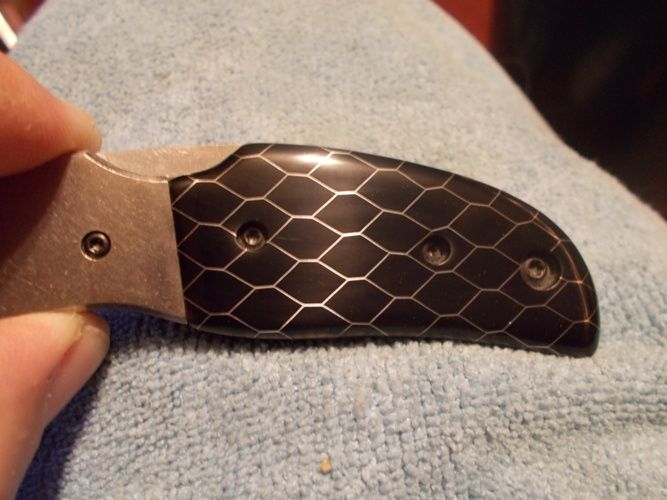
Seeing the pictures I see they are not in focus and the difference is not AS noticeable as it is to the eye. But you can tell a difference. I'm happy with it so far. This was after about 10 minutes of work. If I went back to the fine grit sandpaper and cleaned them first they may look better. I'll do that later. I didn't even remove them from the knife to do this. After the better polish and in the right light I can see the translucency of c-tek much better. Still being a darker color it's not as apparent. On my next set I'll need to take more care even on the underside of the scales. Since you can see through it a bit youcan see the holes in the liners and the lock bar pivot pin. Using transparent material I can't hide any imperfections I don't normally care about because they aren't seen when the knife is back together.
Jack
PS
I made these out of samples the company sent me. Now I can't find the box with the rest of the pieces. I don't know what I did with them when cleaning up for the holidays. NEVER CLEAN! My new motto. :D


Seeing the pictures I see they are not in focus and the difference is not AS noticeable as it is to the eye. But you can tell a difference. I'm happy with it so far. This was after about 10 minutes of work. If I went back to the fine grit sandpaper and cleaned them first they may look better. I'll do that later. I didn't even remove them from the knife to do this. After the better polish and in the right light I can see the translucency of c-tek much better. Still being a darker color it's not as apparent. On my next set I'll need to take more care even on the underside of the scales. Since you can see through it a bit youcan see the holes in the liners and the lock bar pivot pin. Using transparent material I can't hide any imperfections I don't normally care about because they aren't seen when the knife is back together.
Jack
PS
I made these out of samples the company sent me. Now I can't find the box with the rest of the pieces. I don't know what I did with them when cleaning up for the holidays.
NEVER CLEAN! My new motto. :D
-
defenestrate

- Member
- Posts: 2679
- Joined: Fri Sep 24, 2004 10:33 am
- Location: RTP NC area
- Contact:
-
Minibear453

- Member
- Posts: 822
- Joined: Wed Jul 13, 2011 3:36 am
I use a green chromium oxide compound that I bought from Sears. I'm not sure if it makes a difference, but what I do is rub the compound all over the strop, and then use the stove to heat up the strop/compound until the compound essentially "melts." At this point I then use some paper towel to rub the compound into the strop.
Carry a sharp knife, and life will never be dull