YANWDW Sharpmaker

Discuss Spyderco's products and history.
User avatar
vampyrewolf
Member
Posts: 7486
Joined: Fri Sep 24, 2004 10:33 am
Location: Saskatoon, Saskatchewan, Canada

#21

Post by vampyrewolf »

If you can't guess, I've been doing this for a while.

I prefer freehand for setting a bevel, a strop for breaking the burr, and freehand for polishing my edge up.

While the 204 is a great tool for giving a fixed angle it is by no means the ideal tool if you have the time to practice with freehand. I can get a finer edge at a higher polish freehand as I have more control over contact and pressure. I don't have all the answers, and keep learning tricks, but I'm willing to help out others.

If you're willing to go freehand I can get you a sharper edge ;) And as each side can be treated individually you don't have to stress as much about setting identical bevels.
Coffee before Conciousness
Why do people worry more if you argue with your voices than if you just talk with them? What about if you lose those arguements?
Slowly going crazy at work... they found a way to make the voices work too.
User avatar
gunmike1
Member
Posts: 882
Joined: Fri Mar 03, 2006 8:14 am

#22

Post by gunmike1 »

vampyrewolf wrote:If you can't guess, I've been doing this for a while.

I prefer freehand for setting a bevel, a strop for breaking the burr, and freehand for polishing my edge up.

While the 204 is a great tool for giving a fixed angle it is by no means the ideal tool if you have the time to practice with freehand. I can get a finer edge at a higher polish freehand as I have more control over contact and pressure. I don't have all the answers, and keep learning tricks, but I'm willing to help out others.

If you're willing to go freehand I can get you a sharper edge ;) And as each side can be treated individually you don't have to stress as much about setting identical bevels.
My preference is freehand as that is how I first got super sharp edges, and it is a must for thin backbevels. But after back surgery I am unable to use benchstones and can only microbevel on the sharpmaker now. To my surprise I am getting almost as sharp if not as sharp edges by finishing with my .3 micron lapping film stuck to a sharpmaker rod as I was getting on my benchstones. I usually finish with that same film or .05 micron on glass when freehanding, so it really isn't a shock that I am getting similar finished edges. At the same time, the SM has made my Superhawk whittle hair which my benchstones can't touch, and the blades are whittling hair before hitting the lapping film just by using the supplied grits. There is no doubt the benchstones are my preference due to the unlimited angles, but the SM is indispensable due to it's versatilty with SE and other blade shapes that aren't benchstone freindly. As long as your backbevel is thin enough it makes a great quick tool to put on a wicked edge pretty quickly.

Mike
User avatar
THG
Member
Posts: 942
Joined: Mon Jul 28, 2008 8:55 pm

#23

Post by THG »

Swedge wrote:1. Do I start by cutting at right angles across the coarse stone? I tried that before, and while it worked great at dulling the edge, it didn't remover the burr.
A burr doesn't necessarily go away with one stroke. A stone isn't a magic eraser for a burr; a burr has to be ground or broken off. If you keep cutting straight into a stone, you're gonna get a flat spot where the bevels meet, and it'll take a long time to raise an edge. I recommend using the diamond stones I thought I heard you say you have, putting them in the 30˚ or 40˚ slots (whichever you're using), and instead of holding the knife straight up and down, hold it toward the stone a little bit for each side. This way you'll be sharpening the edge for sure and getting that nasty burr.

Again, it likely won't go away in one stroke.
Swedge wrote:3. How often should I be re-applying the Sharpie to check the bevel?
As soon as it goes away if you want to still know where you're sharpening. Eventually you should be able to see where you're sharpening even without the marker (different angles will look different in the light).
Swedge wrote:4. Do I alternate every stroke? Or do I start on the back (using the right-hand stone) and keep going until I feel a burr on the obverse edge?
Recently my idea of sharpening knives has changed because while sharpening, I notice that burrs just don't go away. So this is my new method:

Keep grinding one side until there is a very small amount of metal to go until you get to the edge. Switch to the other side and grind until you've almost gotten to the edge. Now do 1-1 each side until you get to the edge. This eliminates burr formation for me, or at least it makes burrs very easy to deal with when I make a micro-bevel.
Swedge wrote:5. When do I switch to the coarse stone?
You mean from diamond to the brown? I suppose once you've gotten an edge raised with the diamond stones. Then you'll want to use the brown stones until the bevels look more polished uniformly throughout than before (when the scratches are finer).
Swedge wrote:Vampyrewolf, in the other thread, you refer to the "grey flats" as well as the "brown flats" and the "white flats." What stone is the grey one? Mine are brown and white.
I'm pretty sure "gray" and "brown" are the same. They're called "gray" by Spyderco, but they're actually more of a brown color. Kinda like how their waved Delicas and Enduras are called "gray FRN," but they're more blue than anything else ;)
Swedge wrote:I have been learning to use less pressure, and I have been setting it on a table and standing up. And you're right, I can detect smaller burrs now.
Personally, I use moderate pressure when I'm profiling, and when I'm convinced I've got an edge and I just want to make things more uniform, I use light pressure. Then I switch stones (to a finer one), use moderate pressure, then when I'm finishing with it again, I use light pressure. And when I'm making a micro-bevel, it's light pressure all the way. That's just my way of doing things.
Swedge wrote:Does the burr look like a tiny, tiny wire along the edge?
Yes. A burr is also called a "wire edge."
vampyrewolf wrote:The first time might take 20-30 strokes to form a burr,
I dunno if I like that... That's kind of "textbook-ish." It all depends on the situation. When I was learning, I did all the "100, then 50, then 20, then 1-1" and all that kind of thing, but eventually I ditched all of that for my new rule: "It's done when it's done."

20-30 strokes is going to depend on the steel, the stones, the angle of the bevels currently, etc. If you want to form a burr, just grind until you feel one. If you want to minimize the burr, use the marker to see exactly when you get to the edge.

Anyway, the thing to remember is that you're NOT gonna get this over night; it's going to take practice! You must have patience, because even reprofiling jobs can take many, many hours...
Im not good at sharpening, even with a sharpmaker. How get your blade good can your blade with an edge pro system? - Bladeforums user

Has anyone really been far even as decided to use even go want to do look more like? - Some Online Meme
Swedge
Member
Posts: 34
Joined: Sat Mar 21, 2009 10:31 am
Location: California

Progress report

#24

Post by Swedge »

I tried using the diamond stones at 30° on my Delica 4 with zdp-189 steel, applying the Sharpie periodically. I could see that I was hitting the shoulder. I thought I would grind it down to the edge with the diamond stones, but after an hour or so, I gave up. I figured that the zdp-189 is too tough for reprofiling with stones, even diamond coated ones. I'm going to send the knife to Tom Krein for a full flat regrind and practice on other ones.

So the next night, I tried sharpening the blade on a stockman slippie that I bought from Wal-Mart for $5. I figured whatever steel they used in this knife wouldn't be all that tough. Applying the Sharpie regularly, I could see that I was hitting the shoulder. OK, time to go at it with the diamond stones at 30°. Then put on a micro-bevel at 40°. That was the plan.

After examining the edge with a loupe, it looked a little ragged. I decided to take off the bad metal by cutting across the corner of a coarse triangle stone. I dunno. Maybe not a good idea.

I thought I would easily grind it down to the edge with the diamond stones (mostly using the corners), but after several hundred strokes, probably an hour and a half, I wasn't close enough to keep going. I also had a burr (at least this time it was on the obverse, not the back!).

I gave up trying to reprofile the edge to 30°. Perhaps the angle on the blade was more obtuse than usual, but I thought that diamond stones would make short work of cheap steel. Obviously, I thought wrong. Could it take a skilled person an hour or more to re-profile a cheap blade at 30° with diamond stones?

Anyway, I switched to 40° and after a bit, I decided to lean the spine closer to the opposite stone. With not too much additional stroking, the burr came off. I polished the edge with the coarse and then the fine stones. The edge is about as sharp as when I started.

Reminds me of the joke about the movie business:

Q: How do you make a small fortune in the movie business?

A: Start with a large fortune!

Stay tuned for the continuing adventures with the Sharpmaker.

Comments welcome.
User avatar
THG
Member
Posts: 942
Joined: Mon Jul 28, 2008 8:55 pm

#25

Post by THG »

If you're doing ANY kind of rebeveling, it can take HOURS to get to the edge! I was surprised myself when I was learning.

What kind of diamond stone are you using? If I profile with my DMT Fine (red) stone (depending on what angle I started at), it can take around 6 to 7 hours to get to the edge. With my DMT XC (black) stone, I can do it in about a half hour.

So it really depends what kind of equipment you're using, what kind of steel you're using, and what the angle is at now and what you're trying to set it to. If you were thinking you were going to rebevel with the Sharpmaker brown stones, it'll take even longer than my DMT F because:

1. It's even finer
2. There is much less surface area

For reprofiling jobs, I recommend the DMT XC stone and Aligner clamp to get the angle correct. The XC stone really eats metal up, even ZDP.
Im not good at sharpening, even with a sharpmaker. How get your blade good can your blade with an edge pro system? - Bladeforums user

Has anyone really been far even as decided to use even go want to do look more like? - Some Online Meme
User avatar
vampyrewolf
Member
Posts: 7486
Joined: Fri Sep 24, 2004 10:33 am
Location: Saskatoon, Saskatchewan, Canada

#26

Post by vampyrewolf »

... and this is why power tools are fun ;)

If you know a machinist around there, see if they'll set a new bevel for you. If you hold your fingers on the blade you can tell when it's getting warm (if it's warm 1/2" from the contact point, dip it in water or lubrication). Warm doesn't kill the temper... Hot does.

I can set a bevel with just about anything, but it takes practice and a steady hand. Dremel, bench grinder, belt sander, drill press with drum

If I have to do it by hand I dig out my 200/300 grit AO stone, a pad of non-slip rubber... and go at it. Might take 15-20min depending on the steel. Still looking to see if I can find DMT benchstones around here.

Think I put about 30hrs in on my stainless dragonfly so far. I can still drop my bevel a further degree or two if I try. Sandpaper and a mousepad to convex it 7 years ago probably took 15-20hrs total and it got warm in my hands. Since then I've dropped the shoulders down so I now set my blade flat on the stone to sharpen, though usually the strop does enough.
Coffee before Conciousness
Why do people worry more if you argue with your voices than if you just talk with them? What about if you lose those arguements?
Slowly going crazy at work... they found a way to make the voices work too.
Swedge
Member
Posts: 34
Joined: Sat Mar 21, 2009 10:31 am
Location: California

What kind of diamond stone are you using?

#27

Post by Swedge »

Sorry, Vampyrewolf, but power tools for knife sharpening are not an option for me until I learn how to do it by hand. As I mentioned, my D4 is going to Tom Krein, and I have to assume he uses power tools on the zdp-189. ;)

THG, I'm using the diamond stones that are made for the Sharpmaker. I got them because I understood that the coarse Sharpmaker stones (gray/brown) take too long for rebeveling. Any idea how those Sharpmaker diamond stones compare to the DMT stones?

Assuming that the bevel on the cheap knife that I am attempting to rebevel is at, say, 45°, would it take less time to rebevel to 40° than to 30°?
User avatar
THG
Member
Posts: 942
Joined: Mon Jul 28, 2008 8:55 pm

#28

Post by THG »

Swedge wrote:THG, I'm using the diamond stones that are made for the Sharpmaker. I got them because I understood that the coarse Sharpmaker stones (gray/brown) take too long for rebeveling. Any idea how those Sharpmaker diamond stones compare to the DMT stones?
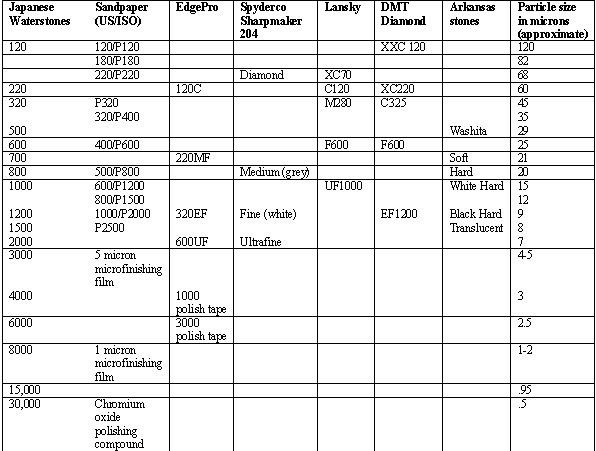
Hmm, that's interesting... According to my chart, the SM diamond rods are even coarser than the DMT XC stone. However, they still have less surface area. See for yourself:

Image
Swedge wrote:Assuming that the bevel on the cheap knife that I am attempting to rebevel is at, say, 45°, would it take less time to rebevel to 40° than to 30°?
Of course, because there will be less metal that you have to remove.
Im not good at sharpening, even with a sharpmaker. How get your blade good can your blade with an edge pro system? - Bladeforums user

Has anyone really been far even as decided to use even go want to do look more like? - Some Online Meme
mbhanzo
Member
Posts: 41
Joined: Fri Jan 25, 2008 9:48 am

#29

Post by mbhanzo »

Color the edge of your knife with a sharpie marker so you can actually see where you are making contact with the abrasive.. To truly use the 204 effectively you will need to sometimes cant the blade a bit either in or out some to match the angle of your edge..

One key point in using the sharpmaker is not to use too much pressure. If you push too hard you end up doing more damage.. The key is medium pressure and controlled passes...

One additional pointer is that you really should also strop your edges. Use a heavy piece of leather or the cardboard backer from a legal pad.. Rub a bit of whatever type of good quality metal polish you have on hand into the surface of the strop and backstroke your edge against the strop using medium pressure.. Say about 2-5 pounds of pressure.. You need to try to nearly match the angle of the edge on your blade when you strop but you only need to be close.. If you strop and edge correctly you will be rewarded with sharper blades that stay sharper longer... Mike
Swedge
Member
Posts: 34
Joined: Sat Mar 21, 2009 10:31 am
Location: California

Progress report #2

#30

Post by Swedge »

I decided to keep working on the stockman slippie that I bought at Wal-Mart for $5, this time using the diamond stones at 40°. I regularly used the Sharpie on the bevel and noted that the back side of the blade was closer to 40° than the obverse. After a while, I got the back side to where it was at 40° but the obverse was still cutting on the shoulder of the bevel. Another hour or so of stroking mostly on the obverse side of the blade brought the fresh marks down near the edge, but the edge is still black from the Sharpie (both sides). So more work to do on that, but that was it for the night.

One thing I noticed is that portion of the edge at the heel of the blade has a lot of black from the Sharpie. I start with the blade resting on the part by the choil, and it's obvious that as I pull back and down, that part is the first to slide off the stone. Therefore, it gets the least amount of working. What should I do about that?

mbhanzo, I look forward to stropping once I learn to get a good edge. That seems like running to me, and I'm still trying to learn to walk.
trucker1964
Member
Posts: 5
Joined: Sat Mar 21, 2009 4:10 pm

#31

Post by trucker1964 »

Hey Swedge. I thought I would share my experience with the Sharpmaker.

I just taught my self to use it this weekend. I have been using a Lansky diamond set for like 15 years more or less I'm not exactly sure. Long time anyways. I have had great success with the Lansky and it taught me what makes a proper edge. I always use a micro bevel by the way. I can sharpen just about anything with it but have had a hard time with some blades.

Anyways I kept reading about how good the Sharpmaker is for maintaining an edge and it is so portable and easy to set up. So I ordered one with a set of the diamond stones and a set of the extra fine stones as well.

I had a hard time at first and actually thought the stones were not set at the same angles because on one side of the blade I would be hitting down near the edge and on the other side I would be hitting way up on the shoulder. I called the company I got it from and asked if I could return it and the answer was no. So I decided to see if I could make it work. Glad I did. This thing is great for what I want. I can carry it with me at work and bring back a hair popping edge any time very quickly. I cut a ton of cardboard to dull a knife I had just sharpened and in less than 3 minutes total it was scary sharp again with just the fine stones. That includes setting up the Sharpmaker.

Ok sorry so long winded. Here is what I learned. First I had to start out slow, I mean real slow as in each down stroke taking 2-3 seconds. I am faster now but I don't think I will ever be as fast as Sal is in the video.

Second and this was very important to me. I think it really made all the difference. The way I push the blade against the stones is critical. I will try to explain. At first I was just trying to hold the blade straight with my arm only and I don't think I was consistent. I learned to use the stones as a support for me to hold the blade straight. What I do is hold the knife with my thumb on top of the spine and put slight pressure on it in the way you would turn a key in a lock. Its hard to explain. I am right handed so the knife is in my right hand and when facing the stones and using the stone on my right I put a slight amount of counter clockwise rotational pressure to the handle. this pulls the edge of the blade up against the stone and with the support of this slight pressure against the stone I can very consistently hold the blade straight. Also very quickly you learn to feel what the edge is doing with this pressure. It becomes very intuitive. Like I said I started with very slow strokes. When I stroke the stone to my left I use a slight clockwise rotational pressure. For me this slight rotational pressure made all the difference. It pulls the edge to the stone and stabilizes my hand to hold the blade straight. I can feel if the blade is straight.

This is an excellent tool and I love it all ready. It is not for re-profiling as others have said but I have my Lansky for that.
One of the blades I had a hard time clamping in the Lansky was a Paramilitary. The angles were not the same on both sides of the blade because of this. I did even out the angles with the diamond stones and it took about 10 minutes. Now I will only use the Sharpmaker with this knife. My Militarys and Manix knives had nice even bevels on them from the Lansky so I just went right to the 40 degree micro bevel on the Sharpmaker and they are scary sharp.

I'm sure this post is too long but I really wanted to help you if I could because I know how frustrated I felt with $140 worth of sharpening equipment that I felt was worthless :mad: It's not in fact I'm stoked that I will be able to touch up my knives anytime at work instead of having to wait until I get home. If you want me to explain any of this more just ask.
hope this helped :)
mbhanzo
Member
Posts: 41
Joined: Fri Jan 25, 2008 9:48 am

#32

Post by mbhanzo »

Swedge wrote:Sorry, Vampyrewolf, but power tools for knife sharpening are not an option for me until I learn how to do it by hand. As I mentioned, my D4 is going to Tom Krein, and I have to assume he uses power tools on the zdp-189. ;)

THG, I'm using the diamond stones that are made for the Sharpmaker. I got them because I understood that the coarse Sharpmaker stones (gray/brown) take too long for rebeveling. Any idea how those Sharpmaker diamond stones compare to the DMT stones?

Assuming that the bevel on the cheap knife that I am attempting to rebevel is at, say, 45°, would it take less time to rebevel to 40° than to 30°?
The diamonds for the sharpmaker... It's my opinion they are nice for thinning and rebeveling the edge of kitchen type cutlery but they are not ideal for many other types and styles of knives.

You are correct to learn what you are doing by hand with non power type tools first.. This is the best way. The Dmt non interrupted type stones.. The ones that dont have the colored spots on them are best. You want to learn on bench type stones. Bigger is always better in bench stones. You should stand and have the stones at about belly height ideally... In my shop I spray the stones with a mister bottle of water or glass cleaner or even rubbing alcohol.. No oil...

Here's the master list of non power type sharpening gear.
DmtD11C- Coarse diamond stone 11" long.. Not cheap but worth every penny.
*In time you will wear this stone down to a very nice medium and will want to keep this aside as more of a finishing type stone when you want a smooth but tootyh edge... This will take a while and eventually you will want to purchase a new coarse or even possible an extra coarse.. For learning the xtra coarse is too coarse and it doesnt allow for as crisp a bevel as the standard coarse... I'm lucky enough that the rep for Dmt lives here in Ft. Wayne and is the guy that also is in charge of the Dmt displays at Blade and the Shot Shows... He keeps me in dmt goods and I keep his knives sharp.. When I walk into the Dmt display it's my classroom and I'm the teacher. :D


Spyderco Medium Bench stone- In reality you will want both the medium and the fine.. You may want the ultra fine also.. I use it on razors and some carving tools... These are great stones.. I love them.. A good friend that worked for Spyderco at the Factory Outlet Store purchased me a set for Christmas in 2001 and they are fantastic. You will never wear out these stones. Again.. worth every penny... I wish only that a larger and longer set were available...

This selection of abrasives used correctly in conjunction with a strop and a 204 system will be all you will should need to make and keep most knife types sharp..

If youre going to do hawkbill blades in the future you'll want to purchase a couple of Hewlett Hmp12's.. Long oval type diamond steels.. another very good tool to have... :)
Swedge
Member
Posts: 34
Joined: Sat Mar 21, 2009 10:31 am
Location: California

#33

Post by Swedge »

trucker1964 wrote:At first I was just trying to hold the blade straight with my arm only and I don't think I was consistent. I learned to use the stones as a support for me to hold the blade straight. What I do is hold the knife with my thumb on top of the spine and put slight pressure on it in the way you would turn a key in a lock. Its hard to explain. I am right handed so the knife is in my right hand and when facing the stones and using the stone on my right I put a slight amount of counter clockwise rotational pressure to the handle. this pulls the edge of the blade up against the stone and with the support of this slight pressure against the stone I can very consistently hold the blade straight. Also very quickly you learn to feel what the edge is doing with this pressure. It becomes very intuitive. Like I said I started with very slow strokes. When I stroke the stone to my left I use a slight clockwise rotational pressure. For me this slight rotational pressure made all the difference. It pulls the edge to the stone and stabilizes my hand to hold the blade straight. I can feel if the blade is straight.
I see that this is your first post, so welcome. And thank you for taking the time to make a detailed post.

I believe I understand what you're saying. In a nutshell, instead of keeping the side of the blade perpendicular to the top of the table, you rotate it so that the bevel of the blade is parallel to the side of the stone. Is that right?

With your approach, it seems to me that you are sharpening the edge whatever the angle of the bevel may be but not reshaping the bevel.

I'd be interested in comments from the more experienced users on this technique.

What I have been doing is to try to keep the the side of the blade as perpendicular to the top of the table as possible. As a result, the stone will cut the shoulder of the bevel if the angle of bevel is greater than (or less than?) the angle of the stone. My technique for keeping the side of the blade as perpendicular to the top of the table as possible consists of looking over the spine of the blade and making sure that I can see both sides of the blade (or neither side). If I can see more of one side than the other, I tilt the blade so that each side seems equally visible. And then I push down and pull back while pressing the side of the blade against the stone.

I'd also be interested in comments from the more experienced users on this technique.
Swedge
Member
Posts: 34
Joined: Sat Mar 21, 2009 10:31 am
Location: California

A separate technique question

#34

Post by Swedge »

I assume that when using the flat sides of the triangle stones it is best to keep the blade flat against the side of the stone. If the blade is angled one way, it will rub against the front corner, and if angled the other way, it will rub against the back corner. This defeats the purpose of having a flat side, or so it seems to me.

Therefore another technique I have been using is to position the blade flat against the flat side of a stone and to move my wrist back and forth. At one point, I can feel the blade resting solely against the front corner of the stone and at another point, I can feel the blade resting solely against the back corner of the stone. I then try to position the blade so that it is not rubbing against either corner but more or less flat against the side of the flat side of the stone.

I'd appreciate confirmation from experienced users that this is correct.
Swedge
Member
Posts: 34
Joined: Sat Mar 21, 2009 10:31 am
Location: California

Progress report #3

#35

Post by Swedge »

All right. After some additional amount of stroking with the diamond stones, and raising a burr and getting rid of it, I finally got all of the black marker off the bevel on the obverse side of the blade. I cleaned my coarse and fine stones (using BarKeeper's Friend and a green Scotchbrite cloth) and then sharpened the edge some more. The bevel looks almost polished now, and the knife slices fairly well. It can't exactly push cut newsprint, but it's pretty sharp for everyday use.

I have the ultra fine stones on order. When they come, I will use them and see if that improves the edge even more.

By the way, carefully inspecting the edge with my 10x loupe, I can see that the bottom of the edge is not perfectly flat. There are a few tiny nicks. Is that common on a properly sharpened knife? Is that something I should be trying to get rid of, and if so, how?
Swedge
Member
Posts: 34
Joined: Sat Mar 21, 2009 10:31 am
Location: California

#36

Post by Swedge »

mbhanzo wrote:The diamonds for the sharpmaker... It's my opinion they are nice for thinning and rebeveling the edge of kitchen type cutlery but they are not ideal for many other types and styles of knives.
I'm starting to think that's the case.
The Dmt non interrupted type stones.. The ones that dont have the colored spots on them are best.


Could you post a link so I can recognize them better? I have gone to websites but it's confusing with the array of DMT products offered.
User avatar
THG
Member
Posts: 942
Joined: Mon Jul 28, 2008 8:55 pm

#37

Post by THG »

Swedge wrote:Could you post a link so I can recognize them better? I have gone to websites but it's confusing with the array of DMT products offered.
What you're looking for is the "Diasharp" models.
Im not good at sharpening, even with a sharpmaker. How get your blade good can your blade with an edge pro system? - Bladeforums user

Has anyone really been far even as decided to use even go want to do look more like? - Some Online Meme
trucker1964
Member
Posts: 5
Joined: Sat Mar 21, 2009 4:10 pm

#38

Post by trucker1964 »

Hey Swedge. I thought my explanation might have been confusing, sorry.

I don't' rotate the blade. I put a slight amount or rotational pressure either clockwise or counterclockwise depending on left or right stone.

when I began using the Sharpmaker I was just standing over the sharpener and while looking down at the blade trying to keep the blade perpendicular to the table top by holding my hand steady. I would then push the blade against the stones by moving my arm toward the stone. I couldn't hold the edge consistently against the stone and keep the blade straight up and down.

I learned to move the edge against the stone by not actually rotating the knife ( the knife must remain straight up and down) but with a slight rotational pressure. the knife cannot rotate because the bevel is in contact with the stone. this gives me more support. It allows me keep the blade straight up and down in relation to the table by working against the pressure I put on the stone.

I wish I could explain it better because it is what allowed me to make it work. My bevels are perfect and repeatable. Thats why I can bring my edge back to scary sharp so fast. Think of it like this, no mater what method you use to sharpen a knife you must be very consistent. With the Sharpmaker all rides on being able to keep that blade perfectly straight up and down in relation to the flat level surface you are using to set the Sharpmaker on. If I just hold a knife blade in front of me with no sharpener and try to move it up and down keeping it straight with just my eye good luck. If I move it against the stone I have more support and it is easier but the way I move it against the stone can make a difference in how easy it is to keep it straight.

I am not moving my arm or hand toward the stone to put pressure on the stone I am pulling the edge or bevel toward the stone.

Sorry I could show you in a second in person, it just sounds complicated. For me this is the secret that allows me to use it. I took it to work with me today and I cut this heavy cardboard tubing from inside carpet rolls until the Para-military was so dull it couldn't catch my finger nail. In just a few minutes I could nip individual hairs with the extreme tip of the blade. I love this thing!!!
User avatar
THG
Member
Posts: 942
Joined: Mon Jul 28, 2008 8:55 pm

#39

Post by THG »

Something I've noticed recently: destroying a burr by using a more obtuse angle using a very coarse stone seems to also destroy the edge quite badly, requiring quite a bit more swiping to get an edge again.

From now on, when I get a burr, I'll destroy it by using my Fine stone at a higher angle and then go 1-1 and raise a proper edge again.
Im not good at sharpening, even with a sharpmaker. How get your blade good can your blade with an edge pro system? - Bladeforums user

Has anyone really been far even as decided to use even go want to do look more like? - Some Online Meme
User avatar
vampyrewolf
Member
Posts: 7486
Joined: Fri Sep 24, 2004 10:33 am
Location: Saskatoon, Saskatchewan, Canada

#40

Post by vampyrewolf »

THG wrote:Something I've noticed recently: destroying a burr by using a more obtuse angle using a very coarse stone seems to also destroy the edge quite badly, requiring quite a bit more swiping to get an edge again.

From now on, when I get a burr, I'll destroy it by using my Fine stone at a higher angle and then go 1-1 and raise a proper edge again.
Try a couple VERY LIGHT strokes with CLEAN mediums, 3-5deg higher than the bevel (if using the 204, sharpen on the 30's, use the 40's for the microbevel)... after hitting a strop. All you want to do is rough up the cutting surface.

If the main bevel is highly polished a strop won't do more than line up what little burr there will be. Then using a higher grit at a higher angle will leave microserrations on a microbevel... essentially you'll end up with a rougher cutting edge on a smooth plane. You'll get an edge that will shave but also be able to cut 1/2" rope ;)

The trick to a scary sharp edge is how polished you can get the bevel. By taking each grit as far as it'll let you (either using a loupe or just the reflection off it if you can't feel it), you shouldn't end up with any large scratches or chips on the edge. I do 90% of my sharpening freehand and can spend an hour polishing a single edge.
Coffee before Conciousness
Why do people worry more if you argue with your voices than if you just talk with them? What about if you lose those arguements?
Slowly going crazy at work... they found a way to make the voices work too.
Post Reply