Woodlander's Edge.
Woodlander's Edge
I just received my new Spyderco Woodlander today and all I can say is Wow! A knife this nice and at this price deserves better packaging but once the box goes in the closet with all the other knife boxes it doesn’t matter. I had heard that some were not happy with the sheath but mine holds the knife very firmly with no play at all even if I hold it upside down and shake it. The feel of this knife in the hand is incredible and exactly what I have come to expect from a knife designed by Jerry Hossom. I do have a question, I’ve seen on other forums were Mr. Hossom says that these knives come with a convex edge yet the Spyderco website says they are flat ground. It appears to my somewhat poor vision (time for new glasses) that this knife is flat ground and very, very sharp at that. If this is convex it’s the most thinnest, sharpest convex edge I’ve ever seen. I know that I have a magnifying glass around here somewhere but I was hoping that someone could clear this up. I’ll be using the Woodlander this weekend and I wouldn’t want to touch it up on my Sharpmaker if the edge is convex. I can’t wait to get this beautiful blade out in the woods.
-
Spyderwings

- Member
- Posts: 346
- Joined: Sat Jun 23, 2007 10:40 am
- Location: Saskatoon, SK, Canada
First of all, welcome to the forums :D
With regards to your question, I could make an educated guess, but don't have any of the Hossom knives so I can't be sure.
The main grind is probably a flat grind, but the edge it self is probably convex. Like I say this is just a guess. I guess you'll have to wait for someone else with more knowledge on the subject to reply.
With regards to your question, I could make an educated guess, but don't have any of the Hossom knives so I can't be sure.
The main grind is probably a flat grind, but the edge it self is probably convex. Like I say this is just a guess. I guess you'll have to wait for someone else with more knowledge on the subject to reply.
- Jason Dalsgaard
Current Spyders > C81GPBK Para-Military > C14SBK Rescue 93mm > C11P Delica 4 > FB05P Temperance > C29S Cricket > C14OR Full Sized Rescue > C90CF Stretch II > C12SBK Matriarch (VG-10)
Current Spyders > C81GPBK Para-Military > C14SBK Rescue 93mm > C11P Delica 4 > FB05P Temperance > C29S Cricket > C14OR Full Sized Rescue > C90CF Stretch II > C12SBK Matriarch (VG-10)

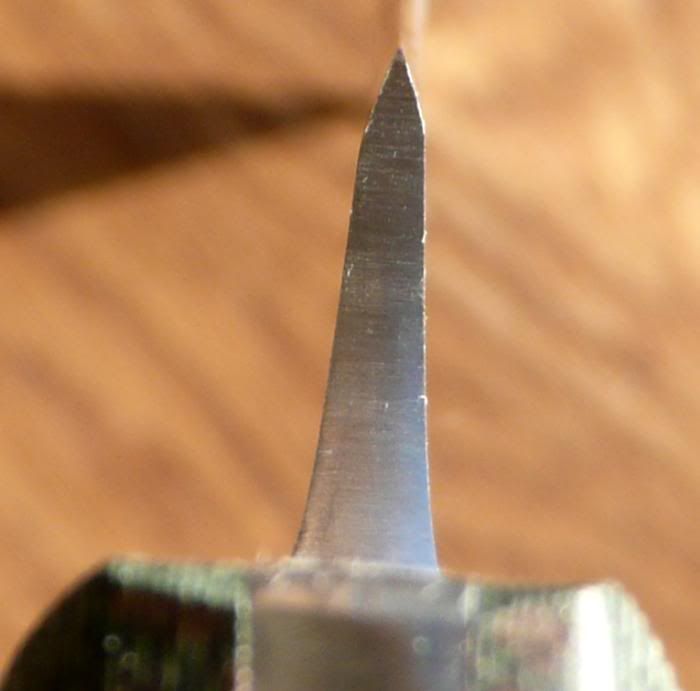
That certainly looks flat ground just like mine, were they convex when they first went into production? I was sure that I had read on some forum Jerry Hossom say that they were convex. Maybe I’m wrong. The only knife I own with a convex sdge is the Bark River Bravo-1 so I haven't seen a lot of convex edges.
-
yablanowitz
- Member
- Posts: 7315
- Joined: Sun Apr 09, 2006 2:16 pm
- Location: Liberal, Kansas
The first response was correct. The main grind of the blade is flat, the edge bevel is convex. The edge bevel, instead of being a flat plane from the edge to the flat of the blade is curved, also called an appleseed or cannel edge. The late, great Bill Moran did his edges that way. The advantage is you get a very sharp edge with a bit more steel behind it to give it more strength, especially for chopping.
Welcome to Sal's living room! Kick your shoes off and stay a while. :D
Welcome to Sal's living room! Kick your shoes off and stay a while. :D
I don't believe in safe queens, only in pre-need replacements.
-
Cliff Stamp
- Member
- Posts: 3852
- Joined: Sat Dec 31, 2005 1:23 pm
- Location: Earth
- Contact:
The edge in the picture is flat not convex, there is however no issue with sharpening convex bevels with the Sharpmaker, just choose the angles correctly more so than the curvature.
-Cliff
Convex edges were long before Moran. Most makers use convex edges similar because that is what comes off a belt sander, there is no magic to convex edges which raise performance. It is the cross section which will control strength and cutting ability. Look at the edge thickness and the angle first.yablanowitz wrote:The late, great Bill Moran did his edges that way.
The sharpness of an edge has nothing to do with the curvature and the strength of an edge has little to do with the curvature either. I have a small paring knife which has a main edge bevel which sweeps out from 3-4 degrees to a final apex bevel of 5-7 degrees. That is a light convex curvature of 1-3 degrees but not something for chopping.The advantage is you get a very sharp edge with a bit more steel behind it to give it more strength, especially for chopping.
-Cliff
-
yablanowitz
- Member
- Posts: 7315
- Joined: Sun Apr 09, 2006 2:16 pm
- Location: Liberal, Kansas
Cliff, I'm sure you know much more about knives than Bill Moran did :rolleyes: I didn't say he invented the convex edge, only that he used it. I also find the convex edge on my axe cuts cleanly and dings less readily than when it had a flat edge bevel. That is what I chop with. Your milage may vary.
I don't believe in safe queens, only in pre-need replacements.
-
Cliff Stamp
- Member
- Posts: 3852
- Joined: Sat Dec 31, 2005 1:23 pm
- Location: Earth
- Contact:
This has nothing to do with the curvature, it has to do with the cross section. As I noted in the above, try chopping with the convex bevel I described. Take a splitting maul with a convex bevel and try to cut down a tree. Neither of them will do anything. One gets destroyed and the other just bounces out of the tree. The bevel on one is too thin and on the other it is too thick but both of them are convex.yablanowitz wrote:I also find the convex edge on my axe cuts cleanly and dings less readily than when it had a flat edge bevel.
-Cliff
Thanks for all the input, the main thing was that I didn’t want to mess up the edge of the Woodlander on a Sharpmaker if I was wrong and it was a convex edge. As I said I only have one knife with a convex and that would be the BRKT Bravo-1, I’m certainly no expert on that type of edge. The Bravo1 looked more like an apple seed shape when you look from the angle that westfork took with the camera. I spoke to Mike Stewart of BRKT on the phone and he told me never to use the Sharpmaker on the Bravo. The Woodlander looks flat ground to my eyes but I’m pretty sure that Mr. Hossom said that they are convex on one of the blade forums. Maybe I am mistaken or maybe he was referring to his custom blades.
Anyway, thank you for the input.
Anyway, thank you for the input.
-
Cliff Stamp
- Member
- Posts: 3852
- Joined: Sat Dec 31, 2005 1:23 pm
- Location: Earth
- Contact:
Convex edges can be sharpened on the Sharpmaker, the suitability just depends on the angles of the convex edge, no different than flat ground edges.KLJTech wrote:Thanks for all the input, the main thing was that I didn’t want to mess up the edge of the Woodlander on a Sharpmaker if I was wrong and it was a convex edge.
-Cliff
-
Jerry Hossom
- Member
- Posts: 26
- Joined: Tue Oct 03, 2006 1:32 pm
- Location: Atlanta
Mr. Stamp's paring knife notwithstanding, the edge is convex, though it is not well represented by the edge at the choil which is what you see in the photo. It is normal to lift the grind right at the choil so you don't round that point at the rear of the edge. What you can see in the photo is that the person who sharpened this is right handed. Knives are sharpened edge down and it is natural for more pressure to be applied when the handle is in the right hand of a right handed person. You can see the bevel is slightly higher and is in fact a bit rounded at the top on that side. The edge is also moved to the left just a little (right in the photo) because more material was removed on the right. It's normal and doesn't effect the functionality, but you may find that resharpening requires more work on the left side because you'll need to remove more material there. (I seem to recall that Busse made a point of producing asymmetric edges for awhile.)
If you look at the edge in the middle area of the blade you'll see that there is a fairly broad area of curvature above the edge. That relief improves cutting efficiency and reduces drag in cuts.
Knifemakers could just as easily sharpen edges on the platen of the belt grinder which would produce a flat bevel. Fact is, most of us know that convex edges cut better and are more durable so we use an area of the belt which flexes to give us the parabolic curvature we want.
I sharpen my edges on a rotary platen, which is a moving belt behind the grinding belt, that I can adjust for the amount of resistance and curvature I want for each type knife I make and its intended uses.
Bottom line, the Woodlander is flat ground with a convex edge. There are no angles in a convex edge, only curves.
If you look at the edge in the middle area of the blade you'll see that there is a fairly broad area of curvature above the edge. That relief improves cutting efficiency and reduces drag in cuts.
Knifemakers could just as easily sharpen edges on the platen of the belt grinder which would produce a flat bevel. Fact is, most of us know that convex edges cut better and are more durable so we use an area of the belt which flexes to give us the parabolic curvature we want.
I sharpen my edges on a rotary platen, which is a moving belt behind the grinding belt, that I can adjust for the amount of resistance and curvature I want for each type knife I make and its intended uses.
Bottom line, the Woodlander is flat ground with a convex edge. There are no angles in a convex edge, only curves.
-
Cliff Stamp
- Member
- Posts: 3852
- Joined: Sat Dec 31, 2005 1:23 pm
- Location: Earth
- Contact:
Mr. Hossom,
Thank you for responding to this post, I love the Woodlander, it feels great in the hand but as you can see I'm a bit confused about the type of edge this knife has. The Spyderco website calls the edge flat ground yet I thought that I read a post from you on a forum saying they are convex. As you can obviously tell I have no experience with convex other than a Bravo-1 that I bought a few weeks ago. Looking down the edge of the Bravo it seems to look more like that apple seed shape (than does the Woodlander) that you hear about when one talks of a convex edge. Is that nothing more than Spyderco chose to make the edge angle more acute before the curve at the very edge? I hope that I’m making sense and you can understand that question.
I bought a strop bat that has leather on four sides, three of which are loaded with Bark River’s sharpening compound (black, green, pink) and then plain leather to finish with. I make a habit of not letting my knives become dull in the first place. This is much easier on me as I’m terrible at sharpening knives unless I’m using the Sharpmaker. Would you recommend the strop bat or another type of strop to keep the Woodlander sharp? As a novice with convex edges I’m not sure how I’m going to work that curved edge of the Woodlander on the strop but I’m sure that after time I would get the hang of it. I did see where Mr. Stamp said that the Sharpmaker can be used on a convex edge but Mr. Stewart of Bark River said to keep the Bravo away from the Sharpmaker.
Thank you.
Thank you for responding to this post, I love the Woodlander, it feels great in the hand but as you can see I'm a bit confused about the type of edge this knife has. The Spyderco website calls the edge flat ground yet I thought that I read a post from you on a forum saying they are convex. As you can obviously tell I have no experience with convex other than a Bravo-1 that I bought a few weeks ago. Looking down the edge of the Bravo it seems to look more like that apple seed shape (than does the Woodlander) that you hear about when one talks of a convex edge. Is that nothing more than Spyderco chose to make the edge angle more acute before the curve at the very edge? I hope that I’m making sense and you can understand that question.
I bought a strop bat that has leather on four sides, three of which are loaded with Bark River’s sharpening compound (black, green, pink) and then plain leather to finish with. I make a habit of not letting my knives become dull in the first place. This is much easier on me as I’m terrible at sharpening knives unless I’m using the Sharpmaker. Would you recommend the strop bat or another type of strop to keep the Woodlander sharp? As a novice with convex edges I’m not sure how I’m going to work that curved edge of the Woodlander on the strop but I’m sure that after time I would get the hang of it. I did see where Mr. Stamp said that the Sharpmaker can be used on a convex edge but Mr. Stewart of Bark River said to keep the Bravo away from the Sharpmaker.
Thank you.
I’ve seen some really great pictures on this forum from others who own one or more of the Spyderco Hossom fixed blades. I wish that I could afford one of his custom pieces (maybe someday) but for now I’m happy to own both of his incredible Retribution folders and beautiful Spyderco Woodlander. It was very, very difficult to choose between the Woodlander and the Forager, I hope that I chose wisely as they all look to be great knives.
What are you guys using to keep your Spyderco Hossom fixed blades sharp?
What are you guys using to keep your Spyderco Hossom fixed blades sharp?
-
thombrogan
- Member
- Posts: 2074
- Joined: Fri Sep 24, 2004 10:33 am
- Location: New Hampshire USA
Since I don't have one yet, I'm using mind. Otherwise, I'd use a 1"x30" belt sander, an array of belts (mine are Tri-zact, but the Lee Valley has belts that are easier to find and won't kill you with shipping charges - super important as belts will wear out), and then a strop for regular at-home maintenance and a Spyderco Double-Stuff for away-from-home maintenance.
N690Co is one of those steels that doesn't need the latest, greatest, most high-tech stropping compound to get a mirror-polished edge. Ferric oxide (the jewellers' rouge that is actually reddish) on leather or paper works great.
N690Co is one of those steels that doesn't need the latest, greatest, most high-tech stropping compound to get a mirror-polished edge. Ferric oxide (the jewellers' rouge that is actually reddish) on leather or paper works great.
"I knew you before you knew you had hands!" ~Tracey Brogan
"Ah-ha! A Spyderco moment!" ~Michael Cook
"Hawkbills - Sink in the tip and let it rip!" ~Axlis
"I would rather have questions that can't be answered than answers which can't be questioned" ~Richard Feynman
"Ah-ha! A Spyderco moment!" ~Michael Cook
"Hawkbills - Sink in the tip and let it rip!" ~Axlis
"I would rather have questions that can't be answered than answers which can't be questioned" ~Richard Feynman
Unfortunately I don’t own a belt sander but then again if I did and tried to sharpen any of my knives I doubt that the results would be what I’m looking for. I’m still trying to get the hang of stropping my Bark River Bravo on the leather bat. It feels kind of natural stropping away from me (or left to right) but very weird once I try to repeat the same motion on the other side of the blade (right to left).
How long is the normal learning curve to become good at stropping a curved blade like the Hossom fixed blades have? A Sharpmaker would remove the convex edge and make it a flat ground edge correct? I’m sorry for all the question, I’m just new to this whole convex edge concept, and just when I thought I had life all figured out.
:)
How long is the normal learning curve to become good at stropping a curved blade like the Hossom fixed blades have? A Sharpmaker would remove the convex edge and make it a flat ground edge correct? I’m sorry for all the question, I’m just new to this whole convex edge concept, and just when I thought I had life all figured out.
:)
-
thombrogan
- Member
- Posts: 2074
- Joined: Fri Sep 24, 2004 10:33 am
- Location: New Hampshire USA
Everyone learns in their own time. The more patient and deliberate you are, the quicker you will learn.KLJTech wrote:How long is the normal learning curve to become good at stropping a curved blade like the Hossom fixed blades have?
It'll only be hitting the very edge, so the convex edge grind will still be convex and the flat grind leading away from the edge up to the spine will still be flat. Now whether the edge you leave with the Sharpmaker is flat or convex depends on the steadiness of your hands. Mine are not steady, so every edge I make with a Sharpmaker, benchstone, or strop is convexed.KLJTech wrote:A Sharpmaker would remove the convex edge and make it a flat ground edge correct?
All of this flat versus convexed stuff is really overthinking it. There's already enough skullsweat in getting the balances worked for having the edge thin enough to cut with ease and thick edge to not get easily damaged and with getting two sides to meet in the thinnest straight line your skills will permit. The rest is good for pointless internet arguments, but not with getting your knives sharp and keeping them that way.
Now you're living on the edge and everything looks different.KLJTech wrote:I’m sorry for all the question, I’m just new to this whole convex edge concept, and just when I thought I had life all figured out.
"I knew you before you knew you had hands!" ~Tracey Brogan
"Ah-ha! A Spyderco moment!" ~Michael Cook
"Hawkbills - Sink in the tip and let it rip!" ~Axlis
"I would rather have questions that can't be answered than answers which can't be questioned" ~Richard Feynman
"Ah-ha! A Spyderco moment!" ~Michael Cook
"Hawkbills - Sink in the tip and let it rip!" ~Axlis
"I would rather have questions that can't be answered than answers which can't be questioned" ~Richard Feynman