Page 1 of 2
A little work with the Nilikka
Posted: Sat Feb 16, 2013 5:52 pm
by Cliff Stamp
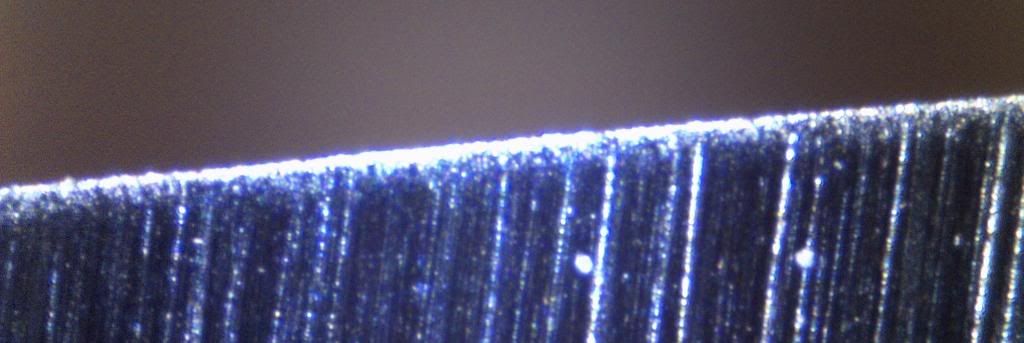
Update, as boxed edge :
after some slicing on 1/8" cardboard :
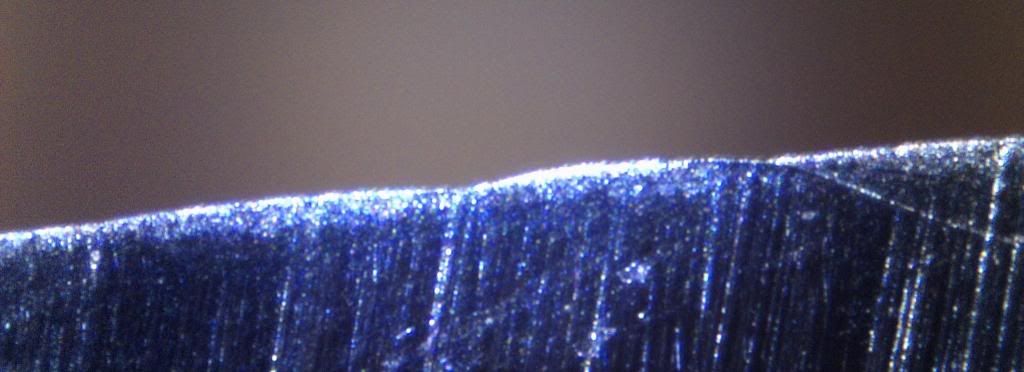
the edge is visibly damaged immediately, it rolls during the cutting, effectively zero edge retention. Extreme cutting ability of course, but loss of sharpness is immediate.
Very light work in cardboard (drilling with the tip) also cracked off about 1 mm of the tip, just the weight of the knife to drill.
The question is what is causing this exactly? The most likely solution is damage from hot grinding and this is trivial to check because if that is the issue then there will be a dramatic difference in behavior after subsequent sharpenings.
Here is the result of two passes right into a 1000 grit waterstone to destress the edge :

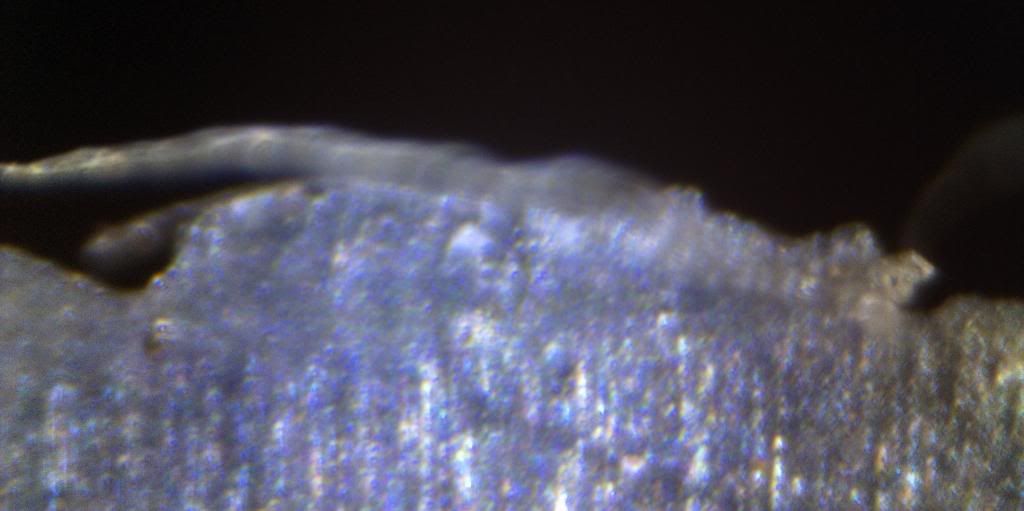
All damage is removed, however after 100 passes per side on the same stone to reset the bevel look what happened :
and

and

and

Obvious huge burr, would not remove even going to 45 dps, just flopped around. Switched to a 3000 grit stone and cut it off right into the stone, then again 100 passes per side, this time no burr :
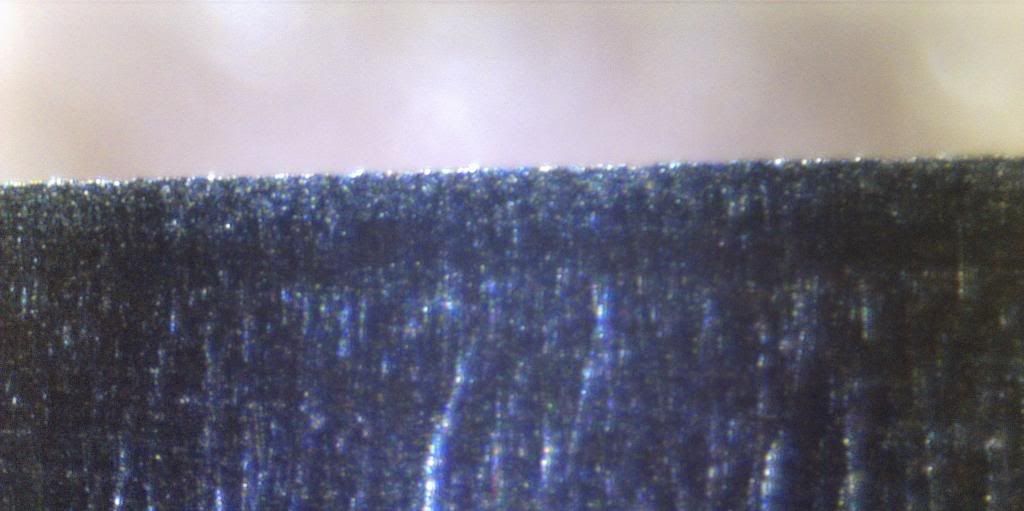
Then the same on 8000 :

Make a few cuts through cardboard, no issues. As expected significant initial edge damage from hot grinding is likely a contributing factor (maybe the most significant one) to issues of reported fragility.
Posted: Sat Feb 16, 2013 6:01 pm
by ABX2011
Interesting. Cool photos.
Posted: Sat Feb 16, 2013 6:59 pm
by defenestrate
Thanks for the info and pics. Will keep this in mind should I get one. I dig zero type grinds and making them more stable would be a big plus.
Posted: Sat Feb 16, 2013 7:02 pm
by Holland
very interesting photos, thanks for sharing!
Posted: Sat Feb 16, 2013 9:07 pm
by Fred Sanford
Good info Cliff. Thanks. I like how instead of complaining he just does what is needed to fix it. We should all learn from this.
Posted: Sat Feb 16, 2013 9:14 pm
by Blerv
David Lowry wrote:Good info Cliff. Thanks. I like how instead of complaining he just does what is needed to fix it. We should all learn from this.
+ 100
Well put David. Kudos for outsmarting the edge Cliff :) . What are your overall thoughts of it now?
Posted: Sun Feb 17, 2013 5:22 am
by SpyderScout
Didnt Spyderco change the design of these?
Posted: Sun Feb 17, 2013 6:48 am
by ABX2011
They added a microbevel in Golden, I believe. Never heard from Sal whether the grind would change or if the Taiwan plant will be the one adding the microbevel in the future...?
Posted: Sun Feb 17, 2013 9:20 am
by Cliff Stamp
Blerv wrote:What are your overall thoughts of it now?
Visually it is a fairly striking design as it has a handle which is normally fixed blade, very deep ride pocket clip and a blade/tip grind which is fairly extreme for cutting performance. I do have concerns about using S30V is such a geometry (carbide volume is very high this isn't a positive thing for edge strength in low angles and low grindability means keeping the edge like that by planing down the primary isn't a trivial process) and would much rather prefer a carbide neutral stainless - but it isn't like they are just selling them all to me, market dictates.
What I need to do now is just start ramping it up through regular work and some stock cutting and see where the edge starts to fail, if that is corrected through sharpening, note how the edge responds with subsequent sharpening (burr should reduce), and hopefully the edge gets finer. Note in the lat 8000 grit shot the edge is still showing some irregular finish, I don't think that is the true limit of the steel.
Posted: Sun Feb 17, 2013 1:37 pm
by Cliff Stamp
Video on the knife demonstrating the cardboard work and more pictures and a video of the results of the sharpening :
http://www.youtube.com/watch?v=GedwymWmPtk
Posted: Sun Feb 17, 2013 3:25 pm
by kennethsime
I laughed and laughed when you started breaking down science to the youtube masses. Keep it up Cliff, you are a breath of fresh air in the stagnant milieu of knife enthusiasts on youtube.
Posted: Sun Feb 17, 2013 3:39 pm
by The Mastiff
Cliff, thanks for the excellent pictures along with the explanations. Personally my brain retains much more than if you placed the same content into one long paragraph. :) I guess I'm getting old but I'd expect I'm not the only one like this.
I also imagine this thread will be used in the future as reference material as some just don't seem to get it and believe once an edge is bad then the knife, the steel, the companies that made both and everybody who ever worked for them are bad, and owe them alms forever.
How many times have I read "Bad heat treat" ? It seems the answer for everything and yet is very much less common than what you have illustrated above.
I hope a lot of people see this and retain a bit of it. :)
Joe
Posted: Sun Feb 17, 2013 4:17 pm
by Mike157
Cliff, your scientific approach is very much appreciated. Many could benefit from a little (more likely, a lot of) science and scientific thinking. Your video is clear, concise, and easy to follow as well as informative. I enjoyed and learned from it. Thank you. Mike
Posted: Sun Feb 17, 2013 4:26 pm
by Evil D
Cliff, you've posted a few times mentioning how you micro bevel and then go back and nearly remove that micro bevel with a higher grit stone...what benefit does this have? It seems like your end result is just an extremely small micro bevel...couldn't you just do that to begin with and not have to go back with the 8k stone or am I just not understanding something? I have a lot of interest in what you're doing here, since I cut a lot of cardboard and would love to get the edge retention that you're seeing in some of your steels.
Posted: Sun Feb 17, 2013 4:37 pm
by Cliff Stamp
kennethsime wrote:I laughed and laughed when you started breaking down science to the youtube masses.
I find it fairly amusing when people say "ok, this isn't meant to be scientific ..." what you are actually saying is "ok, I am about to share my viewpoint on something and I have no observations which support this viewpoint, there are no facts or knowledge of any kind which support it, and it isn't even based on rational thought ... however" .
Science is wrong all the time, all it does it try to be right and more importantly ensure there is a way to see if it is right or wrong.
Mike157 wrote:Cliff, your scientific approach is very much appreciated.
Thanks.
The Mastiff wrote:
How many times have I read "Bad heat treat" ?
It is unfortunate that has become almost an instant response and especially when there is no actual information aside from that one comment. Because it is so undefined you can use that to describe literally any behavior in the knife but what does it actually tell the ELU? I would also ask the obvious question, why was the mistake actually made and what does this say about R&D?
As an ELU, it is also one of the hardest things to check and thus should be a last resort after you have eliminated the things which are more obvious which you can check end see if they are right/wrong.
Posted: Sun Feb 17, 2013 7:29 pm
by JudasD
So the edge was damaged by heat during the sharpening at the factory?
JD
Posted: Sun Feb 17, 2013 7:44 pm
by Pockets
Those are some pretty amazing close-ups of a burr.
Posted: Sun Feb 17, 2013 7:53 pm
by connor
Cliff Stamp wrote:
Make a few cuts through cardboard, no issues. As expected significant initial edge damage from hot grinding is likely a contributing factor (maybe the most significant one) to issues of reported fragility.
Would you go so far as to say it's nearly impossible to grind a knife without minor/recoverable edge damage on a belt grinder without a coolant (in an industrial setting)?
Posted: Sun Feb 17, 2013 10:35 pm
by Sequimite
Great video. I learned something!
Posted: Mon Feb 18, 2013 3:50 am
by The Mastiff
Would you go so far as to say it's nearly impossible to grind a knife without minor/recoverable edge damage on a belt grinder without a coolant (in an industrial setting)?
Speaking for myself only I know I couldn't thin a high carbide steel down that much to a zero grind without getting heating of the thinnest part. As far as heating steel goes it can be a problem especially with certain types of steels. Laser cut knives need a tiny bit of steel removed from where the laser heated it up next to the part cut out. How much depends on a few things like the thickness of the steel, the speed of the laser ( movement, not the speed of light I mean. :) )
Wherever heating occurs it has to be evaluated and if questionable testing is warranted In my opinion. That's me though and I don't make knives any more, and didn't make a lot of them when I did.