Page 1 of 2
Arizona Ironwood
Posted: Mon Apr 30, 2012 4:53 am
by Wolverine666
I've been fascinated with the Ironwood scales on my Sage4 since I got it. It is such a beautiful wood (and from what I understand a very dense and strong wood).
Does anyone know more about this Arizona Ironwood ? Or have a link/site they could recommend I check out ?
Posted: Mon Apr 30, 2012 5:28 am
by The Deacon
As I understand it, Arizona Ironwood is just another name for Desert Ironwood.
Here's one site with some info on it.
Posted: Mon Apr 30, 2012 6:00 am
by jackknifeh
What was the wood in the original pictures of the Sage4? I remember not liking the original picture of the Sage4 but after seeing pictures of knives people were buying I thought it looked great and ended up getting one.
Jack
Original picture
Posted: Mon Apr 30, 2012 6:06 am
by The Deacon
I'm sure it's Arizona Ironwood, as advertised. It's just not as dark a specimen as what we have come to assume is the norm. Some woods are very consistent in color, others are not. Ironwood appears to fall in the later category. Take a look at some of the items shown
here.
Posted: Mon Apr 30, 2012 2:44 pm
by Wolverine666
Thanks Deacon. That site is very informative. Only problem is now I want more knife handles made of Arizona Ironwood. I like G10 on my folder handles very much. But it's nice to change it up a little and I find that Arizona (Desert) Ironwood really does it for me.
Posted: Tue May 01, 2012 10:20 pm
by lambertiana
Desert Ironwood (Olneya Tesota) is a very dense, oily, hard wood. Janka hardness is 2890, compared to 3220 for ebony, about 1300 for most oaks, 1450 for sugar maple, and 1136 for cocobolo.
It has so much oil that it is difficult to finish with many traditional wood coatings, and doesn't really need it anyway. All that oil makes it naturally water resistant. And if you cut it or sand it, you don't get dry sawdust, you get a wet goo.
Posted: Wed May 02, 2012 3:37 pm
by Wolverine666
lambertiana wrote:Desert Ironwood (Olneya Tesota) is a very dense, oily, hard wood. Janka hardness is 2890, compared to 3220 for ebony, about 1300 for most oaks, 1450 for sugar maple, and 1136 for cocobolo.
It has so much oil that it is difficult to finish with many traditional wood coatings, and doesn't really need it anyway. All that oil makes it naturally water resistant. And if you cut it or sand it, you don't get dry sawdust, you get a wet goo.
So the oil in the Desert Ironwood is part of it's secret as to why it's so strong , dense and solid ?
Posted: Wed May 02, 2012 4:05 pm
by jtoler_9
lambertiana wrote: And if you cut it or sand it, you don't get dry sawdust, you get a wet goo.
I must be using a different Ironwood. When I sand mine I get sawdust?
Posted: Wed May 02, 2012 4:30 pm
by phillipsted
lambertiana wrote:Desert Ironwood (Olneya Tesota) is a very dense, oily, hard wood. Janka hardness is 2890, compared to 3220 for ebony, about 1300 for most oaks, 1450 for sugar maple, and 1136 for cocobolo.
It has so much oil that it is difficult to finish with many traditional wood coatings, and doesn't really need it anyway. All that oil makes it naturally water resistant. And if you cut it or sand it, you don't get dry sawdust, you get a wet goo.
I'm not sure how much faith to put into commercial Janka ratings. Cocobolo rates around 1100 on lists I've seen, but every piece of cocobolo I've worked with was as hard as any ebony or lignum vitae I've used. I'm sure there are wide variations by species, tree-to-tree, and even within the tree itself (heartwood vs sapwood). So don't put too much faith into these ratings...
Lignum Vitae is really tough, dense oily stuff though. Same with Ironwood and most cocobolo.
TedP
Posted: Wed May 02, 2012 6:42 pm
by psychophipps
Just keep in mind that wood hardness ratings are like steel hardness ratings. It tells you one thing only, and leaves out any number of other factors that will effect how workable it is once you have it on your table. As mentioned above, heartwood vs sapwood, storage, how long ago it was cut, etc. are also all factors that can hugely change how one specific piece or family of wood reacts to working.
Posted: Wed May 02, 2012 9:44 pm
by fredswartz
Ironwood fascinates me. I have several
small statuetettes in my computer room
and they feel as heavy as lead. About as
dense a wood as I have encountered. All
have beautiful texture and grain.
Posted: Thu May 03, 2012 7:51 am
by phillipsted
Interestingly enough - I live in Virginia, and we have a tree here that locals refer to as "Ironwood". It is the American Hornbeam or as it is sometimes called, the "Hop Hornbeam". I've used saplings of this tree for walking canes and hiking staffs - and it is some of the toughest wood I've ever worked with. Not as oily as the tropical woods (e.g., rosewood, coco, lignum vitae) or desert ironwood, though.
Unfortunately, the trees tend to be small and it isn't really treated as a commercially-viable lumber tree. Therefore you never see it on the market as lumber, blocks, or scales. I might try and harvest a few trees this summer, cure them and slice them into scales. If so, I'll let you guys know and see if I can share some of the bounty...
TedP
Here is the U.S. Forestry Service Data Sheet on Hornbeam


Posted: Thu May 03, 2012 8:42 am
by DCDesigns
Personally, I think the non burl Arizona Ironwood is not all that special.
Desert Ironwood BURL, however, is easily my favorite domestic wood. Check out this prized set of top grade scales I bought about a year ago...
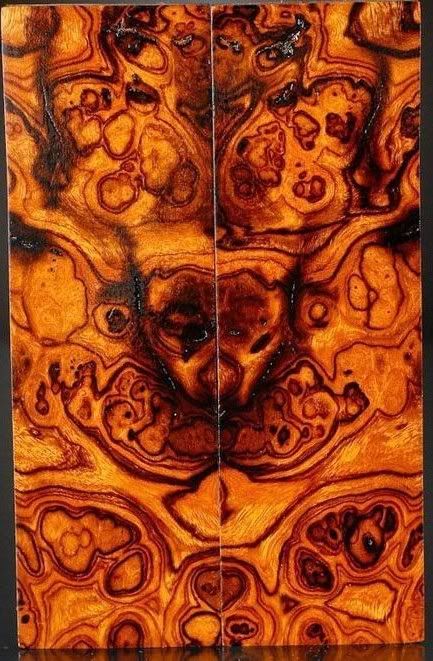
You get GORGEOUS contrast, great topographical map type figure (due to the unique dark rings that grow around this burl's eyes), and beautiful sections of light-shifting golden grain. None of which is in the "clear" ironwood. This being said the burl form is exponentially rarer than the regular wood. Think of it like this, trees are really rare in the desert, burls are really rare on trees, so a burl on a tree in the desert is incredibly rare. One of the reasons it is the rarest domestic wood.
There is only one ARIZONA "DESERT" IRONWOOD, however as phillipsted said, there are other woods that bare the name Ironwood. He mentions the Easter Hophornbeam (a really plain straight grain hardwood), there are also asian woods called ironwood (a particular wood from Laos is even called Ironwood burl, but it is entirely different in appearance and is not related to D.I.)
Posted: Thu May 03, 2012 8:47 am
by DCDesigns
phillipsted wrote:Interestingly enough - I live in Virginia, and we have a tree here that locals refer to as "Ironwood". It is the American Hornbeam or as it is sometimes called, the "Hop Hornbeam". I've used saplings of this tree for walking canes and hiking staffs - and it is some of the toughest wood I've ever worked with. Not as oily as the tropical woods (e.g., rosewood, coco, lignum vitae) or desert ironwood, though.
Unfortunately, the trees tend to be small and it isn't really treated as a commercially-viable lumber tree. Therefore you never see it on the market as lumber, blocks, or scales. I might try and harvest a few trees this summer, cure them and slice them into scales. If so, I'll let you guys know and see if I can share some of the bounty...
TedP
Here is the U.S. Forestry Service Data Sheet on Hornbeam
Im pretty familiar with eastern Hophornbeam AKA "Ironwood." Its pretty plain compared to Desert Ironwood, and in my opinion no where near as pretty. Ive had a friend who even found some burled hophornbeam, Still no match im afraid! good for walking sticks im sure tho!
Posted: Thu May 03, 2012 8:53 am
by DCDesigns
The Deacon wrote:I'm sure it's Arizona Ironwood, as advertised. It's just not as dark a specimen as what we have come to assume is the norm. Some woods are very consistent in color, others are not. Ironwood appears to fall in the later category. Take a look at some of the items shown
here.
The sapwood on Desert Ironwood is that light golden orange, the heartwood is a darker brown. The picture of that Sage 4 seems to have burl figure, not just a straight grain piece. I WISH all Sage 4's looked like that...
Posted: Thu May 03, 2012 9:10 am
by jackknifeh
DCDesigns wrote:Personally, I think the non burl Arizona Ironwood is not all that special.
Desert Ironwood BURL, however, is easily my favorite domestic wood. Check out this prized set of top grade scales I bought about a year ago...
You get GORGEOUS contrast, great topographical map type figure (due to the unique dark rings that grow around this burl's eyes), and beautiful sections of light-shifting golden grain. None of which is in the "clear" ironwood. This being said the burl form is exponentially rarer than the regular wood. Think of it like this, trees are really rare in the desert, burls are really rare on trees, so a burl on a tree in the desert is incredibly rare. One of the reasons it is the rarest domestic wood.
There is only one ARIZONA "DESERT" IRONWOOD, however as phillipsted said, there are other woods that bare the name Ironwood. He mentions the Easter Hophornbeam (a really plain straight grain hardwood), there are also asian woods called ironwood (a particular wood from Laos is even called Ironwood burl, but it is entirely different in appearance and is not related to D.I.)
That is a beautiful set of scales. Have you used them on a knife yet? If so, can we see it?
Please forgive my ignorance but I've never made scales out of wood but have wanted to. I've read the phrase "matched set" and it looks like the picture is a "matched set". Is that correct? And, how would you place them on the tang? If you placed the knife handle under the scales where they are touching and folded the outside edges down onto the sides of the knife would that be the way to place them on the handle?
Jack
Posted: Thu May 03, 2012 9:11 am
by phillipsted
DCDesigns wrote:Im pretty familiar with eastern Hophornbeam AKA "Ironwood." Its pretty plain compared to Desert Ironwood, and in my opinion no where near as pretty. Ive had a friend who even found some burled hophornbeam, Still no match im afraid! good for walking sticks im sure tho!
I completely agree, guys. It is actually pretty boring to look at :rolleyes: Sorta reminds me of pecan or hickory in some ways...just heavier and harder...
But BOY, is it tough stuff. It would make an excellent set of "user" Mule scales, which is how I would use it.
TedP
Posted: Thu May 03, 2012 9:41 am
by jackknifeh
In case I missed it, what is the type on the Sage4? It looks nice but not like the set of scales in DCDesigns post above.
Jack
Posted: Thu May 03, 2012 1:24 pm
by kbuzbee
So what is the best way to cut/shape/contour this stuff? I got a pair of scales with thoughts of fitting them to a mule...
Thought I could use a Dremmel but rather than removing material, it more kinda burned....
I'm not a "whittler" but took off a bit of material with a Para2

Open to suggestions from you wood worker guys....
Ken
Posted: Thu May 03, 2012 1:43 pm
by The Deacon
Dremel runs so fast that heat builds up rapidly. A drum or belt sander running at a lower speed should work. Files and sanding blocks would definitely work, but would take longer.