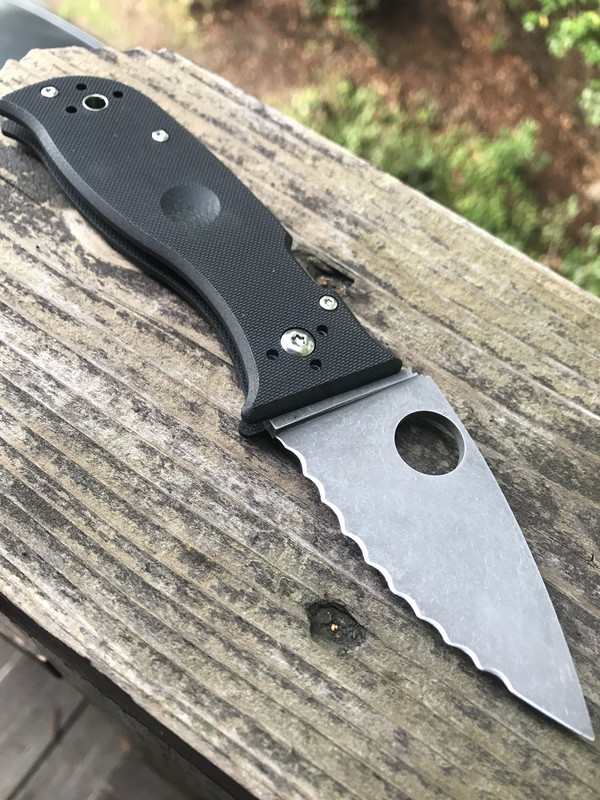
SE performance is more than simply teeth vs no teeth.

Discuss Spyderco's products and history.
vivi
Member
Posts: 16344
Joined: Mon Oct 29, 2007 8:15 am

Re: SE performance is more than simply teeth vs no teeth.

#881

Post by vivi »

Wartstein wrote:
Sat Feb 15, 2025 11:16 am
vivi wrote:
Fri Feb 14, 2025 11:46 pm
Evil D wrote:
Fri Feb 14, 2025 3:42 am
...
give the PE the same edge angle as the SE part and performance is a lot more even.

what a lot of people are seeing when they fall in love with serrated edges are the benefits of acute edge geometry more than the properties of the serrations themselves....
Evil D wrote:
Sat Feb 15, 2025 5:47 am
...There's still a lot to be said for the mechanical advantage of the shape of serrations but I agree a big part of it is just far thinner edges than people are used to,,,
@vivi : Yes, this has always been my question (what makes SE superior over PE in my use: More the "teeth", or more the more acute chisel grind angle) - thanks for your input!

But, as David touches on:

- I think one just CAN`T give a PE V-edge the same acute inclusive edge angle as SE (chisel) grind while maintaining the same edge stability

I may quote Michael Janich once more from the serrations article in the byte August 24 (https://mailchi.mp/spyderco/spyderco-by ... cycb2mvhza):

"Logically, the “included” angle of that chisel-ground edge is half that of a comparable V-ground edge. On a PlainEdge™ blade, that would leave the terminal portion of the edge extremely fragile and prone to rolling or chipping. However, the unique structure of serration teeth and, very importantly, the ridges between them, actually reinforces the structural strength of the edge. Despite its thinner edge geometry, it remains strong."
I could not disagree more. I've been taking PE edges down to 25-10 degrees inclusive over the past couple decades. Not just knives either, but I've taken some hatchets, machetes and other harder use cutting tools like SRK's down to very thin edges with success.

I can chop wood just fine with a 10dps edged hatchet or baton wood fine with an 8dps aqua salt with a microbevel.

I was going to post about the following in the edge stability thread last night - but the biggest variable when it comes to edge stability is one that's often forgotten - the user.

People in that thread mentioned how well certain edge angles and steels hold up to staples in boxes.

I don't ever factor that into my edges, because I take a couple extra seconds to check for staples before breaking down large boxes.

I can get away with thinner edges and thinner tips and enjoy higher performance because I'm careful when I use my knives. Even though I'll chop through briars and baton fatwood with a Pacific Salt, I do it with good technique. Just like I can cut through small fish bones with an 8dps white #1 petty because again, I use good technique.

How you cut can often play a larger role than what you're cutting with.

All that said I do agree that serrated edges will certainly have an advantage slicing certain materials. The biggest advantage stock SE has over stock PE is raw edge geometry, but the inherent differences between the edge types makes a difference on rope, plastics and other materials too.
Michael Janich
Member
Posts: 3318
Joined: Fri Sep 24, 2004 10:33 am
Location: Longmont, CO USA
Contact:

Re: SE performance is more than simply teeth vs no teeth.

#882

Post by Michael Janich »

Hey, Vivi:

You are exactly correct. Thinner edges are definitely possible, provided the steel choice and heat treating of the blade are appropriate and the user understands the proper use of a tool sharpened that way. As you know, the process for achieving those acute edges is also more challenging and takes more care.

All those dynamics are perfectly valid for the experienced knife user--the exception to the rule. My writing in the context of the byte focuses primarily on the realm of factory-made knives, designed for the commercial market, and for knife users of all skill levels.

If you've ever loaned an acutely sharpened knife to someone who didn't possess the skills or knowledge to use it properly and got a hacksaw blade back from them, you know what I mean.

Stay safe,

Mike
User avatar
Wartstein
Member
Posts: 16747
Joined: Mon Jul 02, 2018 10:06 am
Location: Salzburg, Austria, Europe

Re: SE performance is more than simply teeth vs no teeth.

#883

Post by Wartstein »

@vivi @Michael Janich I am a bit confused now:

What I meant and literally said was that "one can´t give a PE V edge the same acute inclusive edge angle as SE (chisel) grind while maintaining the same edge stability

Now, Michael, isn´t that exactly what you state in your article too? (see my post where I quote you again here viewtopic.php?p=1821554#p1821554)
You say there literally that if one gave a plain edge the same acute included angle as a typical SE Spyderco offers, this "would leave the terminal portion of the [plain] edge extremely fragile" While "the unique structur of the serration teeth" and "the ridges between them reinforces the structural strength of the [serrated] edge"

I don´t doubt at all that more acute edge angles work just fine in plain edges, are probably strong enough, but just not as strong as a spyderedge in the same angle (and same blade / same steel).

So while Spyderco can offer a roughly 15 to 20 inclusive edge angle to pretty much any knife user when it comes to serrated edges, they don´t with plain edges- perhaps among other reasons because, yes, THERE one has to know how to treat (and NOT treat) such an edge more because 15 incl in PE just is more fragile than 15 incl. in SE (again, in the same blade / same steel)...
Top three going by pocket-time (update October 25):
- EDC: Endela SE (K390). Endela SE (VG10), Manix 2 LW (REX45)
- Mountains/outdoors: Pac.Salt 2 SE (LC200N), Salt 2 SE (LC200N), Pac.Salt 1 SE (H1)
User avatar
Evil D
Member
Posts: 28603
Joined: Sat Jun 26, 2010 9:48 pm
Location: Northern KY

Re: SE performance is more than simply teeth vs no teeth.

#884

Post by Evil D »

I sort of interpreted Mike's post to maybe have been meant for Vivi's thread about why factory edges aren't thinner, seems to apply to both threads a little though.
~David
User avatar
Wartstein
Member
Posts: 16747
Joined: Mon Jul 02, 2018 10:06 am
Location: Salzburg, Austria, Europe

Re: SE performance is more than simply teeth vs no teeth.

#885

Post by Wartstein »

Evil D wrote:
Mon Feb 17, 2025 9:46 am
I sort of interpreted Mike's post to maybe have been meant for Vivi's thread about why factory edges aren't thinner, seems to apply to both threads a little though.

Ok, thanks!

Generally I am all for also more acute plain edge angles, but without ever doing real tests on this myself:
To me it just seems pretty obvious and matches my unscientific experience that in the same blade and the same steel a 15 incl serrated Spydie just has to have an overall more durable edge than a 7.5 per side (so also 15 incl.) plain edge variant...

So if one reduced everything solely to "most acute edge angle, but edge still as strong as possible": SE should be the way to go imo...
Top three going by pocket-time (update October 25):
- EDC: Endela SE (K390). Endela SE (VG10), Manix 2 LW (REX45)
- Mountains/outdoors: Pac.Salt 2 SE (LC200N), Salt 2 SE (LC200N), Pac.Salt 1 SE (H1)
vivi
Member
Posts: 16344
Joined: Mon Oct 29, 2007 8:15 am

Re: SE performance is more than simply teeth vs no teeth.

#886

Post by vivi »

Wartstein wrote:
Mon Feb 17, 2025 9:32 am
@vivi @Michael Janich I am a bit confused now:

What I meant and literally said was that "one can´t give a PE V edge the same acute inclusive edge angle as SE (chisel) grind while maintaining the same edge stability

With all due respect to Mr. Janich, I wouldn't agree with this statement either. I have not seen anything in SE performance over the years that leads me to believe it has greater edge stability at the same angles as a PE.

Now it does have an edge durability advantage in the sense that the teeth can take damage while the scallops remain sharp, like when slicing a steak on a ceramic plate - but that's different than raw edge stability throughout the entire cutting edge.

I think if you cut a box with a 20 degree inclusive serrated knife in vg10, and cut a box with a 20 degree inclusive plain knife in vg10, they'll both do fine. I think they'll both get edge damage if you hit a staple.

Maybe in some controlled lab testing Spyderco has done SE has an edge stability advantage, which may explain Mr. Janichs posts om the subject, but my years of casual use and sharpening experimentation has not led me to that conclusion.
Bill1170
Member
Posts: 3029
Joined: Tue Oct 20, 2009 7:34 pm
Location: San Diego North County

Re: SE performance is more than simply teeth vs no teeth.

#887

Post by Bill1170 »

Michael Janich wrote:
Mon Feb 17, 2025 7:16 am
Hey, Vivi:

You are exactly correct. Thinner edges are definitely possible, provided the steel choice and heat treating of the blade are appropriate and the user understands the proper use of a tool sharpened that way. As you know, the process for achieving those acute edges is also more challenging and takes more care.

All those dynamics are perfectly valid for the experienced knife user--the exception to the rule. My writing in the context of the byte focuses primarily on the realm of factory-made knives, designed for the commercial market, and for knife users of all skill levels.

If you've ever loaned an acutely sharpened knife to someone who didn't possess the skills or knowledge to use it properly and got a hacksaw blade back from them, you know what I mean.

Stay safe,

Mike
The part about the user is key. Ignorant users are why we can’t have factory geometry that slices like a light saber.
Michael Janich
Member
Posts: 3318
Joined: Fri Sep 24, 2004 10:33 am
Location: Longmont, CO USA
Contact:

Re: SE performance is more than simply teeth vs no teeth.

#888

Post by Michael Janich »

Serrated edges have raised ridges between each scallop. Each scallop provides a short, individual section of edge. Compared to a continuous chisel-ground PlainEdge, this geometry provides greater structural strength to the edge area as a whole. Yes, the actual terminal cutting edge of each individual scallop has the same geometry as a PlainEdge, however, it's harder for an inexperienced user to trash every individual scallop than it would be for him to trash a thinly ground PlainEdge.

If that doesn't make sense, I agree to disagree...

Stay safe,

Mike
Drumlooper
Member
Posts: 19
Joined: Thu Feb 13, 2025 10:35 pm

Re: SE performance is more than simply teeth vs no teeth.

#889

Post by Drumlooper »

Hi. I’m using the Sharpmaker on my SE with pretty good results. It somewhat “flattens” down the “peaks” and the edge snags a little less, which helps.
User avatar
Ankerson
Member
Posts: 7662
Joined: Sat Jul 24, 2010 1:23 pm
Location: Raleigh, NC

Re: SE performance is more than simply teeth vs no teeth.

#890

Post by Ankerson »

Michael Janich wrote:
Mon Feb 17, 2025 7:16 am
Hey, Vivi:

You are exactly correct. Thinner edges are definitely possible, provided the steel choice and heat treating of the blade are appropriate and the user understands the proper use of a tool sharpened that way. As you know, the process for achieving those acute edges is also more challenging and takes more care.

All those dynamics are perfectly valid for the experienced knife user--the exception to the rule. My writing in the context of the byte focuses primarily on the realm of factory-made knives, designed for the commercial market, and for knife users of all skill levels.

If you've ever loaned an acutely sharpened knife to someone who didn't possess the skills or knowledge to use it properly and got a hacksaw blade back from them, you know what I mean.

Stay safe,

Mike


Oh yeah I have gotten hacksaw blades back a number of times over the years. :winking-tongue :rofl :eye-roll :')
Tims
Member
Posts: 552
Joined: Tue Mar 06, 2018 3:25 pm
Location: Australia

Re: SE performance is more than simply teeth vs no teeth.

#891

Post by Tims »

Re edge stability of SE vs PE at the same angle, I tend to agree that overall we should see more stability with SE but the stability will vary along the length of each scallop. We should see maximum stability toward each 'end' of the scallop or 'hill' of each scallop as it gets meatier and less and less stability as you move toward the center or valley of the scallop. Beyond the variability of thickness behind the edge as you move along each scallop, I think there may be other factors at play that provide improved stability in SE. Something to do with stress risers and circles that arent present in a uniform plain edge but I'm no engineer so I can't speak on it.
This has been true for my experience with SE too, the lions share of damage I'm repairing always seems to be in the middle of a scallop.
User avatar
Wartstein
Member
Posts: 16747
Joined: Mon Jul 02, 2018 10:06 am
Location: Salzburg, Austria, Europe

Re: SE performance is more than simply teeth vs no teeth.

#892

Post by Wartstein »

Tims wrote:
Sat Feb 22, 2025 3:25 am
Re edge stability of SE vs PE at the same angle, I tend to agree that overall we should see more stability with SE but the stability will vary along the length of each scallop. We should see maximum stability toward each 'end' of the scallop or 'hill' of each scallop as it gets meatier and less and less stability as you move toward the center or valley of the scallop. Beyond the variability of thickness behind the edge as you move along each scallop, I think there may be other factors at play that provide improved stability in SE. Something to do with stress risers and circles that arent present in a uniform plain edge but I'm no engineer so I can't speak on it.
This has been true for my experience with SE too, the lions share of damage I'm repairing always seems to be in the middle of a scallop.
I am no engineer too, but imo it is pretty obvious that overall a serrated edge has to be more stable and robust than a plain edge - (again: Same edge angle, same blade, same steel).

- Let´s say we have a 15 degree incl. (not per side!) plain edge (so really thin for PE) and a 15 degree serrated edge:
- On the plain edge all forces will obviously always arrive at the thinnest part of the edge - just cause ALL of the edge is thin.
- On the serrated edge there is a very high likelyhood that at least part of the forces will be absorbed or buffered by a thicker, more robust part of the edge ("meatier", outer parts of the scallops as you say).
- This should often be true when penetrating a surface, cutting on a board, twisting the blade when it is already buried in material, and so on.
- Just as Michael Janich says, the structure of serrations and the ridges should reinforce the whole edge overall

Also: There must be some rational reason why Spyderco does never offer PE knives with around 15 degree inclusive edge angles (despite this would enhance performance), but they do so with SE...
Top three going by pocket-time (update October 25):
- EDC: Endela SE (K390). Endela SE (VG10), Manix 2 LW (REX45)
- Mountains/outdoors: Pac.Salt 2 SE (LC200N), Salt 2 SE (LC200N), Pac.Salt 1 SE (H1)
User avatar
SpyderEdgeForever
Member
Posts: 8230
Joined: Mon Jul 23, 2012 6:53 pm
Location: USA

Re: SE performance is more than simply teeth vs no teeth.

#893

Post by SpyderEdgeForever »

Read these and tell me if you agree or disagree. These are replies to Serrated Edge Sharpening pasted from other locations. Not this forum. Some of you may have posted some of this: "

Believe it or not, the easiest way to sharpen serrations is to not mess with the individual serrations at all.

Instead, sharpen the flat back side of the blade. Lay the flat side nearly flat on a stone. Then raise up a couple of degrees (3 to 5). Now grind a little bit off of the back. You'll end up with a very small shiny area on the back at the very edge. As you do this, you'll raise a burr inside the front side of every serration. I've had good results with this using an "extra fine" diamond plate". More damaged serrations may require more grinding or a more coarse abrasive.

Now all you have to do is remove the burr. You can usually do this with the corner of a very fine stone, or with the corner of the leather strop loaded with green or black compound. Just let the corner of the stone slide along the scallops, into and then out of one, and on to the next. Deburring shouldn't take very many strokes at all. It does not require very much abrasion, and should be done *lightly*. White sharp maker stones work great for this. As I said, a leather strop can work quite well also, as long as it has a bit of "body" so that the corner can be used.

With this method you can produce hair shaving, paper cutting edges in every single serration pretty quickly.

People that like doing individual serrations are probably shouting at their screen that I'm wrong and this will destroy the points of the serrations. They are correct that *eventually* this will dull the points. At that point you can reshape the points by grinding from the front side with a cone shaped stone/rod . Or you can just keep sharpening like I've outlined for YEARS and still have razor sharp inner serrations with less sharp points.

For bread knives and similar this method is optimal. For really sharp pointed serrations, it's less optimal, but still good. For itty bitty serrations you find on steak knives or cheap knife sets, there is no method that will work other than grinding them off or buying new ones.

You can use the Spyderco Sharpmaker, or anything with rods or small corners. On the cheap, you can use any rod (like a small wooden dowel for example) wrapped with sandpaper.

guys, I just wanted to share a quick hack I came up with. I LOVE serrated and combo edge knives, but I always got so freaking frustrated trying to sharpen them. Until I figured out that the secret isn’t a special tool, it’s just sandpaper wrapped around a round tool (like a screwdriver) then finish with a piece of denim with metal polish (wrapped around the same tool). I’m so stoked about this find that I made a quick video of it if you want to see the exact technique. SUPER EASY and with basic household items. Let me know what you think! And also let me know if you have something that works better!

That's the approach I like to take (sharpening each serration individually), but it can be a pain. What we need are a set of tools in the proper diameter and in a progression of grits that match the profile of each serration.

When I sharpen my chainsaw, I have a file that exactly fits the scallop of each cutter tooth. While there's no progression of grits -- and none needed for a chainsaw -- the perfect fit of the file makes sharpening the cutters easy.

The problem I've had with wrapping sandpaper around a rod is that the diameter of the rod is changed and the technique wastes a lot of sandpaper. It's difficult to get the exact right fit, which weakens the technique. So there are a lot of factors to be aware of.

But generally, I avoid serrations -- other than the bread knife that I use to cut insulation -- because a plain edge, properly sharp, is better in almost all situations. And when the plain edge isn't, it's not far enough off to warrant a change in edges.

The whole edge has points. So when you do a pressure cut into something, those points start the cut FAR more effectively than a straight edge. Try opening a plastic blister pack with a plain edge and NOT using the tip to pierce. Just do a pressure cut. Now try the same thing with a serrated blade. Serrated is much easier.
B. Because the sharp scallops are recessed from the points, they are protected from high stress. Saw a plain edge into something that's hard to cut. Now test that plain edge and see how much sharpness it has lost. Try the same thing with a serrated blade. Serrated wins BIG TIME in this case.

I still carry plain edged blades most of the time. But I really like serrated for some tasks. They stay usably sharp far longer than a plain edge, particularly when doing high pressure or moderately abusive cuts."


Michael and Wartstein and David and all: here is a question: if I have a serrated or combo edge blade and one or two of the serrations are bent or torn how do I repair them? Thin file wrapped in sandpaper?
User avatar
Evil D
Member
Posts: 28603
Joined: Sat Jun 26, 2010 9:48 pm
Location: Northern KY

Re: SE performance is more than simply teeth vs no teeth.

#894

Post by Evil D »

I couldn't disagree more with "sharpen the back side only". You're just going to grind off your serrations doing that. At least when you do it from the front you can match the bevel angle and maintain their definition.

I don't know why people keep trying to reinvent the wheel with sharpening serrations. It's so easy if you just use the right tool, and that tool is a Sharpmaker.
~David
Bill1170
Member
Posts: 3029
Joined: Tue Oct 20, 2009 7:34 pm
Location: San Diego North County

Re: SE performance is more than simply teeth vs no teeth.

#895

Post by Bill1170 »

Evil D wrote:
Wed Feb 26, 2025 8:25 am
I couldn't disagree more with "sharpen the back side only". You're just going to grind off your serrations doing that. At least when you do it from the front you can match the bevel angle and maintain their definition.

I don't know why people keep trying to reinvent the wheel with sharpening serrations. It's so easy if you just use the right tool, and that tool is a Sharpmaker.
I agree with David here. It’s not rocket science. It’s almost as if people want to make the task more difficult!
Drubieg
Member
Posts: 229
Joined: Thu Mar 03, 2022 12:43 am

Re: SE performance is more than simply teeth vs no teeth.

#896

Post by Drubieg »

Modded a lil temp 3 the other day, thought you serration afi people would like to see

Image
Drubieg
Member
Posts: 229
Joined: Thu Mar 03, 2022 12:43 am

Re: SE performance is more than simply teeth vs no teeth.

#897

Post by Drubieg »

I reground the bade nice and thin, reprofiled the top spine of the blade, added the serrations myself, and acid stonewashed it. slices like a champ. And the serrations are on the “right” side😎
Bill1170
Member
Posts: 3029
Joined: Tue Oct 20, 2009 7:34 pm
Location: San Diego North County

Re: SE performance is more than simply teeth vs no teeth.

#898

Post by Bill1170 »

Drubieg wrote:
Thu Feb 27, 2025 7:42 am
I reground the bade nice and thin, reprofiled the top spine of the blade, added the serrations myself, and acid stonewashed it. slices like a champ. And the serrations are on the “right” side😎
That looks very thin and nice. What’s the degree measurement of the edge bevel?
Drubieg
Member
Posts: 229
Joined: Thu Mar 03, 2022 12:43 am

Re: SE performance is more than simply teeth vs no teeth.

#899

Post by Drubieg »

Bill1170 wrote:
Fri Feb 28, 2025 8:14 pm
Drubieg wrote:
Thu Feb 27, 2025 7:42 am
I reground the bade nice and thin, reprofiled the top spine of the blade, added the serrations myself, and acid stonewashed it. slices like a champ. And the serrations are on the “right” side😎
That looks very thin and nice. What’s the degree measurement of the edge bevel?
Thanks, I got as close as I could to 15 with the dremel, then set it more accurately to 15 on the sharpmaker
User avatar
Aladinsane
Member
Posts: 791
Joined: Thu Oct 03, 2024 10:20 am
Location: Western NC, USA

Re: SE performance is more than simply teeth vs no teeth.

#900

Post by Aladinsane »

I posted this in a Lil' Temperance thread, but thought this might be a better place?

Here’s something I discovered while sharpening my LT3LW SE. I started on the Sharpmaker with the 15 degree rods, but they were clearly only hitting the shoulder of the bevel. I then switched to the 20 degree rods, and that seemed to be ok, until I found that my Leafjumper SE was much sharper.
I then colored the edge with a Sharpie, tried the 20 degree rods again, and saw that no color had been removed from the edge. Practicing further through trial and error, I discovered that in order to hit the edge I had to mimic the angle of the opposing rod, and hold that angle while sharpening the Spyderedge. After a few passes, the serrations were nice and sharp.
I was surprised at the extreme angle that I had to hold the blade in order to get the edge to contact the rods.
What does everyone else set the angle on if you have a LTLW SE and a Sharpmaker?
Is the angle so steep due to the thickness of the bladestock, or am I doing something wrong?
-Jeff-
A falling knife has no handle!
Post Reply