Page 3 of 4
Posted: Sat May 07, 2011 4:59 pm
by Ankerson
jackknifeh wrote:I said I was going to cut some cardboard with an 83Cr13MoV blade so I did. This is straying from the original subject of M4 edge retention but I guess things need to be compared to each other before a bad/good/better opinion can be reached. Anyway the 83Cr13MoV did very well which pleasantly surprised me. I used the Byrd Wings. This reenforced my "good-old" opinion of this steel. It got duller faster but without high magnification I'm not EXACTLY sure why. Chipping, rolling, flattening at the edge, I couldn't really tell. I just know I could feel the resistance in cutting sooner. But isn't this what really matters? Nothing a quick touch-up wouldn't take care of. I know someone who ownes a Persistance along with a few other "regular" Spyderco's. He LOVES the Persistance because he can abuse it, beat it and wouldn't be devestated even it just got lost. He likes all the others and uses them but always has the Persistance at work along with a Delica FFG w/VG-10, Bob T. or something else. The Persistance is the beat-up or loaner knife. If you are going to be using a knife with this steel a lot all day to the point it would get really dull, you just need to carry a good small sharpener in your pocket for touch-ups. I'd recommend one of the 5" Spyderco ceramic stones. I have the double stuff (in a leather pouch for protection) but I don't think I could carry it in my hip pocket. It may break if I sit on it wrong. There are tons of good small "touch-up" sharpeners on the market. I still like the harder steels myself. They stay sharp longer and still aren't hard to get a good edge back if they do get dull.
I've definately gotten off the subject of M4 now and apologize if an apology is necessary.
Jack
It doesn't have any hard carbides in it so it will just wear out pretty fast when cutting abrasive materials like cardboard. Basically what happens is the edge just gets blunt or rounded from wear.
Kinda like taking a sharp stick and rubbing it on cement.
Take that same stick and and put some nails in it and it will take longer to blunt it because the wear resistance will be higher due to the steel in the nails. It's a simple example of what carbides do in steel to increase wear resistance.
Posted: Sat May 07, 2011 6:07 pm
by hunterseeker5
VANAX? What, when, where, how? :P Must have VANAX. :D
As was said before: keep 'em coming and we'll keep buying and testing 'em.
Since this topic has broadened a bit I'd just like to mention a few quick sharpening observations I've made about these different carbide forming steels in terms of performance and sharpening.
One of the main complaints, about S30V in particular, is that people have trouble getting it properly sharp and once they do that initial sharp edge burns off very quickly leaving a "working edge" which will last for a while but isn't super sharp. In my experiments this was VERY true of s30v when sharpened on monacrystaline diamond stones, ceramic stones, arkansas stones, pretty much anything which is hard. What I did notice though is that if you sharpen it down to say..... 1600 grit give or take and then strop it on a diamond embedded strop you'll not only be able to get the edge quite a bit sharper, it'll keep a sharper working edge. (or at least it seems so to me) My theory for this is that on a hard stone of some sort you are knocking some of the carbides out rather than sharpening them, but when you put that finishing edge on the knife with a strop you are gentle to the edge and the super hard diamonds, rather than knocking out carbides, actually sharpen them. I thought I was crazy, but after a few secret sharpenings of my friend's S30V knives they were mentioning similar things to me. This plays into my experiences with ZDP189, S90V, and of course M4 because I've gotten similar results there. Those steels, for me at least, refuse to take a properly sharp edge on a hard stone but when you strop your final edge on there they get VERY sharp, much sharper actually than S30V. My theory for this again is based on the idea that with hard stones you knock out carbides, or at least loosen them within the steel, and that a gentle stropping can instead sharpen all the carbides while keeping them in place.
Has anyone else seen seen results something like this?
Posted: Sat May 07, 2011 6:21 pm
by chuck_roxas45
hunterseeker5 wrote:VANAX? What, when, where, how? :P Must have VANAX. :D
As was said before: keep 'em coming and we'll keep buying and testing 'em.
Since this topic has broadened a bit I'd just like to mention a few quick sharpening observations I've made about these different carbide forming steels in terms of performance and sharpening.
One of the main complaints, about S30V in particular, is that people have trouble getting it properly sharp and once they do that initial sharp edge burns off very quickly leaving a "working edge" which will last for a while but isn't super sharp. In my experiments this was VERY true of s30v when sharpened on monacrystaline diamond stones, ceramic stones, arkansas stones, pretty much anything which is hard. What I did notice though is that if you sharpen it down to say..... 1600 grit give or take and then strop it on a diamond embedded strop you'll not only be able to get the edge quite a bit sharper, it'll keep a sharper working edge. (or at least it seems so to me) My theory for this is that on a hard stone of some sort you are knocking some of the carbides out rather than sharpening them, but when you put that finishing edge on the knife with a strop you are gentle to the edge and the super hard diamonds, rather than knocking out carbides, actually sharpen them. I thought I was crazy, but after a few secret sharpenings of my friend's S30V knives they were mentioning similar things to me. This plays into my experiences with ZDP189, S90V, and of course M4 because I've gotten similar results there. Those steels, for me at least, refuse to take a properly sharp edge on a hard stone but when you strop your final edge on there they get VERY sharp, much sharper actually than S30V. My theory for this again is based on the idea that with hard stones you knock out carbides, or at least loosen them within the steel, and that a gentle stropping can instead sharpen all the carbides while keeping them in place.
Has anyone else seen seen results something like this?
I was actually thinking along these lines. My theory was that since the carbides were harder than the matrix holding them, they were being pulled out just leaving the matrix which was the material that quickly degraded from that hair whittling edge until it exposed the underlying carbides(of course in a degraded edge) which is now the "working edge".
I would also like to agree that stropping might be more gentle on the edge, leaving the carbides in. The only thing that doesn't fit is that polished edges seem to be less aggressive. Shouldn't stropped edges retain the aggressive edge if the carbides are still embedded?
Posted: Sat May 07, 2011 7:28 pm
by hunterseeker5
I would also like to agree that stropping might be more gentle on the edge, leaving the carbides in. The only thing that doesn't fit is that polished edges seem to be less aggressive. Shouldn't stropped edges retain the aggressive edge if the carbides are still embedded?
I'm not so sure.....
You see I think of an aggressive edge as being "toothy," on a microscopic scale of course. If you think about an edge which was hit on a ceramic stone and then wore down to its aggressive edge that will only have carbides which are mostly still embedded in the steel. The carbides which were smaller, or positioned further forward, would have been loosened, dislodged, and knocked out. That would result in just a line of almost medieval looking spires sticking up out of the edge. A polished edge on the other hand would keep the shorter, or just the bottom half of larger, carbides in place. As a result your edge has many more carbides in it being presented and sharp at the surface. Does this make sense? I mean its all theory anyway, but it makes sense in my head...... unless of course I'm missing something. It seems to follow logically though because the blades with higher carbide densities seem to become increasingly less toothy and aggressive with increased carbide volume.
Posted: Sat May 07, 2011 7:32 pm
by chuck_roxas45
hunterseeker5 wrote:I'm not so sure.....
You see I think of an aggressive edge as being "toothy," on a microscopic scale of course. If you think about an edge which was hit on a ceramic stone and then wore down to its aggressive edge that will only have carbides which are mostly still embedded in the steel. The carbides which were smaller, or positioned further forward, would have been loosened, dislodged, and knocked out. That would result in just a line of almost medieval looking spires sticking up out of the edge. A polished edge on the other hand would keep the shorter, or just the bottom half of larger, carbides in place. As a result your edge has many more carbides in it being presented and sharp at the surface. Does this make sense? I mean its all theory anyway, but it makes sense in my head...... unless of course I'm missing something. It seems to follow logically though because the blades with higher carbide densities seem to become increasingly less toothy and aggressive with increased carbide volume.
Yes, I can see you point. That would make sense.
Posted: Sun May 08, 2011 5:57 am
by jackknifeh
hunterseeker5 wrote:VANAX? What, when, where, how? :P Must have VANAX. :D
As was said before: keep 'em coming and we'll keep buying and testing 'em.
Since this topic has broadened a bit I'd just like to mention a few quick sharpening observations I've made about these different carbide forming steels in terms of performance and sharpening.
One of the main complaints, about S30V in particular, is that people have trouble getting it properly sharp and once they do that initial sharp edge burns off very quickly leaving a "working edge" which will last for a while but isn't super sharp. In my experiments this was VERY true of s30v when sharpened on monacrystaline diamond stones, ceramic stones, arkansas stones, pretty much anything which is hard. What I did notice though is that if you sharpen it down to say..... 1600 grit give or take and then strop it on a diamond embedded strop you'll not only be able to get the edge quite a bit sharper, it'll keep a sharper working edge. (or at least it seems so to me) My theory for this is that on a hard stone of some sort you are knocking some of the carbides out rather than sharpening them, but when you put that finishing edge on the knife with a strop you are gentle to the edge and the super hard diamonds, rather than knocking out carbides, actually sharpen them. I thought I was crazy, but after a few secret sharpenings of my friend's S30V knives they were mentioning similar things to me. This plays into my experiences with ZDP189, S90V, and of course M4 because I've gotten similar results there. Those steels, for me at least, refuse to take a properly sharp edge on a hard stone but when you strop your final edge on there they get VERY sharp, much sharper actually than S30V. My theory for this again is based on the idea that with hard stones you knock out carbides, or at least loosen them within the steel, and that a gentle stropping can instead sharpen all the carbides while keeping them in place.
Has anyone else seen seen results something like this?
Maybe. I say maybe because I haven't noticed how I finished an edge if I was going to "test" the edge retention. My observance is that a hair popping edge is gone relatively quickly and a very good working edge is maintianed for a long time on a good steel. Since I don't ever get a hair popping edge with a stone (only after stropping) I have only touched an edge up with a ceramic stone and didn't strop since I figured I may loose the HP edge quickly and I don't need that level of sharpness anyway. A good sharp working edge is what I need. I made the strops I use. An old belt cut into 8" strips and I used DMT diamond pastes of 6, 3 and 1 micron (3 strops). The leather is glued to pieces of wood. I use an Edge Pro sharpener and the water stones that come with it. I can shave my arm after using any of the stones, even the coarser ones but I don't get to where I can whittle a hair unless I use a strop. I have been able to whittle hair which is really great but now I haven't tried it for a while because I never need an edge that sharp plus my hands aren't that steady. I usually just cut the hair instead of whittling it.
If you are right I (we) would get better edge retention if we use a strop after even a light touch-up on an edge. I don't have steel blades except 8Cr13MoV, VG-10, ZDP-189 and now M4. I have limited knowledge of them and no knowledge of any others.
Kind of off the subject but it has been mentioned in this thread that different cardboard has different effects on an edge. Toilet paper also has different textures for different reasons so gives different results when trying to slice it when testing a really sharp edge. One day I cut TP and was very happy to get a clean cut. I tried the same knife a little later on a different brand and it just ripped the TP. If cardboard gets recycled maybe TP does also. :eek: Just a thought.
Jack
Posted: Sun May 08, 2011 10:32 am
by hunterseeker5
I HATE the TP cutting test...... its just not consistent. I managed to work an SG2 blade (kershaw) until it passed the falling hair test and much to my chagrin it STILL wouldn't make what satisfied me as a clean push cut on some brands of TP. I'll save the TP for my other end, and worry about other things.

Its interesting you say that you touch up your blades on stones...... I do touchups on my strops usually. Obviously if I really dulled it I'll hit the stones first, but........ *shrug* I just get better edge retention out of my stropped (carbide forming) knives as I said before.
As far as strops go I make my own as well, but I use scraps of leather off of full hides I have lying around. I'd worry that an old belt of mine would have grit in it from the harsh life it endures holding my pants up.
The one thing I do differently from you though is I NEVER back my strops. The reason for this isn't that I like the barber style hanging strop, but because it allows me more versatility. If I need to hit a nice straight or convex blade profile its super easy on a flat strop, but when you have a blade profile with a real convex belly or worse yet a kris you just can't get inside those curves with a permanently backed strop. What I'll do is, if I can use the strop flat, is simply hold it against a nice flat benchtop like I would with a benchstone, or if I'm trying to get the inside of a curve I'll hold it against the edge of the bench or a dowel. A strop really doesn't require much pressure, so the strop's resistance to flexing is usually enough force to push it nicely against the inside of the curve. Does this make sense, or did I explain it poorly?
*edit*
If a picture is worth a thousand words, and a video is a series of pictures, how much is that worth?
http://www.youtube.com/watch?v=556z34c1iu4
This knife demonstrates a mild concave belly which I sharpen by bending my strop. Does this illustrate it properly?
Posted: Sun May 08, 2011 10:40 am
by xavierdoc
hunterseeker5 wrote: Does this make sense, or did I explain it poorly?
Makes sense to me! I have gone a step further when sharpening hook/crook knives, using clips/clamps to deform the leather to the required profile:
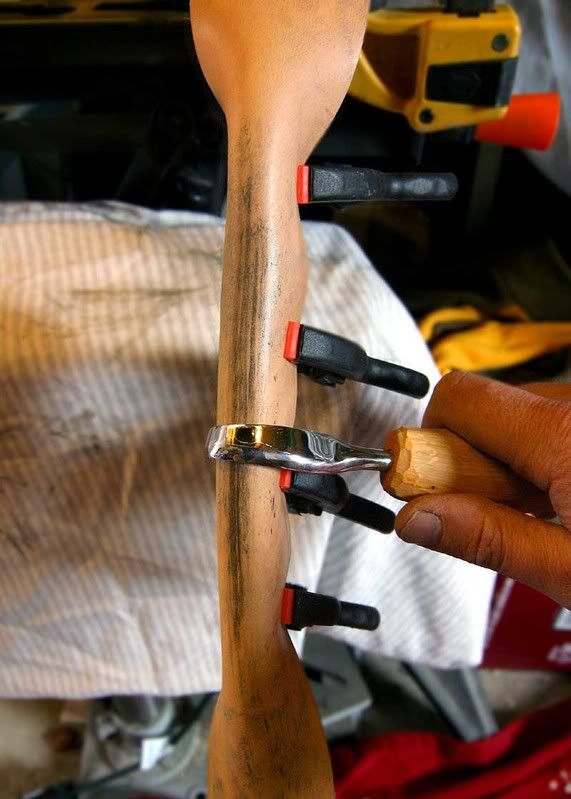
Apologies for continuing the drift off-topic.
M4
Posted: Mon May 09, 2011 6:43 am
by Manix CTS-XHP
Hello,
The steeper your angle 35 degree (17,5 degrees on each side) the finer your edge but also the delicater! I use for normal pocketknife EDC sources a wider 25 degree angle.
The angle your intending is more for straight razors and that kind of stuff. with 25 degree angle (12,5 on each side) you should be fine.
So it is not your steel but your setup who is causing you problems. M4 is a very hard and sturdy super steel! :cool:
Good luck,
Edwin
Posted: Mon May 09, 2011 11:32 am
by Blerv
Did we ever come to a consensus where the edge retention of M4 lies given the current RC?
I know it's hard to label steels for their characteristics but would we say something like it being a fine grain, tough, non-stainless version of CPM-S30v?
My Manix2 M4 isn't anything but hair-popping but in the past I have heard some say that M4 takes a screaming edge relatively easily. It only makes sense it wouldn't cut with the likes of the wear resistant alloys.
I'm a big fan of spiels. Not like, "Buy one today and I'll throw in ___ at no extra charge!" but rather taglines that boil down science into understandable taglines for the masses. I would rather live and breath those if written by the educated steel snobs. :)
Posted: Mon May 09, 2011 4:49 pm
by hunterseeker5
I know it's hard to label steels for their characteristics but would we say something like it being a fine grain, tough, non-stainless version of CPM-S30v?
I'd liken it to S90V more than S30V, but its.... *sigh* Its hard to compare to be frank because I'm not only limited in sample size but also blade geometry. I would definitely say it is more wear resistant and far more corrosion prone than S30V. It also, in my experience, is far more willing to take a super sharp edge when applied correctly, akin to S90V in that respect. Its just hard to say really, so I'll label OPINION in giant letters on this, but if your forced me to make a comparison to another steel I'd say its more like a higher toughness more corrosion prone S90V.
If you'll give me enough rope to hang myself I'll venture out further onto the limb if I may. Both S30 and S90V are more or less the same but for the addition of more vanadium in S90v. This means more of the carbon is eaten up forming carbides with vanadium than chromium resulting in finer grain structure/smaller carbides, and just more and harder carbides. You get a nice corrosion resistant, hard, and reasonably tough steel. M4 went in another direction. Notice how all the carbide forming alloys are present in M4 in relatively equal proportion? Its my theory that M4s increased toughness stems from the fact that it also has extremely high carbide content, but that its carbides are even smaller yet. My GUESS is that this is because carbides don't like to form as part of two different alloys, so you get roughly equal amounts of very small carbides of the four different flavors present. This is what increases the toughness of the steel. To prevent giant chromium carbides from forming though they cut back on the amount of chromium resulting in susceptibility to corrosion. I'm not a metallurgist though, so this may all be crap. Perhaps someone who is would care to step in and offer their opinion?
Posted: Mon May 09, 2011 9:50 pm
by Slash
another thread showing and talking about how different people have different means.
I mostly just use my knives at work(finish carpenter) to ream out the back(usually a glued up chip/partical board type material) of a kitchen or bath cabinet hole cut outs to accomodate plumbing when my hole saw cut wasn't perfect or during the leveling I needed to raise up the box a bit. of course I have a ultility knife that would also work. but, I feel the need to justify having a folder in my pocket as well. :) Plus, a folder just works better for that purpose.
so, a tough steel thats holds a decent edge works fine for me. my most used edc blades would be benchmade 760 lum tanto w/cpm-m4 or hogue drop point g-mascus ex01 w/cyro treated 154cm @ 40 degrees seems about right for any cutting tasks I use the blade for. I mostly carry those 2 cause I like a 4" blade that has fast deployment. All you fanboys don't give me any crap now. I would use a millie. but, I find the thin tip a little to weak for my edc needs.
Why 4" blade? Never know when you'll run into some looney that wants to harm you or someone around you. I find myself in many convenience stores where you have a good possiblity of running into such a person here in Vegas where I live. Plus, it feels good in my hand as a 4" blade has a full length handle.
I don't think I would edc(primary blade) or care to edc anything smaller or something that would be considered a "lesser" steel. even though other blades would also work. I like that old saying that goes if it ain't broke, don't fix it. plus, I kinda spoiled myself and just happy with what I have.
tldr; cpm-m4 seems to work well for my needs. those don't include cutting tp either...
Posted: Mon May 09, 2011 10:17 pm
by Blerv
People keep bringing up TP cutting like it's a joke. It's definitely a test for sharpness.. None of mine will do that.
Posted: Mon May 09, 2011 10:58 pm
by Slash
Blerv wrote:People keep bringing up TP cutting like it's a joke. It's definitely a test for sharpness.. None of mine will do that.
I think the main point being a good working edge that last a long time is better than a very sharp edge that can cut tp. because, if you use it for anything else that super sharp edge goes away fast and needs to be resharpened often to get it back to the tp cutting sharpness.
if that makes any sense to you?
Posted: Tue May 10, 2011 5:42 am
by jackknifeh
Blerv wrote:Did we ever come to a consensus where the edge retention of M4 lies given the current RC?
A.G. Russell's steel chart has CPM-M4 as 59-61 Rc.
http://www.agrussell.com/Steel_Guide/a/73/
I've seen M4 rated as high as 64-66 in other documentation. I looked briefly but didn't find where. I will though. I'd like to know what Spyderco says their M4 blade's Rc is.
Slash wrote:I think the main point being a good working edge that last a long time is better than a very sharp edge that can cut tp. because, if you use it for anything else that super sharp edge goes away fast and needs to be resharpened often to get it back to the tp cutting sharpness.
if that makes any sense to you?
I agree with this. If I want one piece of toilet paper to become two pieces I can handle that without a knife. :) The TP test is to see how sharp you can get a knife, not a test of steel or knife usefulness.
Posted: Tue May 10, 2011 5:58 am
by chuck_roxas45
jackknifeh wrote:
I've seen M4 rated as high as 64-66 in other documentation. I looked briefly but didn't find where. I will though. I'd like to know what Spyderco says their M4 blade's Rc is.
Jack, the OP sent in his GB to Spyderco. This is what he reported.
btb27823 wrote:Got results! Rockwell of my knife and another new one they tested with the same or nearly the same date code tested 64 :) My knife passed the CATRA test, but no more info. than 'passed.'
Posted: Tue May 10, 2011 5:59 am
by unit
Slash wrote:
so, a tough steel thats holds a decent edge works fine for me. my most used edc blades would be benchmade 760 lum tanto w/cpm-m4 or hogue drop point g-mascus ex01 w/cyro treated 154cm @ 40 degrees seems about right for any cutting tasks I use the blade for. I mostly carry those 2 cause I like a 4" blade that has fast deployment. All you fanboys don't give me any crap now. I would use a millie. but, I find the thin tip a little to weak for my edc needs.
tldr; cpm-m4 seems to work well for my needs. those don't include cutting tp either...
I kind of doubt that anyone would have a problem with someone that chooses a blade that suits their needs. This is a pretty friendly place...you might want to ratchet down your tone a little...it seems a little inflammatory.
Regarding cutting tp. Many people have hobbies, and many people try to see how far they can go with their hobbies. Some (most on this forum) of these people can and would help you to potentially see new ways of doing things that might make your life better and more enjoyable (if you do not offend them in the mean time).
I appreciate that you have preferences, and I have no concern for what make and model knife you choose to carry/use. Have a nice day.
Posted: Tue May 10, 2011 6:35 am
by Ankerson
jackknifeh wrote:Blerv wrote:Did we ever come to a consensus where the edge retention of M4 lies given the current RC?
A.G. Russell's steel chart has CPM-M4 as 59-61 Rc.
http://www.agrussell.com/Steel_Guide/a/73/
I've seen M4 rated as high as 64-66 in other documentation. I looked briefly but didn't find where. I will though. I'd like to know what Spyderco says their M4 blade's Rc is.
Spyderco runs M4 in the 61-63 Range so most should end up around 62 HRC.
Personally if I wanted a Non stainless blade I would choose CPM 10V, K294 or the new K390 at 64 HRC over M4 in a Custom.
But then I would just likely go with S110V at 63 or 64, S90V at 61 HRC or M390 at 63 HRC if I was going to do that.
Posted: Tue May 10, 2011 6:38 am
by jackknifeh
chuck_roxas45 wrote:Jack, the OP sent in his GB to Spyderco. This is what he reported.
Thanks Chuck. Now I even remember reading that. I'm getting older by the minute but I guess that's how time works.
Thanks,
Jack
Posted: Tue May 10, 2011 7:20 am
by chuck_roxas45
jackknifeh wrote:Thanks Chuck. Now I even remember reading that. I'm getting older by the minute but I guess that's how time works.
Thanks,
Jack
I only remember it Jack because I was really interested in the result because I had a GB with that date code too. Us grandpas have to stick together.