can't freehand wrote:A critical point is supposedly reached when lowering the angle at which carbide-heavy steels can no longer support the apex in any sense, because of the characteristics you point out, and the edge basically collapses onto itself, thus negating the purpose of the abnormally low angle in the first place (increased edge retention).
This generalization is correct, however this conclusion has issues :
The author suggested 15 degrees being the lowest one should go with S30V.
And this excellent question is complicated :
Also, at what angle can ZDP-189's wear resistance be fully utilized for maximum edge retention without critically compromising the strength of the edge (apex stability)?
Step away from steels for a second and look at 100 m sprinters. The reason I ask to consider this is that we can physically see things obviously, you can't with carbides in steels. Now as a sprinter puts on muscle mass he has the ability to generate more power, this allows him to run faster. Unfortunately the extra muscle weighs more which means he has to generate more power to move it. It also simply gets harder to be explosive and run when you have massive amounts of muscle mass. Then there are the effects of training and what is required to maintain it.
It is easy to understand then that a sprinter will not have the minimum muscle mass nor the maximum, but will be somewhere in the middle. The goal is then to put on enough muscle so that the power is increased, but not so much that the weight slows you down, prevents ideal running technique, or simply becomes too demanding to maintain. Now look at the longer running times, 200m, 400, 1000m, 5 km. The muscle mass tends to start to decrease and by the time you get out to ultra-marathons they look like very different athletes than a 100m sprinter.
It is very similar with knives in that how and what you cut is going to dictate the loads that you put on the knife just like if you run a 5k it is very different than a 100m sprint. The unfortunate thing is that while the sprint and marathon are very well defined, this isn't the case in knife use. If I asked an athlete if he was a sprinter or a marathoner then the answer is very clear. But if I ask you what kind of knife use you typically perform then what would you say? Are there clear labels similar to sprinter vs marathoner?
Here is what I can tell you, ignore the steel for the first part because it makes only a small difference compared to the angle :
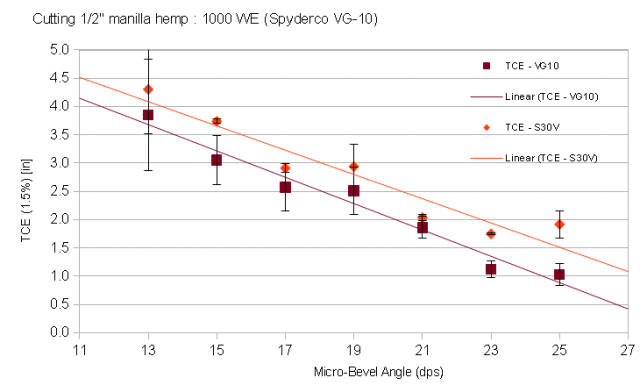
and the grit finish :
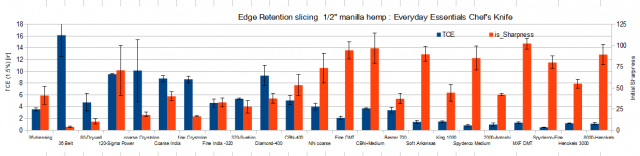
For the knife you carry/use, adjust the edge angle/grit finish until the performance is maximized and keep in mind when you are doing this how the knife is failing in use. With the type of failure you can then look at different steels :
-do you have to increase the angle because the knife would roll otherwise, look for a stronger steel and a higher carbide volume
-do you have to increase the angle because otherwise the knife will chip, look for a tougher steel with a lower carbide volume
-is the edge very resistant to rolling and chipping but it fails due to just slow wear, look for a higher carbide volume
Because the force you use, the technique you use, what you cut and how all will influence the loads on the edge it simply isn't possible to say 15 dps is the ideal angle for S30V. Here is the only general caution I would make, 15-17 dps are common sharpening angles for felling axes. It is very likely, unless you have very demanding tasks for the knife, that the ideal geometry is much closer to 6-8 dps with a suitable apex bevel.
This angle may sound radical, but just keep in mind that the common $5 Mora knives have a 10-11 dps bevel. The may have issues in the beginning due to the fact they are actually hollow ground right to the apex, and often are over heated, but once that bevel is flattened and heat damaged removed, a 10-11 dps bevel is very strong/durable for a hand held knife.
Again, felling axes are typically 15-17 dps and just think about the impacts they take and if the knife you carry and use will see that level of load. If it doesn't, then it is likely that the optimal angle for performance is going to be a lot lower. This is a Svord with an 8 dps edge bevel, normally runs an apex bevel off of a MXF DMT :

It works very well on foods, paper, cardboard, ropes, plastics, woods, and fabrics. If I was doing drywall, shingles, sods, bones, metals, etc. I would move the angle up to prevent rolling.