Page 7 of 12
Posted: Thu Mar 04, 2010 5:56 am
by graham_s
Well I just ordered one, there seems to be stock left.
I'm a member of BCUK, so I thought I should, and at that price it's a shame not to.
If it's ok, I'll leave it as it is, maybe fill any light cracks with CA.
If it's bad, I can see a project coming on.
I'm thinking Black micarta, red fibre spacers, mosaic pins, and a custom Kydex sheath with a tek-lock on it.
Home made NASA version!
Assuming of course, that it makes it to me out here in Saudi Arabia.
Posted: Thu Mar 04, 2010 8:10 am
by UglyJim
I received my Bushcraft 2nd yesterday, and despite the expected imperfections in the wooden handle, it’s a very impressive piece. My knife has 3 visible cracks (two somewhat significant, one very minor), but the spalted wood is quite lovely (sorry, no pics…my camera is currently loaned out). I can’t see how the cracks will compromise the functionality of the knife, but I probably would have been a tad disappointed if I had found them in a “first quality” knife. Despite my lack of mechanical skills, I’ve taken the advice posted here and purchased some rubber-toughened (black) low-viscosity CA to try and fill the cracks; I’ll give it a shot once the wood has had a chance to acclimate to its new environment.
What impresses me the most about this knife is the incredible ergonomics of the handle. Too many of the fixed blades I’ve handled recently have relatively thin, flat handle slabs. While this may enhance the concealability and portability of these knives, I’ve never found those types of handles to be comfortable, particularly for extended use. The Bushcraft’s curves fill the handle nicely and provide a very stable grip. I hadn’t paid too much attention to this knife when it was first announced (I’m not an outdoorsman, and I wasn’t at all familiar with the bushcraft movement), but I can see this knife becoming one of my favorite blades...I’ve always been a fan of knives made with traditional organic materials, and I’m really appreciating the opportunity to use a Spyderco with a wooden handle and a (very well-made) leather sheath. If the wood stabilization issues can be resolved, I would love to see Spyderco make another run of this design.
I have one minor nit, and it pertains to the blade rather than the handle. The first inch or so of the blade has several small irregularities; it looks/feels like a combination of a slightly jagged edge and a rolled burr. I’m not sure it could be accurately described as chipped; it almost looks as if that portion of the edge had an unplanned encounter with a nail or stone. I don’t know if this is a normal consequence of the Scandi grind, but it’s definitely not the polished edge I’m accustomed to on Spyderco products. The rough patch can probably be smoothed out in short order (although I’m not familiar with proper sharpening protocols for Scandi grinds). I realize that the knife is, after all, a “second” and that imperfection are to be expected, but I was a bit surprised by these issues with the edge.
That being said, I’m still very impressed with this design…I would definitely like to see more Spyderco knives in this vein.
Posted: Thu Mar 04, 2010 8:59 am
by MG_Saldivar
UglyJim wrote:What impresses me the most about this knife is the incredible ergonomics of the handle.
I agree. The Spydie Bushcraft is the fourth natural-material-handled bushcraft knife I've owned (excluding plastic-handled Moras) and I really marvel at how Spyderco was able to translate the fantastic ergos they get from man-made materials to this wood-handled model.
UglyJim wrote:If the wood stabilization issues can be resolved, I would love to see Spyderco make another run of this design.
I've been following all the Spydie Bushcraft threads and I don't think this has come up before (if it has, forgive me). I understand this wood was chosen for its appearance but I'm unclear about why "with-the-grain" slabs weren't used - given the same kind of wood, wouldn't "with-the-grain" slabs have been inherently more stable? My other wood-handled bushcraft knives don't have cracking issues (but, admittedly, they are handled with plain-Jane rosewood).
UglyJim wrote:The first inch or so of the blade has several small irregularities
I'm sorry to hear about that. My blade was flawless. I wonder if others have received knives with blade irregularities?
UglyJim wrote:I’m not familiar with proper sharpening protocols for Scandi grinds
This is a good primer.
Posted: Thu Mar 04, 2010 9:19 am
by Sequimite
MG_Saldivar wrote:I
I've been following all the Spydie Bushcraft threads and I don't think this has come up before (if it has, forgive me). I understand this wood was chosen for its appearance but I'm unclear about why "with-the-grain" slabs weren't used - given the same kind of wood, wouldn't "with-the-grain" slabs have been inherently more stable?
On the first question, Sal said they are searching for another wood and may put out a G-10 version as a stop gap if the search is prolonged. The wood handles are an integral part of the concept and are supposed to be the norm.
As for the grain, these are my speculations:
The stabilizing should have caused this to be a non-issue.
Spalted wood has weaker points than cross grain anyway.
The wood was cut for maximum beauty.
Posted: Thu Mar 04, 2010 9:51 am
by Pneumothorax
Hector Castro wrote:Please dont try to mix anything with CA. It will cause it to harden faster. If you want it in black, you can buy a CA that is already black and fortified with a natural rubber compound. This CA is designed for glueing very hard material (metals) The Rubber gives it the ability to absorb shock loads. CA makes a strong bond, but it gets brittle by itself. This is the reason for the black CA.
CA is available in many viscocities at your local hobby shop. I build RC planes in my spare time, and i have seen at least 6 different types available.
Hector, see site below for black CA examples - is this what you're talking about? I think so, just want to make sure.
http://www.google.com/products?source=i ... CCYQrQQwAg
Posted: Thu Mar 04, 2010 10:51 am
by skunk_2
cyanoacrylate or CA is the less common name for "superglue" isnt it?
trying to find out what im in store for, when the time comes for filling the cracks!
Posted: Thu Mar 04, 2010 11:07 am
by Pneumothorax
skunk_2 wrote:cyanoacrylate or CA is the less common name for "superglue" isnt it?
trying to find out what im in store for, when the time comes for filling the cracks!
Yes, and I know because I asked the same question earlier! Hah, got to use my new found knowledge.
Posted: Thu Mar 04, 2010 12:22 pm
by yablanowitz
MG_Saldivar wrote:
I've been following all the Spydie Bushcraft threads and I don't think this has come up before (if it has, forgive me). I understand this wood was chosen for its appearance but I'm unclear about why "with-the-grain" slabs weren't used - given the same kind of wood, wouldn't "with-the-grain" slabs have been inherently more stable? My other wood-handled bushcraft knives don't have cracking issues (but, admittedly, they are handled with plain-Jane rosewood).
Burl woods such as this spalted maple don't have a straight grain, at least not enough of it to make a difference which way it is cut. Properly stabilized burl woods are practically synthetics anyway. It appears to me that insufficient pressure was used during the resin impregnation stage of the stabilization process. The resin simply did not penetrate and seal the wood everywhere the way it should have. I have a stabilized burl Queen whittler in my pocket right now that was made in Titusville, PA and subsequently moved out here to the near-desert without a hint of cracking anywhere. I don't think the wood supplier knows what he is doing.
Posted: Thu Mar 04, 2010 2:03 pm
by Metals of war
Sirs,
I just placed an order. This deal is unmissable. You can't find ANY woodlore knife in O1 under $200. Even with a cracked handle this a great deal. I'm sure about the heat treat was done right and the edge retention will be superb. All I can do is to recommend this to everyone.
P.S. I will make some pics with my Bark River Aurora when the Bushcraft arrives.
Gabe
Posted: Thu Mar 04, 2010 3:14 pm
by CanisMajor
Just took some pics of mine, here ya go.
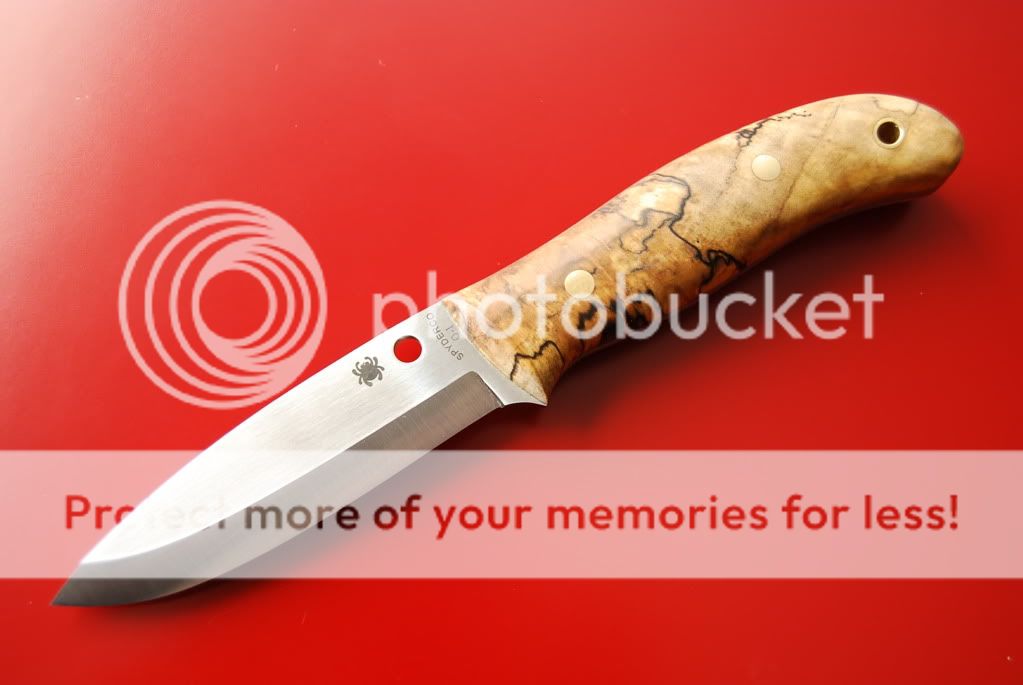
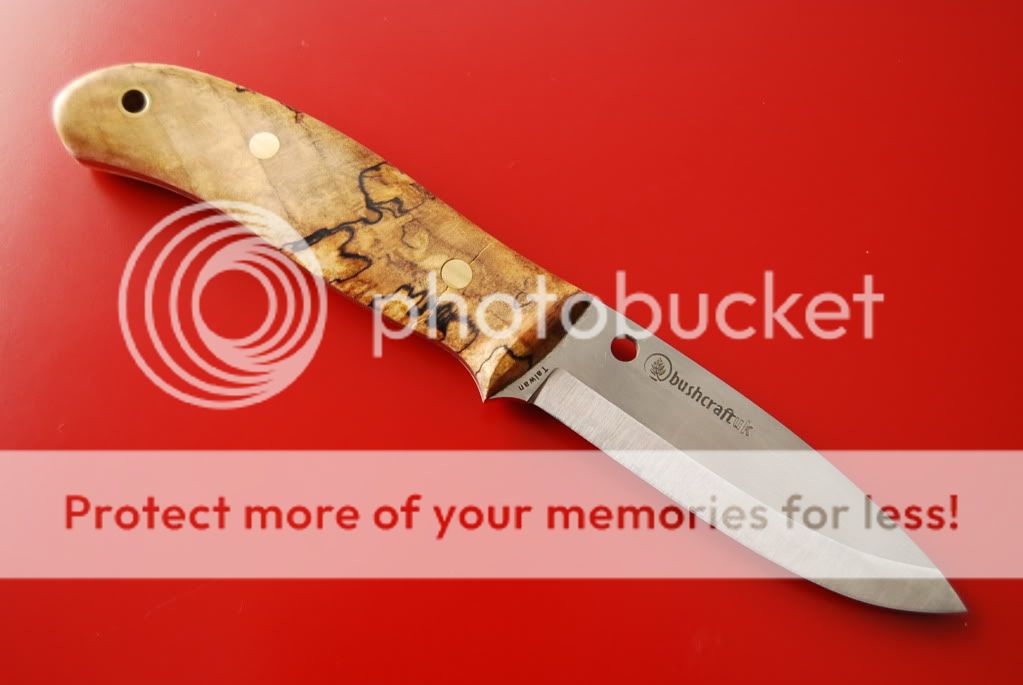
The only crack on mine
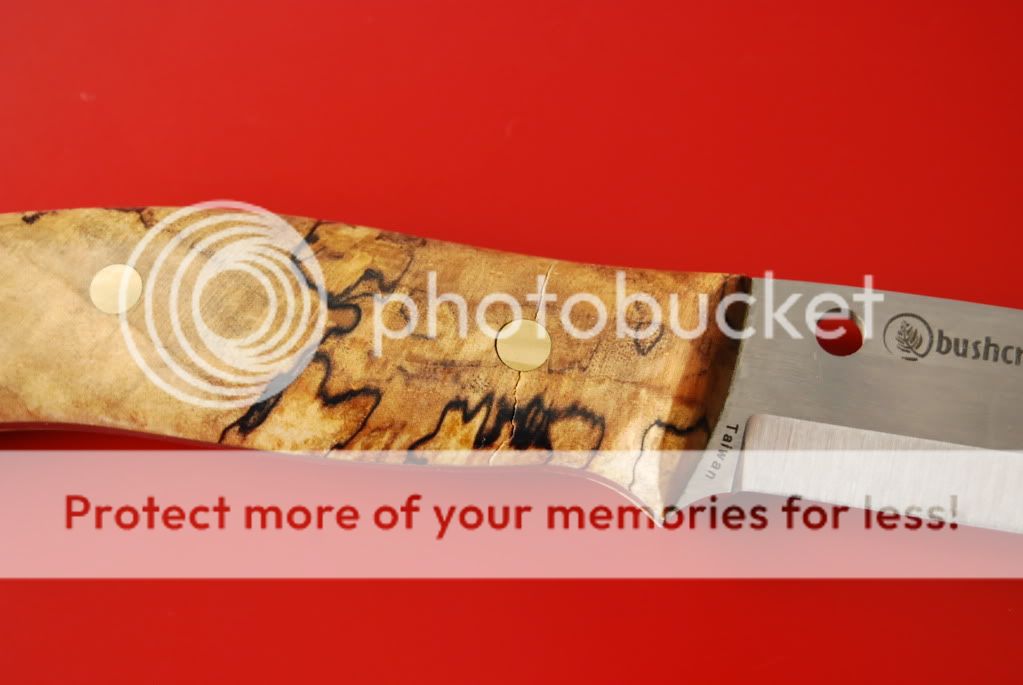
Canis
Posted: Thu Mar 04, 2010 6:37 pm
by Hector Castro
Yes,
that is the stuff. BSI or Bob Smith industries makes some of the best CA out there. Their CA is triple distilled. Keep the black CA out of the sun and high humidty, or it will get hard on you in a few months. Most Airplane modelers put it in the freezer. 0 humidity and dark!
Posted: Thu Mar 04, 2010 6:53 pm
by Hector Castro
yablanowitz wrote:Burl woods such as this spalted maple don't have a straight grain, at least not enough of it to make a difference which way it is cut. Properly stabilized burl woods are practically synthetics anyway. It appears to me that insufficient pressure was used during the resin impregnation stage of the stabilization process. The resin simply did not penetrate and seal the wood everywhere the way it should have. I have a stabilized burl Queen whittler in my pocket right now that was made in Titusville, PA and subsequently moved out here to the near-desert without a hint of cracking anywhere. I don't think the wood supplier knows what he is doing.
You are right about the stabilization process. If it is stabilized correctly, the wood is now an acrylic. The way the big boys do this, is in a big auto clave. They use resinol 88 that is fairly expensive, and they put the wood in an auto clave and pull 20Hg of vacuum on it. This puts the resinol into the cell walls of the wood, replacing the natural moisture found in the woods cell walls. The resinol dries, and it is like dipping a sponge in epoxy. You now have a totally different product. The product is also impervious to moisture, gas, fuel, kerosene, diesel, antifreeze. FYI if you have a vacuum pot and a way to pull 20hg of vacuum, you can do this at home. The only problem is , last time I looked resinol 88 is $256 a gallon :eek:
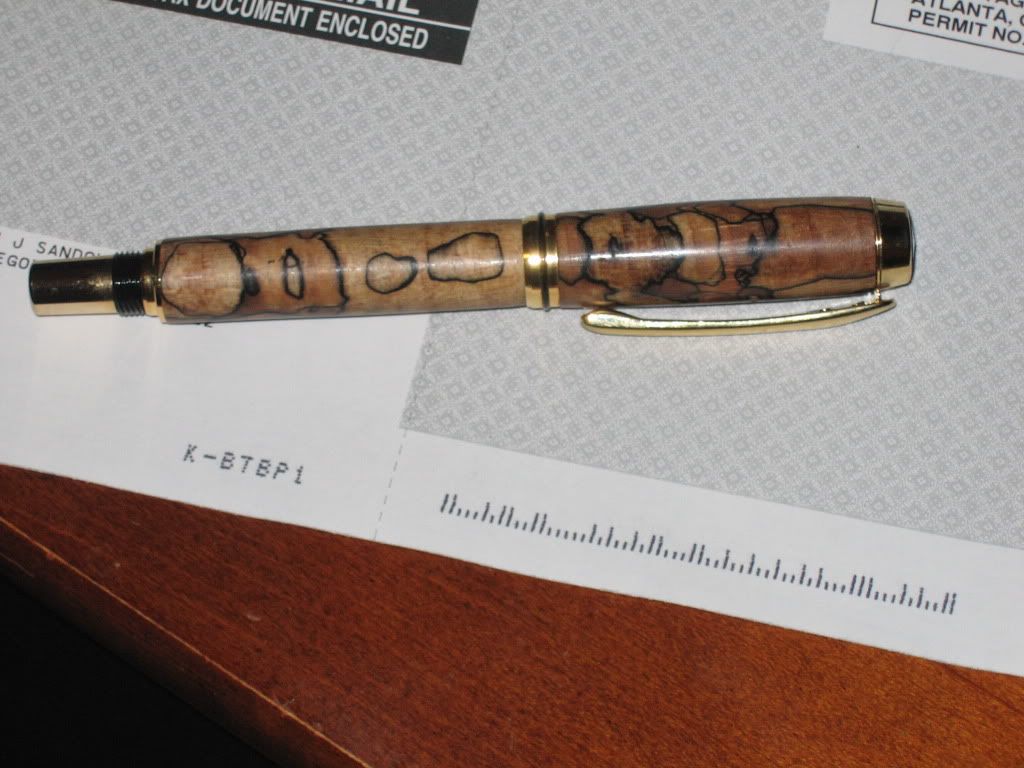
Here is a pen I turned from some Crosscut Spalted English Beech
In this picture you will see that the lines that run perpendicular to the pens (East/West) axis are not the grain, but the rings of the tree. the grain actually is point at you, and at the desk. (like the end of a log,when you split it) If you tried to turn a regular/non stabilized piece of wood on a lathe, oriented this way, it would explode on you, once you hit it with a cutting tool! I hope this all makes sense!
Posted: Thu Mar 04, 2010 6:58 pm
by Hector Castro
UglyJim wrote:.
I have one minor nit, and it pertains to the blade rather than the handle. The first inch or so of the blade has several small irregularities; it looks/feels like a combination of a slightly jagged edge and a rolled burr.
My second has this also. Kinda looks like it was used to try and cut a brick. My 1st has a perfect blade though, so I am not complaining.
Posted: Thu Mar 04, 2010 8:34 pm
by MCM
Posted: Thu Mar 04, 2010 9:05 pm
by cougar337
I couldn't help myself I had to order a 2nd Bushcraft. I was floored by my first one I had to have another one at such a great price. just a heads up, at the time of my purchase it showed only 150 left.
Posted: Thu Mar 04, 2010 9:32 pm
by MCM
Almost did the same thing when I opened the box!
Will sleep on it......... :)
(no, wait a minute I might get cut)
Posted: Fri Mar 05, 2010 7:44 am
by westfork
MCM, That's a real beauty.
Posted: Fri Mar 05, 2010 9:25 am
by grg
I just realized I don't own a knife with O1 steel so I had better get my first.I do have a knife with stabilized spalted maple its my favorite small fixed blade knife.
It was made by Neil Blackwood he used to go by(Dr Lathe)on blade forums.
He called it either a small game or bird and trout with a clip point ,and D2steel as far as I know its the only one he made of this configuration.
Posted: Fri Mar 05, 2010 2:29 pm
by MG_Saldivar
Hector Castro wrote: I hope this all makes sense!
Thanks for your explanation, I do have a better grip on on this stabilization process.
Posted: Fri Mar 05, 2010 4:59 pm
by dbcad
Recieved my Bushcraft today. immediately noticed the 4 pretty good sized cracks and on examination found a fifth smaller one. This was expected. Pretty much like the other pics I've seen on this thread.
As I handle it further I'm amazed at how much a part of your hand this knife can be. It feels like an extension of me. The feel is superb! It is exceedingly beautiful as well! I have already ordered another one.
Now, to fix the cracks and get the scales back out to the tang:
1) Let it acclimate for a week or so.
2) fill the cracks with low viscosity rubberized CA, let it cure and sand (with dust mask).
3) repeat step 2 until the cracks are completely filled.
4) obtain some Tru Oil and wet sand using 000 steel wool (would 0000 steel wool work? Think so) as per Hector's advice.
5) use the knife during the time required for these steps. Being held and used might help it feel better :) :)
Please correct me on these steps for the handle If I've gotten anything wrong. All have been garnered from this thread, hopefully understood as intentioned. This'll be my first time attempting this kind of wood rehabilitation.
Question; when sanding after applying CA what grit would be best?
After I look at the blade I know finally know what a Scandi grind is after my reading. The grind goes all the way down to the edge. It's much different than the rest of my knives. Going to have to try it out on some wood this weekend. Whittles paper well, but think it'll like wood. It looks like it'll be real easy to sharpen.
The handle problems must have been a heartbreak for Sal. They've been working on this for quite a while and :spyder: has produced a gorgeous knife, every one unique.
I'm glad I bought 2 of these 2nds.
Great info in this thread, thanks all :D
Charlie