TedP


They're bulky, but made of a very lightweight alloy so they don't change the balance much. No different than using on of the various wood densities seen in this thread I imagine.xceptnl wrote:Those are some serious fasteners. They look like Torx T-50 or T-65 at first glance. They probably significantly change the balance.
Its raw walnut, sanded to 500 grit and then treated with tru-oil and buffed with a paper towel.phillipsted wrote:I like the walnut dfriedl! It looks like it is stablized - did you need to add a finish to it to get that smooth silky texture?
TedP


Thank you for your help! I was still wondering what size pivot bolts to use, so that is very helpful. Thanks again!phillipsted wrote:Hey, Thompson!
You've got a few choices about the style of pins/bolts you want to use on your knife. I use 3/16" pivot bolts with torx screws so I can make the scales detachable. Other folks use pins or Corby bolts along with epoxy to make a more permanent bond. Each of these methods use slightly different finishing processes.
I'd go check out the knife supply houses and pick the supplies for the method you want to try. (e.g., USA Knifemaker Supply, Texas Knifemaker Supplies, Jantz Supply)
Check back here if you have questions - we'd be glad to provide assistance!
You are welcome! Here's what you are looking for, Thompson:Thompson wrote:Thank you for your help! I was still wondering what size pivot bolts to use, so that is very helpful. Thanks again!
First off, welcome to the Forum, farns! And what a beautiful mule - very nice work on the scales!farns wrote:This is my first attempt at putting scales on a mule. Except for some overzealous filing in a couple spots I am pretty happy with it. My question would be about finish, I have currently sanded to 600 grit and buffed the handle. It is bubinga and I would like to maintain a somewhat food safe finish. I understand that food safe finishes may need to be re-applied as time passes but was considering walnut oil with a coat of bees wax. Does anyone have experience that would recommend not doing this?
That is way too much to explain here. What you basically are asking for is a beginners crash course on knife making. I will explain the basics, but you have more research to do, books to read, websites to find, forums to peruse. The skill and information it takes to make and fit handles correctly is not likely something that can be learned just through one post. There is no one correct way to do it, so most likely you will develope your on technique based on your skills and whats available to you. What I use are three main tools to do just about everything when Im making handles. 1- Bandsaw- to rough out the handle shape - 2 Drill Press, to drill holes (as well as to use with a spindle sanding attatchment to do inside radii) 3- Belt/circular combination stand alone sanding machine- to do the rough shaping on outter radii. However, thats a couple grand worth of equipment, so if you arent a wood worker already, it is not likely you will have access to all of these. The one thing I would say you need access to out of these is a bandsaw (or scroll saw, even a jigsaw, something you can get a rough shape out of wood scales with) . However the most useful of the three, and if you were to BUY one, I would say get a drill press. Many attatchments exist that can turn it into several different tools. Also, it is MUCH MUCH more precise than trying to clamp things and use a hand drill. Its also the cheapest. You can find a decent Delta bench mounted drill press for $200 (dont bother with anything cheaper. Just as I would say dont bother with cheap bench mounted bandsaws. If all you are doing is shaping .3" thick wood, then I guess its ok, but it really cannot handle much thicker. for that you need at least 1 hp) The bare minimum saw I would say that is worth buying is a 14" 1hp+ bandsaw. They start at around $500 when you figure in shipping the 250lb thing and go up to a grand or more with all the bells and whistles or if it has a prestigious badge.eitenbuffalo34 wrote:I have a question, how does everyone do this?
Where do you all get the handle scale materials?
Do you do this with power tools (like a dremmel, etc.) or do you use files and sand paper?
How do you put the finish on (wood) or texture for other materials?
What screws/pivots do you all use?
and how do you figure out where the holes in the handle are behind the handle scale so that you can put the screw there?
I am thinking about getting one and trying this all out and just was looking for some advice because the mules on this forum are beautiful, thank you...
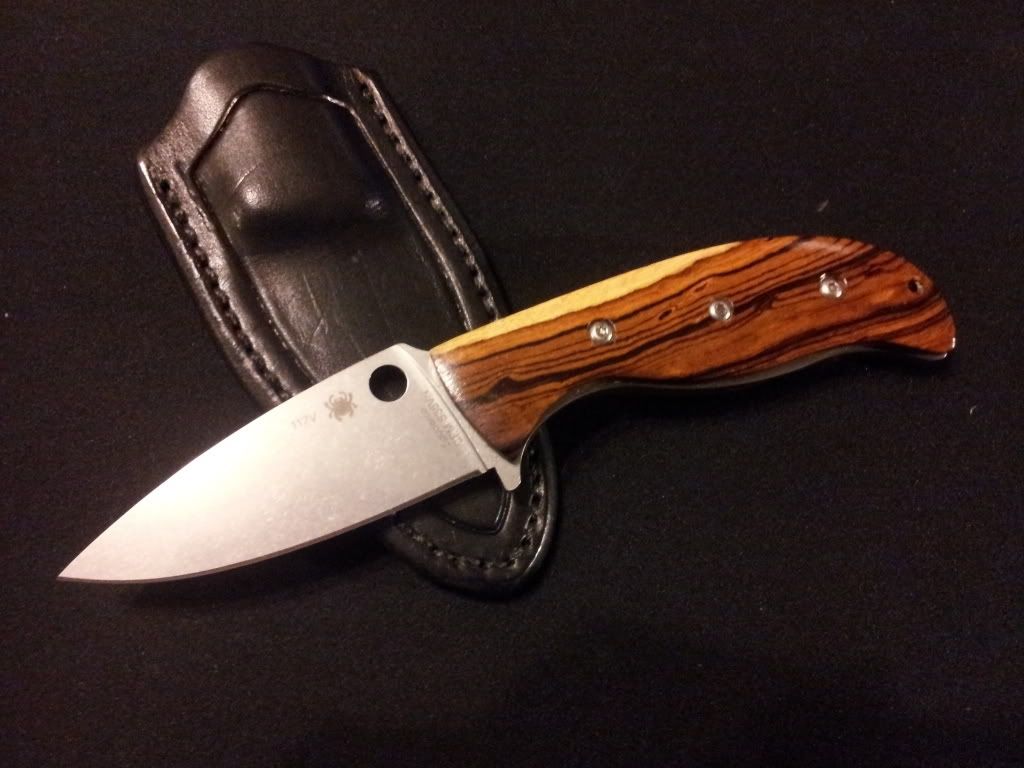
Thats beautiful work man. Very unique approach. If-8 I didnt commit one set of scales to one mule Id go crazy making tons of them to match my outfit and what not lol. Its always a tough choice for which wood to use. I have probably 12 different sets of scales commited that I have pre-roughed out for mule handles of the highest figured woods I have collected over the years, that I drag out everytime I get a mule and try to match the wood to the "character" of the steel. Its never easy!phillipsted wrote:Sorry for the tease, guys. I was just so excited about this one, I couldn't wait to share the results. This is my Super Blue Mule shod in some Cocobolo purchased off the 'bay. The Cocobolo was a bit softer and than other cocobolo I've worked with in the past and had more of an open grain - it might be an alternate species. But the color and contrasts are very fetching. I'll probably end up sealing it with TruOil sometime soon.
As I noted in the previous post, I used the washers under the screws to provide a more secure attachment. The scales are just screwed on at this point - they aren't expoxied. There are good points and bad points to that, I know. But I wanted to be able to take off the scales and check the scales for discoloration/rust periodically.
TedP
WOW, Great first post! welcome to the forums! Gotta love ariszona Ironwood. That is one really nice looking sheath too! The pieces Im using are the wildest of burls I have found. Im working on an Ironwood re-scale myself. Check it out!:Ironwood Bushcraft Threadnlmd wrote:
Looks like a good excuse for a first time post :)
Desert Ironwood scales
Thank you for the nice comment. It was an experience filled with many lessons learned.phillipsted wrote: First off, welcome to the Forum, farns! And what a beautiful mule - very nice work on the scales!
I have read a lot on the forums about Tru-Oil. My budget on this is very small, so if I can not spend more that would be great. I have read some information about using teak/danish oil which I have some of that and rub on poly. Maybe those would work ok as a two stage application process. The teak oil looks very nice on a scrap piece of wood I have left over. Thoughts?phillipsted wrote: And the best product I've found for making knife scales waterproof is Tru-Oil, which is sold in sporting goods stores as a gun stock finish. Tru-Oil is a polymerized linseed oil base which cures hard and waterproof.