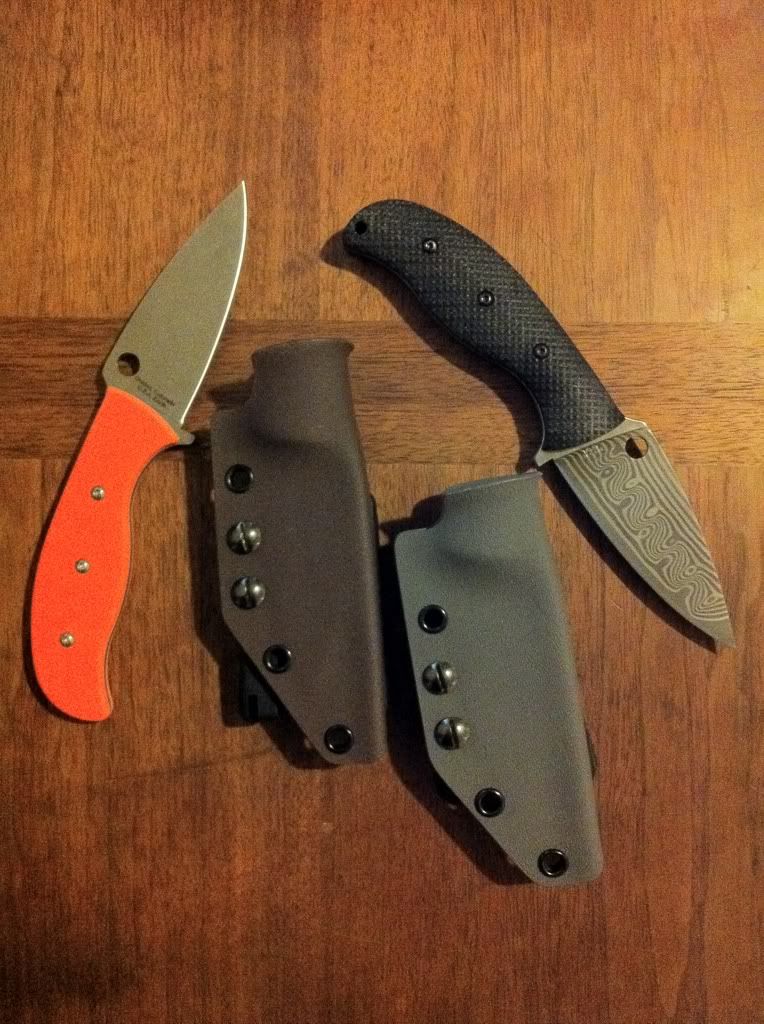
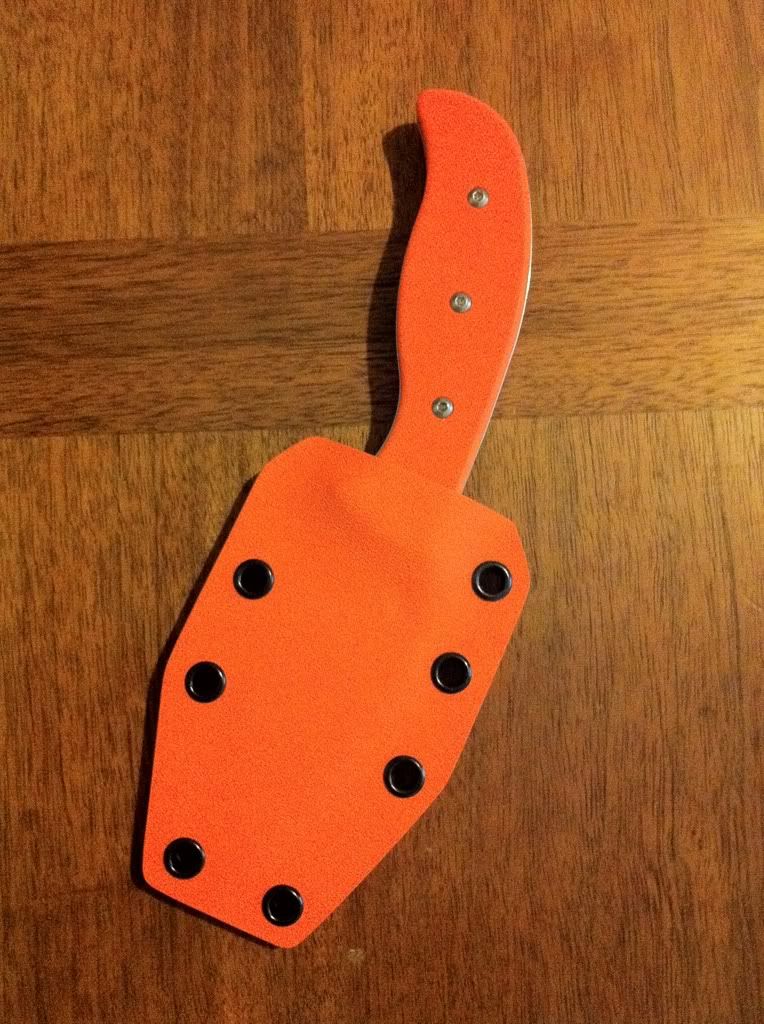
Show your Mule


-
GLOCKCRAZZ

- Member
- Posts: 37
- Joined: Wed Sep 07, 2011 9:28 am
- Location: Bayou Custom Sheaths, LA
- Contact:
-
GLOCKCRAZZ
- Member
- Posts: 37
- Joined: Wed Sep 07, 2011 9:28 am
- Location: Bayou Custom Sheaths, LA
- Contact:

-
phillipsted

- Member
- Posts: 3674
- Joined: Tue Oct 05, 2010 11:30 am
- Location: North Virginia
Thanks, Doug! I use the F6 Stainless Pivot Pins from Jantz (http://www.knifemaking.com/product-p/f6.htm). These use a 4-40 button head Torx bolt and a 0.1875" x 0.500" threaded spacer. The Torx bolts have a 0.210" head, so if you step-drill your holes in the scale material, the bolt heads will cinch down scales onto the blade. This is the same type of attachment that Halpern provides with its scales.DougB2 wrote:phillipsted,
I like how your micarta turned out! What size screws did you use?
This set of micarta scales is not glued at all - the bolts, pins and friction hold the scales onto the knife. Since this is going to be primarily a display piece, this is OK - I might even go back and add a contrasting red spacer at some point. But all my user Mules get the Epoxy - especially the non-stainless ones where corrosion under the scales can be a problem...
TedP
-
phillipsted
- Member
- Posts: 3674
- Joined: Tue Oct 05, 2010 11:30 am
- Location: North Virginia
Problem with artisan Micarta
I finished another set of scales for my Woodcraft Mules today. For this one, I had high hopes for some "artisan" micarta made by someone on eBay. This was his maroon-and-dark-brown linen micarta. This isn't truly micarta (which is actually a registered trade name) - because it uses what appears to be a commercial-grade epoxy rather than a phenolic base. Overall, I like the color scheme and workability of the material.
The problem with the material starts to manifest itself once I had the scales shaped and began to sand it down. For this life of me, I can't get it sanded smooth - the pits and divots in the material simply don't sand out. Then it dawns on me - these are voids in the epoxy substrate that were created during the backyard manufacturing process. No matter how much I sand, they aren't coming out. So I just sanded it down to 1200 grit and buffed it with green compound on a felt wheel. You can see the result.
Fortunately, when I saw what was going on, I didn't glue the scales to the blade, so I can put another set on later.
Anyone have thoughts about anything I might be able to treat the scales with to fill some of the voids?
TedP


The problem with the material starts to manifest itself once I had the scales shaped and began to sand it down. For this life of me, I can't get it sanded smooth - the pits and divots in the material simply don't sand out. Then it dawns on me - these are voids in the epoxy substrate that were created during the backyard manufacturing process. No matter how much I sand, they aren't coming out. So I just sanded it down to 1200 grit and buffed it with green compound on a felt wheel. You can see the result.
Fortunately, when I saw what was going on, I didn't glue the scales to the blade, so I can put another set on later.
Anyone have thoughts about anything I might be able to treat the scales with to fill some of the voids?
TedP
-
jabba359

- Member
- Posts: 4965
- Joined: Fri Feb 10, 2006 10:07 pm
- Location: Van Nuys, CA U.S.A. Earth
- Contact:
I see people use superglue to fill in small holes in wood. They take some of the wood dust from sanding, mix with superglue, and fill the holes. Once dry, it can be sanded smooth. I imagine it would work just as well for micarta, but I haven't worked with micarta before. Perhaps someone with more experience with this material can substantiate or invalidate my suggestion.phillipsted wrote:Anyone have thoughts about anything I might be able to treat the scales with to fill some of the voids?
TedP


-
phillipsted
- Member
- Posts: 3674
- Joined: Tue Oct 05, 2010 11:30 am
- Location: North Virginia
Good suggestions, folks. I've used the Superglue trick before, but to fill larger divots. This set of scales will require me to coat virtually the entire handle with a thin film of glue, then sand it down. Not sure how that would turn out.
I'm also toying with the idea of using a gun stock finish called TruOil. It is a catalyzed linseed oil product that finishes to a hard durable gloss which can be sanded.
Sorry to get off topic from the "Show Your Mule" thread. I'll post more pictures of the doctored scales when I'm done...
TedP
I'm also toying with the idea of using a gun stock finish called TruOil. It is a catalyzed linseed oil product that finishes to a hard durable gloss which can be sanded.
Sorry to get off topic from the "Show Your Mule" thread. I'll post more pictures of the doctored scales when I'm done...
TedP
-
TheNeedyCat
- Member
- Posts: 45
- Joined: Mon Jul 04, 2011 11:02 am
 i want one but everyones so far look great

Good idea on the TruOil, it will work nicely. When using CA glue (superglue) to cover larger areas like you described, just do patches at a time by spreading the CA around with a Q-tip (you will have to work fast) and you should have no troubles.phillipsted wrote:Good suggestions, folks. I've used the Superglue trick before, but to fill larger divots. This set of scales will require me to coat virtually the entire handle with a thin film of glue, then sand it down. Not sure how that would turn out.
I'm also toying with the idea of using a gun stock finish called TruOil. It is a catalyzed linseed oil product that finishes to a hard durable gloss which can be sanded.
Sorry to get off topic from the "Show Your Mule" thread. I'll post more pictures of the doctored scales when I'm done...
TedP


