If the next mule is intended for use in the kitchen then could we please get rid of the Spydiehole as it serves as another catch point for bacteria, another hole to machine for Spyderco and an additional cost for the buyer.
If it is intended for the kitchen could it please be 1-2mm stock thickness.
6" Mule discussion.
-
ChrisinHove

- Member
- Posts: 4424
- Joined: Tue Dec 17, 2013 7:12 am
- Location: 27.2046° N, 77.4977° E
Re: 6" Mule discussion.
I agree strongly on the latter.Flash wrote: ↑Sun Mar 08, 2026 5:46 amIf the next mule is intended for use in the kitchen then could we please get rid of the Spydiehole as it serves as another catch point for bacteria, another hole to machine for Spyderco and an additional cost for the buyer.
If it is intended for the kitchen could it please be 1-2mm stock thickness.
Regarding the Spydiehole, I agree in principle but tbh I haven’t found this a problem on my Spyderco Cooks knives, or Chefs knife. The Nakiri doesn’t have one. This might be more of an issue in a professional rather than home kitchen, however.
-
Pengubandit

- Member
- Posts: 30
- Joined: Tue Feb 24, 2026 11:26 pm
- Location: Connecticut
Re: 6" Mule discussion.
I have absolutely no issues with an 8" mule team over 6" and strongly prefer thinner stock over thick. I was mainly thinking about how it can in spirit be very similar at first glance to a standard mule team. That's also why I'm leaning towards the idea that it needs to have an unsharpened bolster look to it but personally I prefer the blade to extend all the way to the heel (with a slight cuved grind away on the heel to prevent accidental cuts, thought taller grinds make this way less neccesary) I think the lowest 1/3 portion of the cutting edge is really nice when it's flat or nearly flat for straight chopping while keeping the tip region curved for rocking chops and slicing.vivi wrote: ↑Sat Mar 07, 2026 4:58 pmRespectfully, we see the kitchen Mule a bit differently.
To me 8" is about the perfect size for a general purpose kitchen knife. If I were going to pick a single knife to use in the kitchen, it'd be an 8" chefs.
Personally I reach for 10" chefs 9/10 times over 8", but those can be a bit much for smaller tasks, and you need the right sized cutting board too.
0.100" stock is already too thick in my eyes to begin with.
I own a 3mm stock chefs knife, the cold steel commercial series one. It spends most of its days at home because I notice additional binding on certain hard foods like honey dew and taro roots that 2mm or 1mm don't experience as much.
Thick blade stock is bad for almost every cutting job in a kitchen in my experience.
What benefits do you see with going thicker at the spine?
Here's a drawing I've been tweaking over the last week. This was targeting something slightly shorter than 8" (i had both 7 and 7.5" versions but it could esily be elognated to be 8")
If the blade isn't tall enough I'd strongly consider a small swedge to make the thickest portion of the blade even thinner. I haven't done the geometry on it but even a 1/8" swedge can reduce the max blade thickness by about 0.010". I also wouldn't mind a swedge on a very tall blade for the sliciest possible knife.
I would like a blade height of at least 1.75" or so but ideally something taller like 2" to 2.25" would be amazing. This would end up with something like a 1.1 degree to 1.8 degree primary grind.
BTE would be amazing at 0.010" but I know that's hard to manage in large production runs, so maybe 0.015" to 0.020" makes more sense (or whatever production feels they can maintain eithout significant issues.) Either way I think the sharpened agnle should be as close to 14-15 degrees as possible but probably no more than 17 degrees (unless the steel can't handle it or something but most modern steels can easily manage that)
Current favorite Spydies: Drunken, Spydiechef, Sage5 LW Rex121, Manix 2 LW 15V BBB
Favorite materials. Steel: Maxamet, Rex121, 15V, S90V, Magnacut. Scales: Carbon Fiber, Titanium, Micarta, G10, FRN.
Favorite materials. Steel: Maxamet, Rex121, 15V, S90V, Magnacut. Scales: Carbon Fiber, Titanium, Micarta, G10, FRN.
Re: 6" Mule discussion.
Excellent work. I think the bottom knife in your image is a great starting point.Pengubandit wrote: ↑Sun Mar 08, 2026 8:54 amI have absolutely no issues with an 8" mule team over 6" and strongly prefer thinner stock over thick. I was mainly thinking about how it can in spirit be very similar at first glance to a standard mule team. That's also why I'm leaning towards the idea that it needs to have an unsharpened bolster look to it but personally I prefer the blade to extend all the way to the heel (with a slight cuved grind away on the heel to prevent accidental cuts, thought taller grinds make this way less neccesary) I think the lowest 1/3 portion of the cutting edge is really nice when it's flat or nearly flat for straight chopping while keeping the tip region curved for rocking chops and slicing.vivi wrote: ↑Sat Mar 07, 2026 4:58 pmRespectfully, we see the kitchen Mule a bit differently.
To me 8" is about the perfect size for a general purpose kitchen knife. If I were going to pick a single knife to use in the kitchen, it'd be an 8" chefs.
Personally I reach for 10" chefs 9/10 times over 8", but those can be a bit much for smaller tasks, and you need the right sized cutting board too.
0.100" stock is already too thick in my eyes to begin with.
I own a 3mm stock chefs knife, the cold steel commercial series one. It spends most of its days at home because I notice additional binding on certain hard foods like honey dew and taro roots that 2mm or 1mm don't experience as much.
Thick blade stock is bad for almost every cutting job in a kitchen in my experience.
What benefits do you see with going thicker at the spine?
Here's a drawing I've been tweaking over the last week. This was targeting something slightly shorter than 8" (i had both 7 and 7.5" versions but it could esily be elognated to be 8")
7in mule team.png
If I could have everything I wanted in a kitchen mule team I'd target something like a stock thickness of 0.100-0.125 keeping most of that stock thickness for the handle region but then doing a full flat grind on the blade section targeting something like 0.090" thickness at the spine. This would hopefully allow enough freedome using holes to target the center of mass near the pinch grip region.
If the blade isn't tall enough I'd strongly consider a small swedge to make the thickest portion of the blade even thinner. I haven't done the geometry on it but even a 1/8" swedge can reduce the max blade thickness by about 0.010". I also wouldn't mind a swedge on a very tall blade for the sliciest possible knife.
I would like a blade height of at least 1.75" or so but ideally something taller like 2" to 2.25" would be amazing. This would end up with something like a 1.1 degree to 1.8 degree primary grind.
BTE would be amazing at 0.010" but I know that's hard to manage in large production runs, so maybe 0.015" to 0.020" makes more sense (or whatever production feels they can maintain eithout significant issues.) Either way I think the sharpened agnle should be as close to 14-15 degrees as possible but probably no more than 17 degrees (unless the steel can't handle it or something but most modern steels can easily manage that)
The things I'd tweak would be no bolster like the top image, as a sharp heel can be useful for certain tasks like removing the seed from an avocado.
I'd also remove the small thumb ramp. While it's a nice homage to the standard Mule, I think it would be out of place on this more niche Mule team design. One of my most heavily used grips concentrates force right at the base of my index finger where that thumb ramp is placed.
Other than that your mock-up really appeals to me. The mellow blade curve would provide a nice flat area near the heel like you mentioned, and it'd work well for draw slices. It wouldn't feel 100% as natural as more upswept blade shapes for rocking cuts, but it would still handle those well.
I typically sharpen Kiwi and Victorinox knives to 10 degrees per side with a 12-15dps microbevel, so I would imagine the harder, tougher steels Mules tend to be made out of would hold a sub-15dps edge without issue.
Most kitchen use is very easy on thin edges, as long as you avoid certain bad habits like scraping the apex on cutting boards to remove food, using glass cutting boards, cutting on stainless work tables, cutting frozen foods, etc. Also, specialty knives should be used for dealing with hard impacts into bone.
The idea of a kitchen Mule really appeals to me because I know I could put one through 20+ hours of real world testing, per week.
Regular Mules I have to go a little more out of my way to even use for 5 hours a week.

-
Pengubandit
- Member
- Posts: 30
- Joined: Tue Feb 24, 2026 11:26 pm
- Location: Connecticut
Re: 6" Mule discussion.
Where do you generally like the weight balance to be on a kitchen knife?
Personally, I like it at the pinch grip center.
Personally, I like it at the pinch grip center.
Current favorite Spydies: Drunken, Spydiechef, Sage5 LW Rex121, Manix 2 LW 15V BBB
Favorite materials. Steel: Maxamet, Rex121, 15V, S90V, Magnacut. Scales: Carbon Fiber, Titanium, Micarta, G10, FRN.
Favorite materials. Steel: Maxamet, Rex121, 15V, S90V, Magnacut. Scales: Carbon Fiber, Titanium, Micarta, G10, FRN.
Re: 6" Mule discussion.
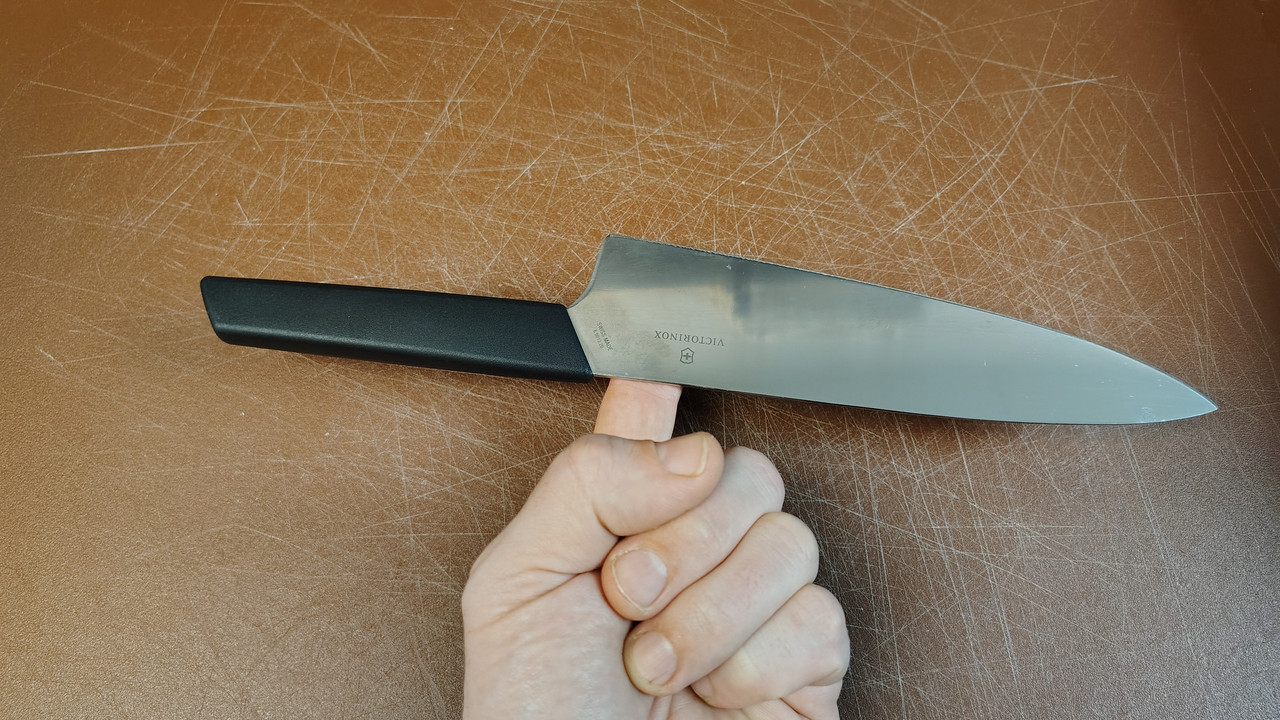
Same. Just a bit in front of the handle for a neutral balance in my most used grips.Pengubandit wrote: ↑Sun Mar 08, 2026 10:59 amWhere do you generally like the weight balance to be on a kitchen knife?
Personally, I like it at the pinch grip center.
-
FirstPenguin
- Member
- Posts: 9
- Joined: Tue Feb 20, 2024 2:22 pm
Re: 6" Mule discussion.
I really like many of the latest comments regarding a Mule kitchen knife, and the concept art is really cool! I often look for thin edges, comfortable pinch grips, flatter profiles, and a forward/middle balance in kitchen knives and I'm seeing a lot of advocacy for that here. A few thoughts:
- Could we just engrave/etch a Spydiehole on instead of milling it?
- It may be worth considering not using a full flat grind. Instead, more of a high scandi grind for the kitchen knife would make it easier for a (determined/masochistic) home user to thin the bevels to get into that 0.010-0.005" BTE range. This would also help with food release.
- No bolster/sharp heel is a definite win for a kitchen knife
- I'm on the fence about the thumb ramp. I think it's worth trying, but will probably need to be more subtle to accommodate grips more commonly used in the kitchen.
-
ChrisinHove
- Member
- Posts: 4424
- Joined: Tue Dec 17, 2013 7:12 am
- Location: 27.2046° N, 77.4977° E
Re: 6" Mule discussion.
Food release is an interesting one. What is the consensus on achieving the best without frou-frou scallops or dimples? In my very limited experience of a small range of knives, the high bevel has worked best.
For a thin edge why not consider a single bevel? Would that also reduce manufacturing cost?
A straight spine for scraping chopping boards would be useful.
For a thin edge why not consider a single bevel? Would that also reduce manufacturing cost?
A straight spine for scraping chopping boards would be useful.

Re: 6" Mule discussion.
Interesting discussion. Thanx for all of the input and pictures. SSSssooooo......Am I to guess that a "Kitchen Mule" would be preferred over a 6" fixed blade?
It would be an entirely new shape that you will have to be a part in creating. The Mule Team project was concocted at Spyderco and to my knowledge, no others are extending that effort. So we might be up for a "2" in this project?
"To boldly go where no man has gone before"
sal
It would be an entirely new shape that you will have to be a part in creating. The Mule Team project was concocted at Spyderco and to my knowledge, no others are extending that effort. So we might be up for a "2" in this project?
"To boldly go where no man has gone before"
sal
Re: 6" Mule discussion.
This might be interesting. Kitchen use comes with different geometry and different requirements, so different steels will perform better. I'd be definitely in
-
Pengubandit
- Member
- Posts: 30
- Joined: Tue Feb 24, 2026 11:26 pm
- Location: Connecticut
Re: 6" Mule discussion.
I'm mostly with you on all points though if theres no spydiehole, then just dont put one in, no need to laser one on. Personally I dont think a little hole will cause any problems at all. My main reasons in my mind to keep those features is to make it feel or at least resemble the mule team (even if its just a passing resemblance)FirstPenguin wrote: ↑Mon Mar 09, 2026 1:28 pmI really like many of the latest comments regarding a Mule kitchen knife, and the concept art is really cool! I often look for thin edges, comfortable pinch grips, flatter profiles, and a forward/middle balance in kitchen knives and I'm seeing a lot of advocacy for that here. A few thoughts:Nice work, everyone!
- Could we just engrave/etch a Spydiehole on instead of milling it?
- It may be worth considering not using a full flat grind. Instead, more of a high scandi grind for the kitchen knife would make it easier for a (determined/masochistic) home user to thin the bevels to get into that 0.010-0.005" BTE range. This would also help with food release.
- No bolster/sharp heel is a definite win for a kitchen knife
- I'm on the fence about the thumb ramp. I think it's worth trying, but will probably need to be more subtle to accommodate grips more commonly used in the kitchen.
My guess right now is that the handle needs to tilt back even more to be more in line with the spine contour
I think a partial grind up to maybe the 50-60% of the blade height would make a lot more sense if it was a lot thinner stock to start with. I made a little guy using an old dollar atore german style/hollow scandi style "chefs" knife and could only manage to grind the primary up to about 60% without making it feel like a flimsy piece of sheet metal (though to be fair the stock thickness was 0.0558") I am not suggesting we go that thin, anything under 0.070" would probably be too far
We also have to consider the thickness of the tang which if it has to be a certain minimum. Ive seen no isses with tangs in the 0.090" range.
Ive been sketching a few more ideas. Here's my most recent drawing with a standard MT superimposed.
I smoothed out the thumb ramp a little and kept the standard MT layout but tilted and elongated the handle slightly relative to the blade to minimize any negative thumb ramp effects. I'll make a quick plywood/cardboard mockup later today and update on how it feels in hand.
My guess is that I need to tilt the handle back even more to get it more in line with the spine contour
- Attachments
-
- Standard MT vs 8" Kitchen MT concept. Pencil = MT, Blue = Kitchen MT
Current favorite Spydies: Drunken, Spydiechef, Sage5 LW Rex121, Manix 2 LW 15V BBB
Favorite materials. Steel: Maxamet, Rex121, 15V, S90V, Magnacut. Scales: Carbon Fiber, Titanium, Micarta, G10, FRN.
Favorite materials. Steel: Maxamet, Rex121, 15V, S90V, Magnacut. Scales: Carbon Fiber, Titanium, Micarta, G10, FRN.
-
Pengubandit
- Member
- Posts: 30
- Joined: Tue Feb 24, 2026 11:26 pm
- Location: Connecticut
Re: 6" Mule discussion.
Scratch that last sketch. Handle felt awful. Definitely needed more tilt. This feels a lot nicer, i barely notice the thumb ramp unless i actually need to use it. Still 8" blade & just under 13" OA length
- Attachments
-
- Cardboard KM
Current favorite Spydies: Drunken, Spydiechef, Sage5 LW Rex121, Manix 2 LW 15V BBB
Favorite materials. Steel: Maxamet, Rex121, 15V, S90V, Magnacut. Scales: Carbon Fiber, Titanium, Micarta, G10, FRN.
Favorite materials. Steel: Maxamet, Rex121, 15V, S90V, Magnacut. Scales: Carbon Fiber, Titanium, Micarta, G10, FRN.
-
N. Brian Huegel
- Member
- Posts: 370
- Joined: Fri Sep 24, 2004 10:33 am
- Location: Country Knives - Intercourse, PA USA
- Contact:
Re: 6" Mule discussion.
Giving the blade a SpydieHole could be incorporated into the design as the balance point and as the place for thumb and forefinger to "pinch grip" for best control and lightness in hand.
Regarding blade design, I have been using the heck out of my Carter Bunka Bocho (https://spyderco.com/products/the-murra ... unka-bocho) lately. It seems to be a hybrid design that incorporates the rocking ability of a chef’s knife with an edge that is a continuous (lively) arc, a blade that is wide enough for scooping, more acute point (ship’s keel design?) than a Santoku for improved trimming, boning, and cutting between (under hand) gripping fingers when mincing garlic cloves and shallots. As with most of Murray’s kitchen knives, they are ground super thin for minimal resistance which has a secondary advantage of easier sharpening as the cutting edge with is very narrow.
nb
Regarding blade design, I have been using the heck out of my Carter Bunka Bocho (https://spyderco.com/products/the-murra ... unka-bocho) lately. It seems to be a hybrid design that incorporates the rocking ability of a chef’s knife with an edge that is a continuous (lively) arc, a blade that is wide enough for scooping, more acute point (ship’s keel design?) than a Santoku for improved trimming, boning, and cutting between (under hand) gripping fingers when mincing garlic cloves and shallots. As with most of Murray’s kitchen knives, they are ground super thin for minimal resistance which has a secondary advantage of easier sharpening as the cutting edge with is very narrow.
nb
-
FirstPenguin
- Member
- Posts: 9
- Joined: Tue Feb 20, 2024 2:22 pm
Re: 6" Mule discussion.
Hi Sal, I think that there's clearly a broad interest in a "Kitchen Mule," though I also think that a 6" utility Mule would also be well received. Both of them would likely be successful, but it does seem like there's some more community momentum around the kitchen version. If you have to choose only one then it might be prudent to go with the flow and see what we can come up with.
While consensus in any knife community can be elusive, certain approaches like convex grinds, S- or C-grinds, or even using multiple bevels to approximate convexity have shown to be more effective for food release. Scallops or other cut outs only really work if they are truly massive. A high, thin, scandi grind (say, reaching ~1.5mm thick at ~18mm above the edge) would be a good starting place. With a spine 2mm thick this geometry would cut quite well. If we'd like to use a thicker stock, like 3mm, then another, shallower, bevel could be made above the primary bevel to reduce wedging. Depending on the manufacturing method this could either be easy to do or add considerable complexity.ChrisinHove wrote: ↑Mon Mar 09, 2026 2:15 pmFood release is an interesting one. What is the consensus on achieving the best without frou-frou scallops or dimples? In my very limited experience of a small range of knives, the high bevel has worked best.
I really like the handle angle and thumb ramp on your drawing! Focusing on just the grip, I think that this is workable, but the area between the heel and the bottom of the grip needs some fine tuning. In that configuration the shape would cause the hand to want to seat further back while in a pinch grip. If we can get the handle to flow into the blade in a way that seats the forward-most finger (middle in pinch, index in hammer grip) almost directly above the heel then that would provide the most stability and reduce hand stress. Reversing the curve above the heel and then moving the handle further in towards the blade, effectively creating a little carve-out above the heel, could accomplish this.Pengubandit wrote: ↑Tue Mar 10, 2026 8:22 amScratch that last sketch. Handle felt awful. Definitely needed more tilt. This feels a lot nicer, i barely notice the thumb ramp unless i actually need to use it. Still 8" blade & just under 13" OA length
If you'll forgive a bit of crude MS Paint editing, it might look more like the attached image.
- Attachments
-
Re: 6" Mule discussion.
For me, 3mm stock and any degree of thumb ramp would be a deal breaker on a kitchen Mule. I've used enough kitchen knives featuring either of those to recognize their drawbacks for the type of work they are intended for.
Putting a hotspot right where most of the pressure is applied would be, no offense intended, an awful design choice.
If it's going to be a kitchen mule, it should truly be a kitchen mule. 3mm stock works better on utility knives than chef knives. I've compared multiple 3mm 8-10" chef knives to 2mm in the same size range and I found zero benefits to the thicker stock.
Those asking for 3mm stock, what do you hope to gain by going with that VS 2mm stock?
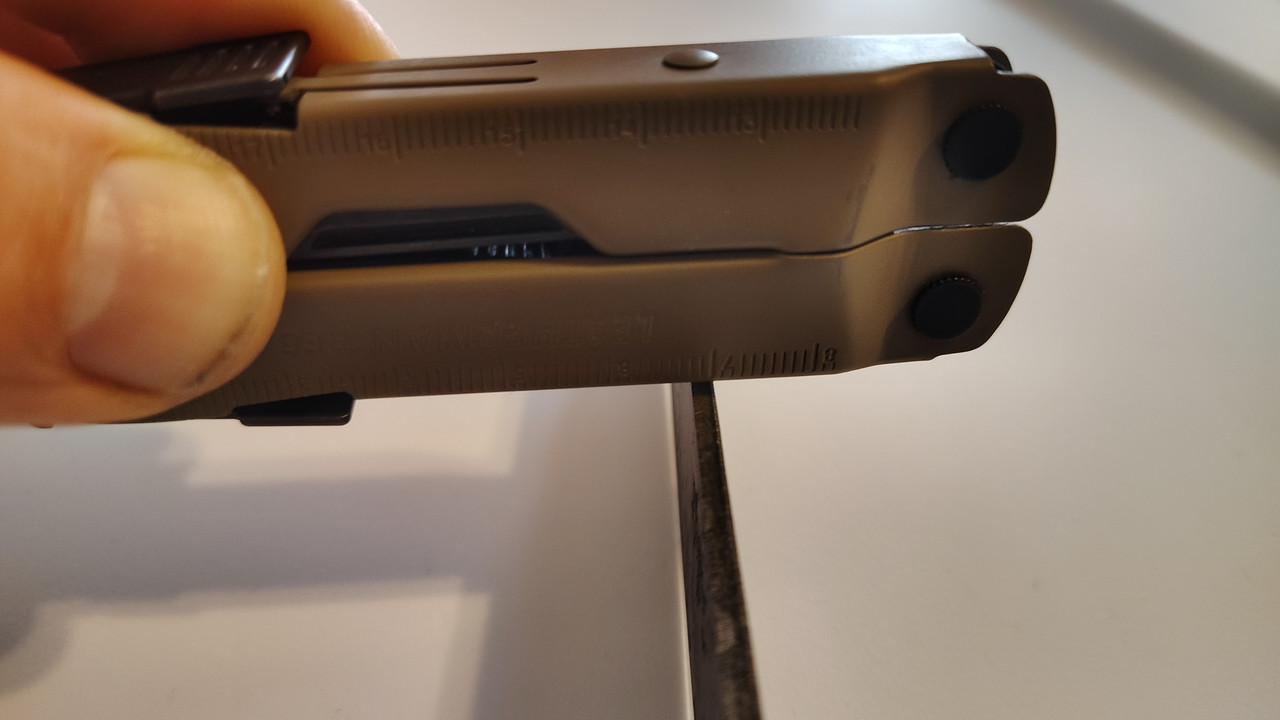
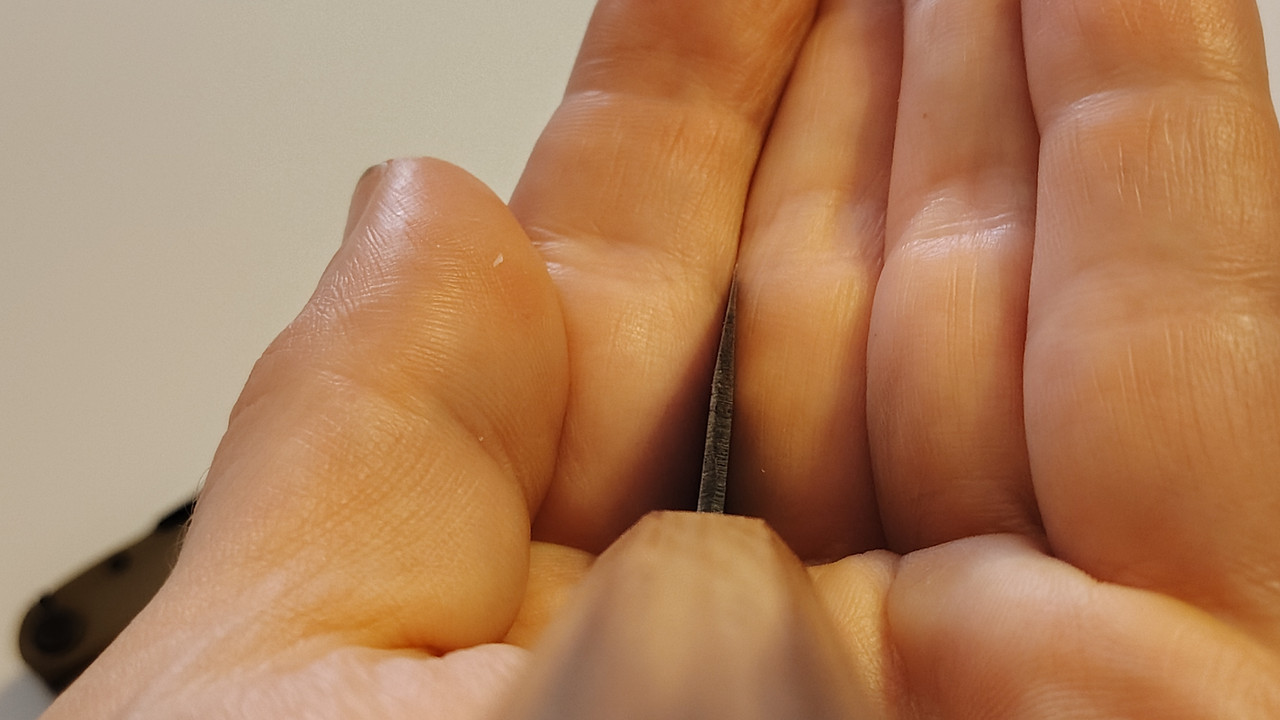
Here's a 3mm thick chef knife VS a 1mm thick one. Cold Steel Commercial Series VS Kiwi 21:
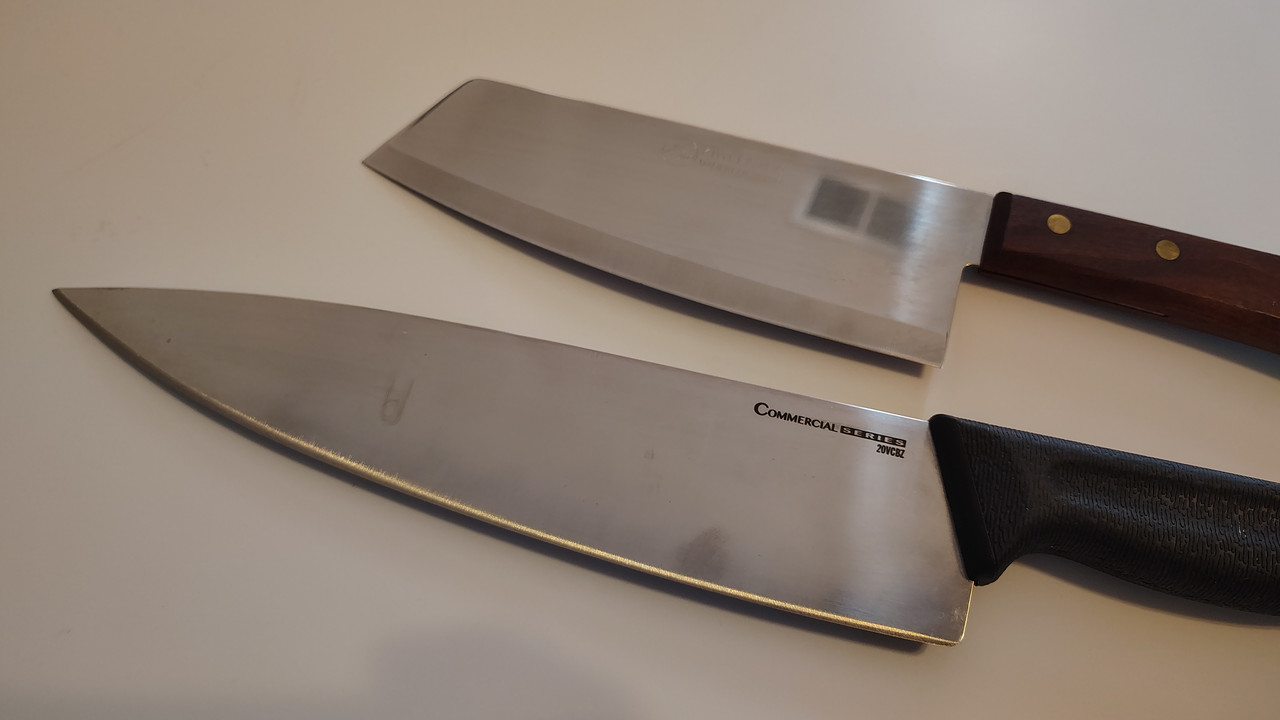
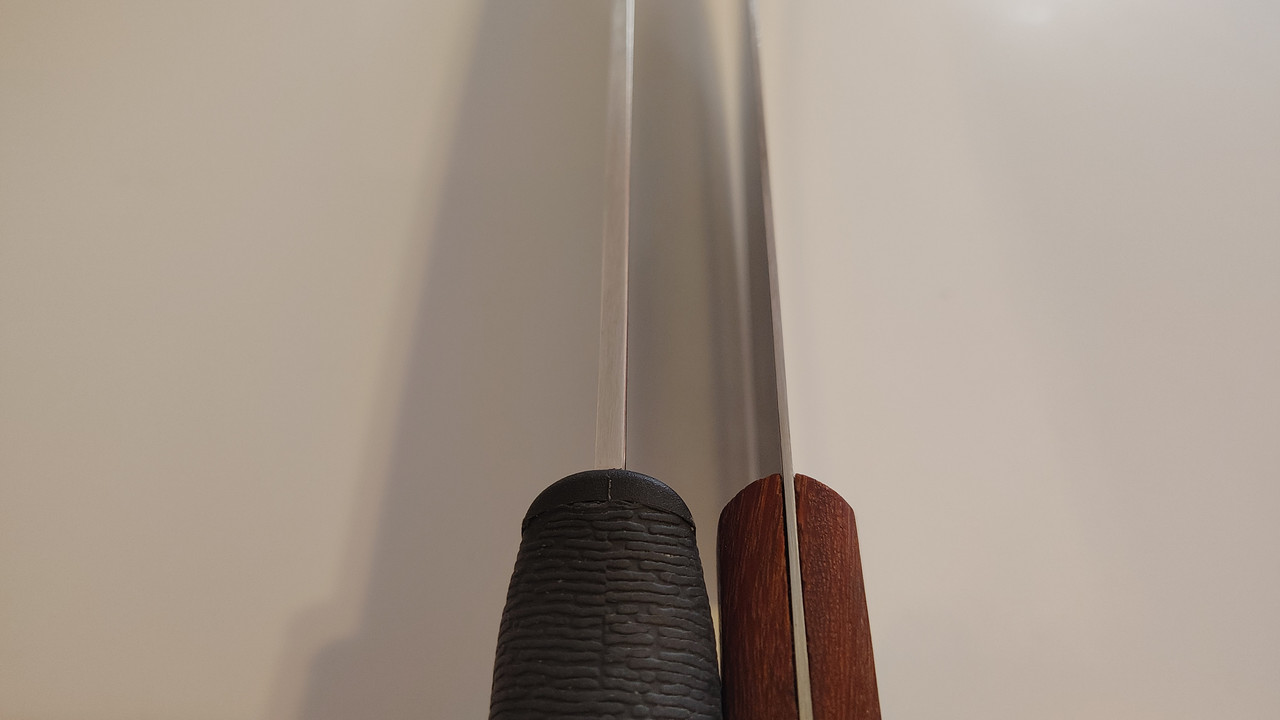
I've put in over 10,000 hours of cutting with the Kiwi and I can tell you first hand, off the top of my head I can't think of anything the Cold Steel can do in the kitchen the Kiwi cannot.
Scallops never made a difference in my experience when it comes to food release, and would only add to the costs.
I'm not overly concerned with food release. For home use the quantities of food being cut are so small it's a non issue IMO. For professional use, well, there's techniques you can use like slightly tilting the knife away from what you're slicing, etc. I wouldn't worry about it if I were designing the Mule.
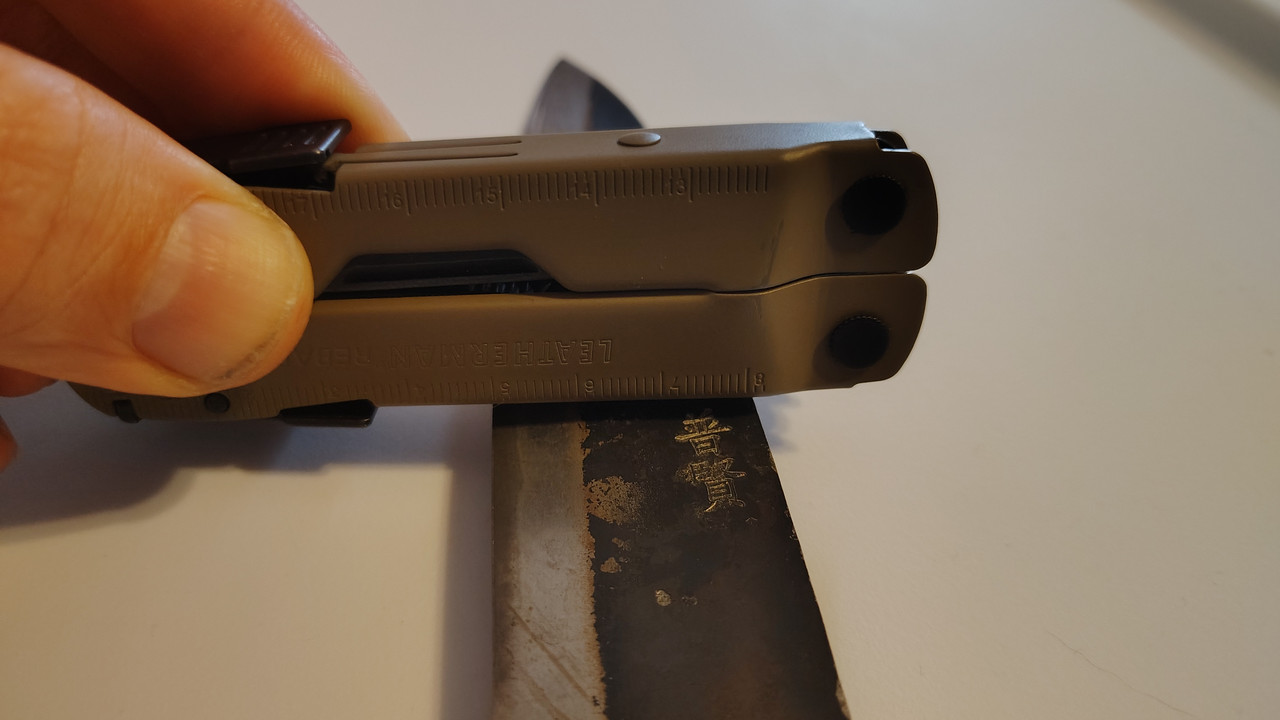
That said a scandi style grind does help there. This petty does better than FFG chef knives and santokus when it comes to food release. The rougher finish near the spine also helps - higher polish finishes stick worse.
Putting a hotspot right where most of the pressure is applied would be, no offense intended, an awful design choice.
If it's going to be a kitchen mule, it should truly be a kitchen mule. 3mm stock works better on utility knives than chef knives. I've compared multiple 3mm 8-10" chef knives to 2mm in the same size range and I found zero benefits to the thicker stock.
Those asking for 3mm stock, what do you hope to gain by going with that VS 2mm stock?
Here's a 3mm thick chef knife VS a 1mm thick one. Cold Steel Commercial Series VS Kiwi 21:
I've put in over 10,000 hours of cutting with the Kiwi and I can tell you first hand, off the top of my head I can't think of anything the Cold Steel can do in the kitchen the Kiwi cannot.
Scallops never made a difference in my experience when it comes to food release, and would only add to the costs.
I'm not overly concerned with food release. For home use the quantities of food being cut are so small it's a non issue IMO. For professional use, well, there's techniques you can use like slightly tilting the knife away from what you're slicing, etc. I wouldn't worry about it if I were designing the Mule.
That said a scandi style grind does help there. This petty does better than FFG chef knives and santokus when it comes to food release. The rougher finish near the spine also helps - higher polish finishes stick worse.