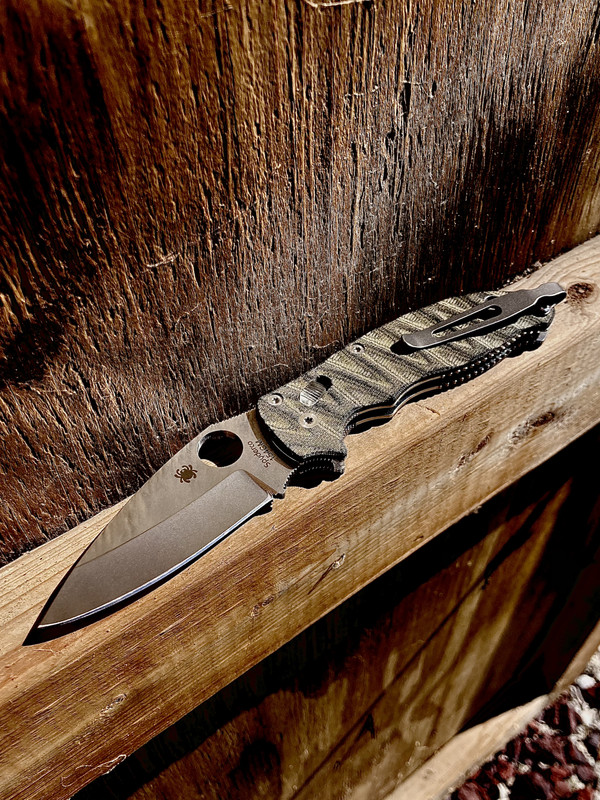
That would definitely make a great companion to the 4V hollow ground Manix I've got, basically the stainless and non stainless versions both on the same platform and geometry. I'd absolutely love that. It'd be really cool to see a modern clear polymer cage as well(even just translucent, I believe FRCP was actually developed to be translucent, wonder if something similar could be done now for the cage now with new advancements in technology). Honestly, I'd love a G10 Magnacut hollow ground Manix
Hollow ground Manix appreciation, and an introductory post.
- Skylark427
- Member
- Posts: 118
- Joined: Sun Apr 13, 2025 5:59 am
- Location: Chicago
Re: Hollow ground Manix appreciation, and an introductory post.
●Manix 2 G10: •15V, •S110V, •CPM-154/S90V Peel-Ply carbon fiber, •4V hollow ground marbled carbon fiber (Fradon Lock Manix), •2010 S30V hollow ground clear cage, •CPM-M4 jade G10
●Manix 2 LW: •15V, •S110V, •Magnacut
●Manix 2 XL: •4V
●Shaman: •15V, •10V
●Military 2: •15V
●Mule Team: ▪︎MagnaMax •15V
Current most pocket time: Manix G10 15V, MagnaMax Mule
Re: Hollow ground Manix appreciation, and an introductory post.
Since you are obviously truly interested in steels and testing their performance:Skylark427 wrote: ↑Sun Nov 16, 2025 6:45 pm...
I'm also actually looking into an H1 Pacific Salt, or the original one with the "volcano grip" so these comments actually help me a bit on getting that. I've always found H1 fascinating as it's an austenitic stainless that's been cold formed to be work hardened...
I think if you get an H1/H2 Pac Salt you should go with the serrated one, or even better with SE and PE so you can compare.
I don't know if you are familiar with the claims or actually Sals own words that serrated H1 has the best edge retention of any steel Spyderco has tested due to some special work hardening that is going on when grinding the serrations. While this is not or by far not to that degree the case with plain edge H1 (never owned H1/H2 in PE, but they say edge retention there is really nothing to write home about).
I love my old Pac Salt 1 SE in H1... great performance especially in rougher tasks and prooves that linerless FRN when done well is really more than strong enough for any, even "hard" folder task - my Pac Salt has gone through a lot already (don't have it with me right now, so here is an old pic when it still was rather new).
Some who actually put their thumb on the ramp when working also prefer the old Endura-shape of the Pac Salt 1 handle over the new Endura 4 shape (I personally rarely ever use the ramp but put my thumb on the flat of the blade which lets my hand sit further forward. In that grip the Endura 4 shape is better for me, but the Pac Salt 1 handle still more than fine too).
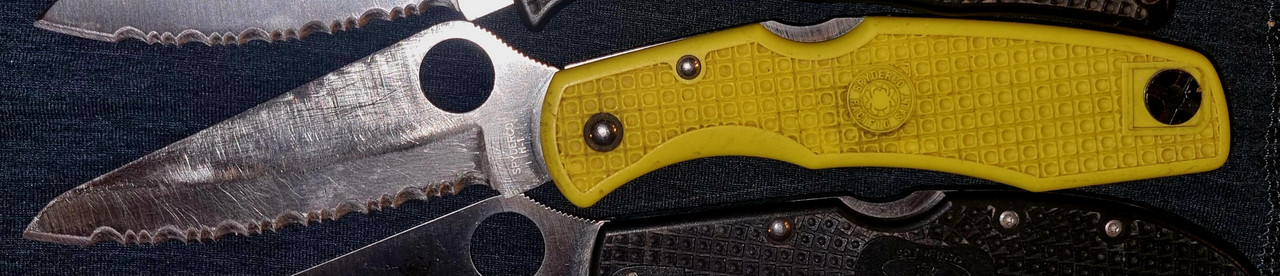
Top three going by pocket-time (update October 25):
- EDC: Endela SE (K390). Endela SE (VG10), Manix 2 LW (REX45)
- Mountains/outdoors: Pac.Salt 2 SE (LC200N), Salt 2 SE (LC200N), Pac.Salt 1 SE (H1)
- EDC: Endela SE (K390). Endela SE (VG10), Manix 2 LW (REX45)
- Mountains/outdoors: Pac.Salt 2 SE (LC200N), Salt 2 SE (LC200N), Pac.Salt 1 SE (H1)
Re: Hollow ground Manix appreciation, and an introductory post.
I would be interested in a magnacut g10 hollow ground manix! Sign me up!
-Ryan
MNOSD member #00053
MNOSD member #00053
- Manixguy@1994
- Member
- Posts: 17820
- Joined: Fri Jun 10, 2016 12:12 pm
- Location: Central Illinois
- Contact:
Re: Hollow ground Manix appreciation, and an introductory post.
I definitely would love to see another hollow grind , only have one . MG2MNOSD 0002 / Do more than is required of you . Patton
Nothing makes earth so spacious as to have friends at a distance; they make the latitudes and longitudes.
Henry David Thoreau
Nothing makes earth so spacious as to have friends at a distance; they make the latitudes and longitudes.
Henry David Thoreau
- 8th_Note
- Member
- Posts: 548
- Joined: Mon Dec 16, 2024 7:56 am
- Location: Southern Appalachian Foothills
Re: Hollow ground Manix appreciation, and an introductory post.
deleted. wrong thread
S30V; S35VN; VG-10; BD1N; H1; SuperBlue/SUS410; 8Cr13MoV; Micro-Melt PD#1; REX-45; Cruwear; BD1; K390; Magnacut; HAP40/SUS410; 20CV; 15V; M4; SPY27; LC200N; S90V
Re: Hollow ground Manix appreciation, and an introductory post.
No offense and certainly none to Sal but I think until this is backed up by even a little bit of data I think we should stop repeating it. We run the risk of people making buying decisions based on that and then being surprised when it performs like (surprise) the high toughness/low wear resistant steel that it is.
- Skylark427
- Member
- Posts: 118
- Joined: Sun Apr 13, 2025 5:59 am
- Location: Chicago
Re: Hollow ground Manix appreciation, and an introductory post.
Hey, thank you for the recommendation! I actually did plan to get one of both SpydieEdge and plain edge.Wartstein wrote: ↑Mon Nov 17, 2025 12:54 amSince you are obviously truly interested in steels and testing their performance:Skylark427 wrote: ↑Sun Nov 16, 2025 6:45 pm...
I'm also actually looking into an H1 Pacific Salt, or the original one with the "volcano grip" so these comments actually help me a bit on getting that. I've always found H1 fascinating as it's an austenitic stainless that's been cold formed to be work hardened...
I think if you get an H1/H2 Pac Salt you should go with the serrated one, or even better with SE and PE so you can compare.
I don't know if you are familiar with the claims or actually Sals own words that serrated H1 has the best edge retention of any steel Spyderco has tested due to some special work hardening that is going on when grinding the serrations. While this is not or by far not to that degree the case with plain edge H1 (never owned H1/H2 in PE, but they say edge retention there is really nothing to write home about).
I love my old Pac Salt 1 SE in H1... great performance especially in rougher tasks and prooves that linerless FRN when done well is really more than strong enough for any, even "hard" folder task - my Pac Salt has gone through a lot already (don't have it with me right now, so here is an old pic when it still was rather new).
Some who actually put their thumb on the ramp when working also prefer the old Endura-shape of the Pac Salt 1 handle over the new Endura 4 shape (I personally rarely ever use the ramp but put my thumb on the flat of the blade which lets my hand sit further forward. In that grip the Endura 4 shape is better for me, but the Pac Salt 1 handle still more than fine too).
![]()
On the H1 and the mysterious properties surrounding it, I actually had a talk with a friend about it a few days ago. What Sal was basically saying was that, if you look at it as a percentage, that the serrated edge on H1 has a higher percentage increase vs its plain edge counterpart on CATRA testing compared to other steels. I've actually got the screenshot saved, it's comment #16 on this post: viewtopic.php?p=1829610&hilit=H1#p1829610
So he's basically saying, compared to a steel, let's pick K390. That plain edge K390 saw maybe a 4× increase on CATRA testing, and S30V maybe saw a 3.5× increase, 10V maybe saw around a 4× increase as well (this is all hypothetical, I don't know the actual percentages) but when going from plain edge to serrated on H1, that percentage was increased to something like 7× or 8× better. Thus, overall it has the highest percentage increase going from plain edge to serrated.
I don't really want to ruin any of the mystery of the steel, I know it very coveted around here, I've actually got a materials science degree in metallurgy, and another specialized degree for forming, bonding, and working these alloys and numerous others, so I'm actually really familiar with work hardening, austenitic stainless, dual phase stainless, martensitic alloys and nickel based alloys(I'm no Larrin, but I'm very familiar with metals, I've been working with them since I was still in high school, half my life ago now nearly). I'm actually really familiar with how work hardening works, I'll agree there's definitely something special about H1. But I'm not going to be the one explaining the technicalities on the microhardness testing that Crucible did in the early 2000s compared to Sandvik's more recent study of it.
What I WILL say, is H1 being an austenitic stainless that's work hardened to become a knife steel fascinates me, the higher percentage of performance gained, is also very interesting. But I believe Sal explained it more in depth(with clarity) that it's not necessarily like it out performed K390/10V if both were equal geometry and Spydieedge on a CATRA tester. Regardless, austenitic stainless steels tend to have far better corrosion resistance than martensitic grades, and in general the fact Spyderco did what no company even attempted is amazing(should edit that I was referring to long term, as mentioned by James, Benchmade also used it briefly).
I'm definitely planning on getting one of each and seeing how I like each of them. I want to stick to the old school H1, just for the history and mysterious aspects of it. So at some point, I'll also be uploading those images as well of what I get
Last edited by Skylark427 on Mon Nov 17, 2025 12:24 pm, edited 2 times in total.
●Manix 2 G10: •15V, •S110V, •CPM-154/S90V Peel-Ply carbon fiber, •4V hollow ground marbled carbon fiber (Fradon Lock Manix), •2010 S30V hollow ground clear cage, •CPM-M4 jade G10
●Manix 2 LW: •15V, •S110V, •Magnacut
●Manix 2 XL: •4V
●Shaman: •15V, •10V
●Military 2: •15V
●Mule Team: ▪︎MagnaMax •15V
Current most pocket time: Manix G10 15V, MagnaMax Mule
- 8th_Note
- Member
- Posts: 548
- Joined: Mon Dec 16, 2024 7:56 am
- Location: Southern Appalachian Foothills
Re: Hollow ground Manix appreciation, and an introductory post.
Thank you for clarifying. That is very good info.Skylark427 wrote: ↑Mon Nov 17, 2025 10:48 amHey, thank you for the recommendation! I actually did plan to get one of both SpydieEdge and plain edge.Wartstein wrote: ↑Mon Nov 17, 2025 12:54 amSince you are obviously truly interested in steels and testing their performance:Skylark427 wrote: ↑Sun Nov 16, 2025 6:45 pm...
I'm also actually looking into an H1 Pacific Salt, or the original one with the "volcano grip" so these comments actually help me a bit on getting that. I've always found H1 fascinating as it's an austenitic stainless that's been cold formed to be work hardened...
I think if you get an H1/H2 Pac Salt you should go with the serrated one, or even better with SE and PE so you can compare.
I don't know if you are familiar with the claims or actually Sals own words that serrated H1 has the best edge retention of any steel Spyderco has tested due to some special work hardening that is going on when grinding the serrations. While this is not or by far not to that degree the case with plain edge H1 (never owned H1/H2 in PE, but they say edge retention there is really nothing to write home about).
I love my old Pac Salt 1 SE in H1... great performance especially in rougher tasks and prooves that linerless FRN when done well is really more than strong enough for any, even "hard" folder task - my Pac Salt has gone through a lot already (don't have it with me right now, so here is an old pic when it still was rather new).
Some who actually put their thumb on the ramp when working also prefer the old Endura-shape of the Pac Salt 1 handle over the new Endura 4 shape (I personally rarely ever use the ramp but put my thumb on the flat of the blade which lets my hand sit further forward. In that grip the Endura 4 shape is better for me, but the Pac Salt 1 handle still more than fine too).
![]()
On the H1 and the mysterious properties surrounding it, I actually had a talk with a friend about it a few days ago. What Sal was basically saying was that, if you look at it as a percentage, that the serrated edge on H1 has a higher percentage increase vs its plain edge counterpart on CATRA testing compared to other steels. I've actually got the screenshot saved, it's comment #16 on this post: viewtopic.php?p=1829610&hilit=H1#p1829610
Screenshot_20251009_112353_Chrome.jpg
So he's basically saying, compared to a steel, let's pick K390. That plain edge K390 saw maybe a 4× increase on CATRA testing, and S30V maybe saw a 3.5× increase, 10V maybe saw around a 4× increase as well (this is all hypothetical, I don't know the actual percentages) but when going from plain edge to serrated on H1, that percentage was increased to something like 7× or 8× better. Thus, overall it has the highest percentage increase going from plain edge to serrated.
I don't really want to ruin any of the mystery of the steel, I know it very coveted around here, I've actually got a materials science degree in metallurgy, and another specialized degree for forming, bonding, and working these alloys and numerous others, so I'm actually really familiar with work hardening, austenitic stainless, dual phase stainless, martensitic alloys and nickel based alloys(I'm no Larrin, but I'm very familiar with metals). I'm actually really familiar with how work hardening works, I'll agree there's definitely something special about H1. But I'm not going to be the one explaining the technicalities on the microhardness testing that Crucible did in the early 2000s compared to Sandvik's more recent study of it.
What I WILL say, is H1 being an austenitic stainless that's work hardened to become a knife steel fascinates me, the higher percentage of performance gained, is also very interesting. But I believe Sal explained it more in depth(with clarity) that it's not necessarily like it out performed K390/10V if both were equal geometry and Spydieedge on a CATRA tester. Regardless, austenitic stainless steels tend to have far better corrosion resistance than martensitic grades, and in general the fact Spyderco did what no company even attempted is amazing.
I'm definitely planning on getting one of each and seeing how I like each of them. I want to stick to the old school H1, just for the history and mysterious aspects of it. So at some point, I'll also be uploading those images as well of what I get![]()
Are there any knife makers, besides Spyderco, that use H1 in knife blades? And what are the other, more typical, uses for H1 steel?
S30V; S35VN; VG-10; BD1N; H1; SuperBlue/SUS410; 8Cr13MoV; Micro-Melt PD#1; REX-45; Cruwear; BD1; K390; Magnacut; HAP40/SUS410; 20CV; 15V; M4; SPY27; LC200N; S90V
Re: Hollow ground Manix appreciation, and an introductory post.
8th_Note wrote: ↑Mon Nov 17, 2025 10:55 amThank you for clarifying. That is very good info.Skylark427 wrote: ↑Mon Nov 17, 2025 10:48 amHey, thank you for the recommendation! I actually did plan to get one of both SpydieEdge and plain edge.Wartstein wrote: ↑Mon Nov 17, 2025 12:54 amSince you are obviously truly interested in steels and testing their performance:Skylark427 wrote: ↑Sun Nov 16, 2025 6:45 pm...
I'm also actually looking into an H1 Pacific Salt, or the original one with the "volcano grip" so these comments actually help me a bit on getting that. I've always found H1 fascinating as it's an austenitic stainless that's been cold formed to be work hardened...
I think if you get an H1/H2 Pac Salt you should go with the serrated one, or even better with SE and PE so you can compare.
I don't know if you are familiar with the claims or actually Sals own words that serrated H1 has the best edge retention of any steel Spyderco has tested due to some special work hardening that is going on when grinding the serrations. While this is not or by far not to that degree the case with plain edge H1 (never owned H1/H2 in PE, but they say edge retention there is really nothing to write home about).
I love my old Pac Salt 1 SE in H1... great performance especially in rougher tasks and prooves that linerless FRN when done well is really more than strong enough for any, even "hard" folder task - my Pac Salt has gone through a lot already (don't have it with me right now, so here is an old pic when it still was rather new).
Some who actually put their thumb on the ramp when working also prefer the old Endura-shape of the Pac Salt 1 handle over the new Endura 4 shape (I personally rarely ever use the ramp but put my thumb on the flat of the blade which lets my hand sit further forward. In that grip the Endura 4 shape is better for me, but the Pac Salt 1 handle still more than fine too).
![]()
On the H1 and the mysterious properties surrounding it, I actually had a talk with a friend about it a few days ago. What Sal was basically saying was that, if you look at it as a percentage, that the serrated edge on H1 has a higher percentage increase vs its plain edge counterpart on CATRA testing compared to other steels. I've actually got the screenshot saved, it's comment #16 on this post: viewtopic.php?p=1829610&hilit=H1#p1829610
Screenshot_20251009_112353_Chrome.jpg
So he's basically saying, compared to a steel, let's pick K390. That plain edge K390 saw maybe a 4× increase on CATRA testing, and S30V maybe saw a 3.5× increase, 10V maybe saw around a 4× increase as well (this is all hypothetical, I don't know the actual percentages) but when going from plain edge to serrated on H1, that percentage was increased to something like 7× or 8× better. Thus, overall it has the highest percentage increase going from plain edge to serrated.
I don't really want to ruin any of the mystery of the steel, I know it very coveted around here, I've actually got a materials science degree in metallurgy, and another specialized degree for forming, bonding, and working these alloys and numerous others, so I'm actually really familiar with work hardening, austenitic stainless, dual phase stainless, martensitic alloys and nickel based alloys(I'm no Larrin, but I'm very familiar with metals). I'm actually really familiar with how work hardening works, I'll agree there's definitely something special about H1. But I'm not going to be the one explaining the technicalities on the microhardness testing that Crucible did in the early 2000s compared to Sandvik's more recent study of it.
What I WILL say, is H1 being an austenitic stainless that's work hardened to become a knife steel fascinates me, the higher percentage of performance gained, is also very interesting. But I believe Sal explained it more in depth(with clarity) that it's not necessarily like it out performed K390/10V if both were equal geometry and Spydieedge on a CATRA tester. Regardless, austenitic stainless steels tend to have far better corrosion resistance than martensitic grades, and in general the fact Spyderco did what no company even attempted is amazing.
I'm definitely planning on getting one of each and seeing how I like each of them. I want to stick to the old school H1, just for the history and mysterious aspects of it. So at some point, I'll also be uploading those images as well of what I get![]()
Are there any knife makers, besides Spyderco, that use H1 in knife blades? And what are the other, more typical, uses for H1 steel?
I know that back in the early 2000s(?), Benchmade made a fixed blade river/dive knife with H1 blade steel, but they soon abandoned H1 for another steel. This might have been before Spyderco began using H1. If you Google it now, the AI response is that no, Benchmade never used H1, but they did, albeit very briefly, as I recall.
Jim
-
barnaclesonaboat
- Member
- Posts: 283
- Joined: Thu May 04, 2023 1:00 pm
Re: Hollow ground Manix appreciation, and an introductory post.
Cool discussion and I am really appreciating the Spyderco (and other) history lessons - thanks! I've used quite a few cheaper (Kershaw) pocketknives with hollow grinds over the years and enjoyed them, but my only recent reunion with Spyderco products the last few years had me miss the higher availability of these hollow grinds from years ago. I really dig the Manix platform and could easily see how a hollow or high-hollow would be so excellent in that pattern. I'm aiming to pick up a 15V Yojimbo or Yojumbo in the coming releases to try out a hollow-ground Spydie, but would be interested in seeing more Manix sprints or other hollow grinds cropping up.
- Skylark427
- Member
- Posts: 118
- Joined: Sun Apr 13, 2025 5:59 am
- Location: Chicago
Re: Hollow ground Manix appreciation, and an introductory post.
As @James Y said, I also remember hearing of Benchmade using H1 steel. I don't recall if it was prior to Spyderco, or after though. It was incredibly limited and if you search arround on the older knife forums you can still find references of it, but it's buried in articles upon articles. I don't unfortunately have the link I read about it, but I do recall it, sane as James.8th_Note wrote: ↑Mon Nov 17, 2025 10:55 amThank you for clarifying. That is very good info.Skylark427 wrote: ↑Mon Nov 17, 2025 10:48 amHey, thank you for the recommendation! I actually did plan to get one of both SpydieEdge and plain edge.Wartstein wrote: ↑Mon Nov 17, 2025 12:54 amSince you are obviously truly interested in steels and testing their performance:Skylark427 wrote: ↑Sun Nov 16, 2025 6:45 pm...
I'm also actually looking into an H1 Pacific Salt, or the original one with the "volcano grip" so these comments actually help me a bit on getting that. I've always found H1 fascinating as it's an austenitic stainless that's been cold formed to be work hardened...
I think if you get an H1/H2 Pac Salt you should go with the serrated one, or even better with SE and PE so you can compare.
I don't know if you are familiar with the claims or actually Sals own words that serrated H1 has the best edge retention of any steel Spyderco has tested due to some special work hardening that is going on when grinding the serrations. While this is not or by far not to that degree the case with plain edge H1 (never owned H1/H2 in PE, but they say edge retention there is really nothing to write home about).
I love my old Pac Salt 1 SE in H1... great performance especially in rougher tasks and prooves that linerless FRN when done well is really more than strong enough for any, even "hard" folder task - my Pac Salt has gone through a lot already (don't have it with me right now, so here is an old pic when it still was rather new).
Some who actually put their thumb on the ramp when working also prefer the old Endura-shape of the Pac Salt 1 handle over the new Endura 4 shape (I personally rarely ever use the ramp but put my thumb on the flat of the blade which lets my hand sit further forward. In that grip the Endura 4 shape is better for me, but the Pac Salt 1 handle still more than fine too).
![]()
On the H1 and the mysterious properties surrounding it, I actually had a talk with a friend about it a few days ago. What Sal was basically saying was that, if you look at it as a percentage, that the serrated edge on H1 has a higher percentage increase vs its plain edge counterpart on CATRA testing compared to other steels. I've actually got the screenshot saved, it's comment #16 on this post: viewtopic.php?p=1829610&hilit=H1#p1829610
Screenshot_20251009_112353_Chrome.jpg
So he's basically saying, compared to a steel, let's pick K390. That plain edge K390 saw maybe a 4× increase on CATRA testing, and S30V maybe saw a 3.5× increase, 10V maybe saw around a 4× increase as well (this is all hypothetical, I don't know the actual percentages) but when going from plain edge to serrated on H1, that percentage was increased to something like 7× or 8× better. Thus, overall it has the highest percentage increase going from plain edge to serrated.
I don't really want to ruin any of the mystery of the steel, I know it very coveted around here, I've actually got a materials science degree in metallurgy, and another specialized degree for forming, bonding, and working these alloys and numerous others, so I'm actually really familiar with work hardening, austenitic stainless, dual phase stainless, martensitic alloys and nickel based alloys(I'm no Larrin, but I'm very familiar with metals). I'm actually really familiar with how work hardening works, I'll agree there's definitely something special about H1. But I'm not going to be the one explaining the technicalities on the microhardness testing that Crucible did in the early 2000s compared to Sandvik's more recent study of it.
What I WILL say, is H1 being an austenitic stainless that's work hardened to become a knife steel fascinates me, the higher percentage of performance gained, is also very interesting. But I believe Sal explained it more in depth(with clarity) that it's not necessarily like it out performed K390/10V if both were equal geometry and Spydieedge on a CATRA tester. Regardless, austenitic stainless steels tend to have far better corrosion resistance than martensitic grades, and in general the fact Spyderco did what no company even attempted is amazing.
I'm definitely planning on getting one of each and seeing how I like each of them. I want to stick to the old school H1, just for the history and mysterious aspects of it. So at some point, I'll also be uploading those images as well of what I get![]()
Are there any knife makers, besides Spyderco, that use H1 in knife blades? And what are the other, more typical, uses for H1 steel?
Actually, Larrin's article mentions Benchmade using it before Spyderco:
https://knifesteelnerds.com/2019/06/24/ ... -it-works/
The typical uses for H1, or in general an austenitic stainless steel, is that they typically have much better corrosion resistance than their martensitic counterparts. This comes with the drawbacks that they can only be hardened through work hardening, which is cold deformation. For the H1/2 blades Spyderco uses, I believe they start out at 7mm thick, and are rolled to between 3mm and 2mm to increase the hardness of the steel. This takes a good amount of pressure, as I maxed out the tonage on my work's 150 ton press trying to compress a 1/4"×2"×8" long piece of 316 stainless steel (a very corrosion resistant grade of stainless, more so than H1 and 2). So your basically getting the corrosion resistance of an austenitic stainless, in the form of a very tough alloy. There are no carbides to my knowledge, just a partial phase transformation to martensite (enough to make it magnetic I've read). So it's really unique in the knife steel world in general. If you like absolutely zero maintenance, a Spyderco H1/2 knife is basically rust proof under normal situations. It's also much more tough than comparable martensitic grades, at the cost of attainable hardness.
So, it's just really interesting to me to be honest
●Manix 2 G10: •15V, •S110V, •CPM-154/S90V Peel-Ply carbon fiber, •4V hollow ground marbled carbon fiber (Fradon Lock Manix), •2010 S30V hollow ground clear cage, •CPM-M4 jade G10
●Manix 2 LW: •15V, •S110V, •Magnacut
●Manix 2 XL: •4V
●Shaman: •15V, •10V
●Military 2: •15V
●Mule Team: ▪︎MagnaMax •15V
Current most pocket time: Manix G10 15V, MagnaMax Mule
- Skylark427
- Member
- Posts: 118
- Joined: Sun Apr 13, 2025 5:59 am
- Location: Chicago
Re: Hollow ground Manix appreciation, and an introductory post.
I would honestly really love it to be put back into rotation in some way on the Manix, and even the Native models (I'm not as familiar with the Native, did they only do saber grinds?). Regardless, it'd be really cool to see something like a 15V Manix G10 in a hollow grind. That would be awesome, as would Magnacut, or really anything. Just to have a new option again, I think it would be really cool. I wish I got into Spyderco's earlier to have gotten them as they were first released. They'd unfortunately be gone due to the robbery that happened, but it still would've been nice to use them when they weren't quite as rare. Regardless, I'm very grateful for the two I have. The Fradon Lock one is just something special, abd the original S30V one with the clear cage made in 2010, that's just really cool to have. I've only got a few knives older than that since the robbery.barnaclesonaboat wrote: ↑Mon Nov 17, 2025 11:36 amCool discussion and I am really appreciating the Spyderco (and other) history lessons - thanks! I've used quite a few cheaper (Kershaw) pocketknives with hollow grinds over the years and enjoyed them, but my only recent reunion with Spyderco products the last few years had me miss the higher availability of these hollow grinds from years ago. I really dig the Manix platform and could easily see how a hollow or high-hollow would be so excellent in that pattern. I'm aiming to pick up a 15V Yojimbo or Yojumbo in the coming releases to try out a hollow-ground Spydie, but would be interested in seeing more Manix sprints or other hollow grinds cropping up.
Hopefully though I'll at least be getting some H1 models soon though
●Manix 2 G10: •15V, •S110V, •CPM-154/S90V Peel-Ply carbon fiber, •4V hollow ground marbled carbon fiber (Fradon Lock Manix), •2010 S30V hollow ground clear cage, •CPM-M4 jade G10
●Manix 2 LW: •15V, •S110V, •Magnacut
●Manix 2 XL: •4V
●Shaman: •15V, •10V
●Military 2: •15V
●Mule Team: ▪︎MagnaMax •15V
Current most pocket time: Manix G10 15V, MagnaMax Mule
-
Red Leader
- Member
- Posts: 739
- Joined: Thu Oct 17, 2024 9:35 am
Re: Hollow ground Manix appreciation, and an introductory post.
This was my takeaway as well. I started a thread a while back asking for specific numbers from CATRA for the cut test on H1/H2 serrated, since in a thread even previous to that, I had asked about that specific claim (the one about H1/H2 being the longest lasting edge they had ever tested) and when I had asked how they made that determination, Sal had responded simply, 'CATRA'. But the numbers were not released. Based on another interesting article Larrin had posted a while back about the overall merits with serrated edges and measuring edge retention, I had tried to pin down what the numbers actually were.Skylark427 wrote: ↑Mon Nov 17, 2025 10:48 amHey, thank you for the recommendation! I actually did plan to get one of both SpydieEdge and plain edge.Wartstein wrote: ↑Mon Nov 17, 2025 12:54 amSince you are obviously truly interested in steels and testing their performance:Skylark427 wrote: ↑Sun Nov 16, 2025 6:45 pm...
I'm also actually looking into an H1 Pacific Salt, or the original one with the "volcano grip" so these comments actually help me a bit on getting that. I've always found H1 fascinating as it's an austenitic stainless that's been cold formed to be work hardened...
I think if you get an H1/H2 Pac Salt you should go with the serrated one, or even better with SE and PE so you can compare.
I don't know if you are familiar with the claims or actually Sals own words that serrated H1 has the best edge retention of any steel Spyderco has tested due to some special work hardening that is going on when grinding the serrations. While this is not or by far not to that degree the case with plain edge H1 (never owned H1/H2 in PE, but they say edge retention there is really nothing to write home about).
I love my old Pac Salt 1 SE in H1... great performance especially in rougher tasks and prooves that linerless FRN when done well is really more than strong enough for any, even "hard" folder task - my Pac Salt has gone through a lot already (don't have it with me right now, so here is an old pic when it still was rather new).
Some who actually put their thumb on the ramp when working also prefer the old Endura-shape of the Pac Salt 1 handle over the new Endura 4 shape (I personally rarely ever use the ramp but put my thumb on the flat of the blade which lets my hand sit further forward. In that grip the Endura 4 shape is better for me, but the Pac Salt 1 handle still more than fine too).
![]()
On the H1 and the mysterious properties surrounding it, I actually had a talk with a friend about it a few days ago. What Sal was basically saying was that, if you look at it as a percentage, that the serrated edge on H1 has a higher percentage increase vs its plain edge counterpart on CATRA testing compared to other steels. I've actually got the screenshot saved, it's comment #16 on this post: viewtopic.php?p=1829610&hilit=H1#p1829610
Screenshot_20251009_112353_Chrome.jpg
So he's basically saying, compared to a steel, let's pick K390. That plain edge K390 saw maybe a 4× increase on CATRA testing, and S30V maybe saw a 3.5× increase, 10V maybe saw around a 4× increase as well (this is all hypothetical, I don't know the actual percentages) but when going from plain edge to serrated on H1, that percentage was increased to something like 7× or 8× better. Thus, overall it has the highest percentage increase going from plain edge to serrated.
I don't really want to ruin any of the mystery of the steel, I know it very coveted around here, I've actually got a materials science degree in metallurgy, and another specialized degree for forming, bonding, and working these alloys and numerous others, so I'm actually really familiar with work hardening, austenitic stainless, dual phase stainless, martensitic alloys and nickel based alloys(I'm no Larrin, but I'm very familiar with metals, I've been working with them since I was still in high school, half my life ago now nearly). I'm actually really familiar with how work hardening works, I'll agree there's definitely something special about H1. But I'm not going to be the one explaining the technicalities on the microhardness testing that Crucible did in the early 2000s compared to Sandvik's more recent study of it.
What I WILL say, is H1 being an austenitic stainless that's work hardened to become a knife steel fascinates me, the higher percentage of performance gained, is also very interesting. But I believe Sal explained it more in depth(with clarity) that it's not necessarily like it out performed K390/10V if both were equal geometry and Spydieedge on a CATRA tester. Regardless, austenitic stainless steels tend to have far better corrosion resistance than martensitic grades, and in general the fact Spyderco did what no company even attempted is amazing(should edit that I was referring to long term, as mentioned by James, Benchmade also used it briefly).
I'm definitely planning on getting one of each and seeing how I like each of them. I want to stick to the old school H1, just for the history and mysterious aspects of it. So at some point, I'll also be uploading those images as well of what I get![]()
I didn't end up getting any CATRA numbers (which I would still like to see) on H1/H2, but he did mention that the increase in edge retention from plain edge to serrated was a greater difference (4x) than is usually seen from most steels when comparing edge retention from plain edge to serrated (2x). At this point, the lore of SE H1/H2 lives on, but seeing discussions that happened over a decade ago on this same topic also show this is nothing new. Until we get hard data or independent testing, we'll likely never know, and I've come back down to earth about it all now. Also, perhaps that claim was first made when there was no Rex-121, or Maxamet, or 15V in knives.
I have very little doubt that a serrated Magnamax edge will blow away a serrated H2, all other things being identical.
Re: Hollow ground Manix appreciation, and an introductory post.
Skylark427 wrote: ↑Mon Nov 17, 2025 11:55 amAs @James Y said, I also remember hearing of Benchmade using H1 steel. I don't recall if it was prior to Spyderco, or after though. It was incredibly limited and if you search arround on the older knife forums you can still find references of it, but it's buried in articles upon articles. I don't unfortunately have the link I read about it, but I do recall it, sane as James.8th_Note wrote: ↑Mon Nov 17, 2025 10:55 amThank you for clarifying. That is very good info.Skylark427 wrote: ↑Mon Nov 17, 2025 10:48 amHey, thank you for the recommendation! I actually did plan to get one of both SpydieEdge and plain edge.Wartstein wrote: ↑Mon Nov 17, 2025 12:54 am
Since you are obviously truly interested in steels and testing their performance:
I think if you get an H1/H2 Pac Salt you should go with the serrated one, or even better with SE and PE so you can compare.
I don't know if you are familiar with the claims or actually Sals own words that serrated H1 has the best edge retention of any steel Spyderco has tested due to some special work hardening that is going on when grinding the serrations. While this is not or by far not to that degree the case with plain edge H1 (never owned H1/H2 in PE, but they say edge retention there is really nothing to write home about).
I love my old Pac Salt 1 SE in H1... great performance especially in rougher tasks and prooves that linerless FRN when done well is really more than strong enough for any, even "hard" folder task - my Pac Salt has gone through a lot already (don't have it with me right now, so here is an old pic when it still was rather new).
Some who actually put their thumb on the ramp when working also prefer the old Endura-shape of the Pac Salt 1 handle over the new Endura 4 shape (I personally rarely ever use the ramp but put my thumb on the flat of the blade which lets my hand sit further forward. In that grip the Endura 4 shape is better for me, but the Pac Salt 1 handle still more than fine too).
![]()
On the H1 and the mysterious properties surrounding it, I actually had a talk with a friend about it a few days ago. What Sal was basically saying was that, if you look at it as a percentage, that the serrated edge on H1 has a higher percentage increase vs its plain edge counterpart on CATRA testing compared to other steels. I've actually got the screenshot saved, it's comment #16 on this post: viewtopic.php?p=1829610&hilit=H1#p1829610
Screenshot_20251009_112353_Chrome.jpg
So he's basically saying, compared to a steel, let's pick K390. That plain edge K390 saw maybe a 4× increase on CATRA testing, and S30V maybe saw a 3.5× increase, 10V maybe saw around a 4× increase as well (this is all hypothetical, I don't know the actual percentages) but when going from plain edge to serrated on H1, that percentage was increased to something like 7× or 8× better. Thus, overall it has the highest percentage increase going from plain edge to serrated.
I don't really want to ruin any of the mystery of the steel, I know it very coveted around here, I've actually got a materials science degree in metallurgy, and another specialized degree for forming, bonding, and working these alloys and numerous others, so I'm actually really familiar with work hardening, austenitic stainless, dual phase stainless, martensitic alloys and nickel based alloys(I'm no Larrin, but I'm very familiar with metals). I'm actually really familiar with how work hardening works, I'll agree there's definitely something special about H1. But I'm not going to be the one explaining the technicalities on the microhardness testing that Crucible did in the early 2000s compared to Sandvik's more recent study of it.
What I WILL say, is H1 being an austenitic stainless that's work hardened to become a knife steel fascinates me, the higher percentage of performance gained, is also very interesting. But I believe Sal explained it more in depth(with clarity) that it's not necessarily like it out performed K390/10V if both were equal geometry and Spydieedge on a CATRA tester. Regardless, austenitic stainless steels tend to have far better corrosion resistance than martensitic grades, and in general the fact Spyderco did what no company even attempted is amazing.
I'm definitely planning on getting one of each and seeing how I like each of them. I want to stick to the old school H1, just for the history and mysterious aspects of it. So at some point, I'll also be uploading those images as well of what I get![]()
Are there any knife makers, besides Spyderco, that use H1 in knife blades? And what are the other, more typical, uses for H1 steel?
Actually, Larrin's article mentions Benchmade using it before Spyderco:
https://knifesteelnerds.com/2019/06/24/ ... -it-works/
The typical uses for H1, or in general an austenitic stainless steel, is that they typically have much better corrosion resistance than their martensitic counterparts. This comes with the drawbacks that they can only be hardened through work hardening, which is cold deformation. For the H1/2 blades Spyderco uses, I believe they start out at 7mm thick, and are rolled to between 3mm and 2mm to increase the hardness of the steel. This takes a good amount of pressure, as I maxed out the tonage on my work's 150 ton press trying to compress a 1/4"×2"×8" long piece of 316 stainless steel (a very corrosion resistant grade of stainless, more so than H1 and 2). So your basically getting the corrosion resistance of an austenitic stainless, in the form of a very tough alloy. There are no carbides to my knowledge, just a partial phase transformation to martensite (enough to make it magnetic I've read). So it's really unique in the knife steel world in general. If you like absolutely zero maintenance, a Spyderco H1/2 knife is basically rust proof under normal situations. It's also much more tough than comparable martensitic grades, at the cost of attainable hardness.
Sorry for going off-topic from the hollow-ground Manix 2. Oh, and welcome to the forum!
Jim
So, it's just really interesting to me to be honest![]()
Hi, Skylark.
I had seen the Benchmade H1 fixed blade in an ad in either Blade magazine, Knives Illustrated, or possibly Tactical Knives magazines (or in all of them?) way back. I also might have seen one in a B&M knife shop that has since closed down many years ago.
My experience with H1 serrated is that it's pretty amazing stuff. I use my old H1 Pac Salt as a gardening and other dirty-use knife. It holds up amazingly well.
Sorry for going off-topic from the Manix in this thread.
By the way, welcome to the forum!
Jim
- Skylark427
- Member
- Posts: 118
- Joined: Sun Apr 13, 2025 5:59 am
- Location: Chicago
Re: Hollow ground Manix appreciation, and an introductory post.
Unfortunately, I imagine the reason that the numbers weren't given to you were more for proprietary reasons than anything else. Yes, throughout the old article, it was clear there's a difference between percentage on the CATRA studys, but that was the big difference. Here's Larrin's take on it from way back whenRed Leader wrote: ↑Mon Nov 17, 2025 3:12 pmThis was my takeaway as well. I started a thread a while back asking for specific numbers from CATRA for the cut test on H1/H2 serrated, since in a thread even previous to that, I had asked about that specific claim (the one about H1/H2 being the longest lasting edge they had ever tested) and when I had asked how they made that determination, Sal had responded simply, 'CATRA'. But the numbers were not released. Based on another interesting article Larrin had posted a while back about the overall merits with serrated edges and measuring edge retention, I had tried to pin down what the numbers actually were.Skylark427 wrote: ↑Mon Nov 17, 2025 10:48 amHey, thank you for the recommendation! I actually did plan to get one of both SpydieEdge and plain edge.Wartstein wrote: ↑Mon Nov 17, 2025 12:54 amSince you are obviously truly interested in steels and testing their performance:Skylark427 wrote: ↑Sun Nov 16, 2025 6:45 pm...
I'm also actually looking into an H1 Pacific Salt, or the original one with the "volcano grip" so these comments actually help me a bit on getting that. I've always found H1 fascinating as it's an austenitic stainless that's been cold formed to be work hardened...
I think if you get an H1/H2 Pac Salt you should go with the serrated one, or even better with SE and PE so you can compare.
I don't know if you are familiar with the claims or actually Sals own words that serrated H1 has the best edge retention of any steel Spyderco has tested due to some special work hardening that is going on when grinding the serrations. While this is not or by far not to that degree the case with plain edge H1 (never owned H1/H2 in PE, but they say edge retention there is really nothing to write home about).
I love my old Pac Salt 1 SE in H1... great performance especially in rougher tasks and prooves that linerless FRN when done well is really more than strong enough for any, even "hard" folder task - my Pac Salt has gone through a lot already (don't have it with me right now, so here is an old pic when it still was rather new).
Some who actually put their thumb on the ramp when working also prefer the old Endura-shape of the Pac Salt 1 handle over the new Endura 4 shape (I personally rarely ever use the ramp but put my thumb on the flat of the blade which lets my hand sit further forward. In that grip the Endura 4 shape is better for me, but the Pac Salt 1 handle still more than fine too).
![]()
On the H1 and the mysterious properties surrounding it, I actually had a talk with a friend about it a few days ago. What Sal was basically saying was that, if you look at it as a percentage, that the serrated edge on H1 has a higher percentage increase vs its plain edge counterpart on CATRA testing compared to other steels. I've actually got the screenshot saved, it's comment #16 on this post: viewtopic.php?p=1829610&hilit=H1#p1829610
Screenshot_20251009_112353_Chrome.jpg
So he's basically saying, compared to a steel, let's pick K390. That plain edge K390 saw maybe a 4× increase on CATRA testing, and S30V maybe saw a 3.5× increase, 10V maybe saw around a 4× increase as well (this is all hypothetical, I don't know the actual percentages) but when going from plain edge to serrated on H1, that percentage was increased to something like 7× or 8× better. Thus, overall it has the highest percentage increase going from plain edge to serrated.
I don't really want to ruin any of the mystery of the steel, I know it very coveted around here, I've actually got a materials science degree in metallurgy, and another specialized degree for forming, bonding, and working these alloys and numerous others, so I'm actually really familiar with work hardening, austenitic stainless, dual phase stainless, martensitic alloys and nickel based alloys(I'm no Larrin, but I'm very familiar with metals, I've been working with them since I was still in high school, half my life ago now nearly). I'm actually really familiar with how work hardening works, I'll agree there's definitely something special about H1. But I'm not going to be the one explaining the technicalities on the microhardness testing that Crucible did in the early 2000s compared to Sandvik's more recent study of it.
What I WILL say, is H1 being an austenitic stainless that's work hardened to become a knife steel fascinates me, the higher percentage of performance gained, is also very interesting. But I believe Sal explained it more in depth(with clarity) that it's not necessarily like it out performed K390/10V if both were equal geometry and Spydieedge on a CATRA tester. Regardless, austenitic stainless steels tend to have far better corrosion resistance than martensitic grades, and in general the fact Spyderco did what no company even attempted is amazing(should edit that I was referring to long term, as mentioned by James, Benchmade also used it briefly).
I'm definitely planning on getting one of each and seeing how I like each of them. I want to stick to the old school H1, just for the history and mysterious aspects of it. So at some point, I'll also be uploading those images as well of what I get![]()
I didn't end up getting any CATRA numbers (which I would still like to see) on H1/H2, but he did mention that the increase in edge retention from plain edge to serrated was a greater difference (4x) than is usually seen from most steels when comparing edge retention from plain edge to serrated (2x). At this point, the lore of SE H1/H2 lives on, but seeing discussions that happened over a decade ago on this same topic also show this is nothing new. Until we get hard data or independent testing, we'll likely never know, and I've come back down to earth about it all now. Also, perhaps that claim was first made when there was no Rex-121, or Maxamet, or 15V in knives.
I have very little doubt that a serrated Magnamax edge will blow away a serrated H2, all other things being identical.
From: viewtopic.php?t=92676&hilit=H1&start=20
The interesting part is that he mentioned that a VG-10 serrated blade hardly dulled at all during the extended CATRA test used for plain edges. Which is actually really interesting in and of itself because regular CATRA testing is basically doing the majority of the test in extreme states of dullness for the knife, as the abrasive in the cardstock is harder than cementite, making it harder than the vast majority of full martensite. It goes to show how much the saw-like teeth actually improve cutting ability, which makes sense, considering bi-metal bandsaws and circular saws will cut steel an extremely long time at sharpness levels not extremely high, it's the shape in combination with the speed which allows it to cut through metal more than anything, even a mild steel saw blade will cut mild steel for a long time, surprisingly long in fact.
On the rest of it, I'm not overly wanting to bring up old arguments, nor really take away the "mystery" of it for everyone. Regardless, it's still a pretty cool knife steel. I can attest that just heat treating a piece of steel is much easier that compressing it with enough tonnage to work harden it. So it's, regardless of everything surrounding it, still a very interesting steel. I would say you're correct on steels like 15V, Maxamet, Rex 121, and MagnaMax exceeding it performance wise serrated all else equal(this is pretty much uncontested at this point).
Regardless, wear resistance isn't the huge reason I want it, more how unique the steel itself actually is.
@James Y Thank you for that bit of information, seeing from Larrin's article the year Benchmade would've used it, sense it predated Spyderco's use of it, I would've been incredibly young and not have seen it anywhere.
I am definitely looking forward to trying it in both configurations, it just really interests me in general. Thank you for sharing your experiences on it, hopefully I will have some soon!
And thank you for the welcome, that's appreciated as well
●Manix 2 G10: •15V, •S110V, •CPM-154/S90V Peel-Ply carbon fiber, •4V hollow ground marbled carbon fiber (Fradon Lock Manix), •2010 S30V hollow ground clear cage, •CPM-M4 jade G10
●Manix 2 LW: •15V, •S110V, •Magnacut
●Manix 2 XL: •4V
●Shaman: •15V, •10V
●Military 2: •15V
●Mule Team: ▪︎MagnaMax •15V
Current most pocket time: Manix G10 15V, MagnaMax Mule
-
Red Leader
- Member
- Posts: 739
- Joined: Thu Oct 17, 2024 9:35 am
Re: Hollow ground Manix appreciation, and an introductory post.
Yeah, thanks for indulging me and sorry for going so far off tangent. A hearty welcome, and thanks for your contributions to the 'knife steel afi' realm of the community. It is a pretty small corner, but very passionate, usually knowledgeable, and extremely nerdySkylark427 wrote: ↑Mon Nov 17, 2025 7:14 pmUnfortunately, I imagine the reason that the numbers weren't given to you were more for proprietary reasons than anything else. Yes, throughout the old article, it was clear there's a difference between percentage on the CATRA studys, but that was the big difference. Here's Larrin's take on it from way back whenRed Leader wrote: ↑Mon Nov 17, 2025 3:12 pmThis was my takeaway as well. I started a thread a while back asking for specific numbers from CATRA for the cut test on H1/H2 serrated, since in a thread even previous to that, I had asked about that specific claim (the one about H1/H2 being the longest lasting edge they had ever tested) and when I had asked how they made that determination, Sal had responded simply, 'CATRA'. But the numbers were not released. Based on another interesting article Larrin had posted a while back about the overall merits with serrated edges and measuring edge retention, I had tried to pin down what the numbers actually were.Skylark427 wrote: ↑Mon Nov 17, 2025 10:48 amHey, thank you for the recommendation! I actually did plan to get one of both SpydieEdge and plain edge.Wartstein wrote: ↑Mon Nov 17, 2025 12:54 am
Since you are obviously truly interested in steels and testing their performance:
I think if you get an H1/H2 Pac Salt you should go with the serrated one, or even better with SE and PE so you can compare.
I don't know if you are familiar with the claims or actually Sals own words that serrated H1 has the best edge retention of any steel Spyderco has tested due to some special work hardening that is going on when grinding the serrations. While this is not or by far not to that degree the case with plain edge H1 (never owned H1/H2 in PE, but they say edge retention there is really nothing to write home about).
I love my old Pac Salt 1 SE in H1... great performance especially in rougher tasks and prooves that linerless FRN when done well is really more than strong enough for any, even "hard" folder task - my Pac Salt has gone through a lot already (don't have it with me right now, so here is an old pic when it still was rather new).
Some who actually put their thumb on the ramp when working also prefer the old Endura-shape of the Pac Salt 1 handle over the new Endura 4 shape (I personally rarely ever use the ramp but put my thumb on the flat of the blade which lets my hand sit further forward. In that grip the Endura 4 shape is better for me, but the Pac Salt 1 handle still more than fine too).
![]()
On the H1 and the mysterious properties surrounding it, I actually had a talk with a friend about it a few days ago. What Sal was basically saying was that, if you look at it as a percentage, that the serrated edge on H1 has a higher percentage increase vs its plain edge counterpart on CATRA testing compared to other steels. I've actually got the screenshot saved, it's comment #16 on this post: viewtopic.php?p=1829610&hilit=H1#p1829610
Screenshot_20251009_112353_Chrome.jpg
So he's basically saying, compared to a steel, let's pick K390. That plain edge K390 saw maybe a 4× increase on CATRA testing, and S30V maybe saw a 3.5× increase, 10V maybe saw around a 4× increase as well (this is all hypothetical, I don't know the actual percentages) but when going from plain edge to serrated on H1, that percentage was increased to something like 7× or 8× better. Thus, overall it has the highest percentage increase going from plain edge to serrated.
I don't really want to ruin any of the mystery of the steel, I know it very coveted around here, I've actually got a materials science degree in metallurgy, and another specialized degree for forming, bonding, and working these alloys and numerous others, so I'm actually really familiar with work hardening, austenitic stainless, dual phase stainless, martensitic alloys and nickel based alloys(I'm no Larrin, but I'm very familiar with metals, I've been working with them since I was still in high school, half my life ago now nearly). I'm actually really familiar with how work hardening works, I'll agree there's definitely something special about H1. But I'm not going to be the one explaining the technicalities on the microhardness testing that Crucible did in the early 2000s compared to Sandvik's more recent study of it.
What I WILL say, is H1 being an austenitic stainless that's work hardened to become a knife steel fascinates me, the higher percentage of performance gained, is also very interesting. But I believe Sal explained it more in depth(with clarity) that it's not necessarily like it out performed K390/10V if both were equal geometry and Spydieedge on a CATRA tester. Regardless, austenitic stainless steels tend to have far better corrosion resistance than martensitic grades, and in general the fact Spyderco did what no company even attempted is amazing(should edit that I was referring to long term, as mentioned by James, Benchmade also used it briefly).
I'm definitely planning on getting one of each and seeing how I like each of them. I want to stick to the old school H1, just for the history and mysterious aspects of it. So at some point, I'll also be uploading those images as well of what I get![]()
I didn't end up getting any CATRA numbers (which I would still like to see) on H1/H2, but he did mention that the increase in edge retention from plain edge to serrated was a greater difference (4x) than is usually seen from most steels when comparing edge retention from plain edge to serrated (2x). At this point, the lore of SE H1/H2 lives on, but seeing discussions that happened over a decade ago on this same topic also show this is nothing new. Until we get hard data or independent testing, we'll likely never know, and I've come back down to earth about it all now. Also, perhaps that claim was first made when there was no Rex-121, or Maxamet, or 15V in knives.
I have very little doubt that a serrated Magnamax edge will blow away a serrated H2, all other things being identical.
Screenshot_20251009_112148_Chrome.jpg
Screenshot_20251117_195638_Chrome.jpg
From: viewtopic.php?t=92676&hilit=H1&start=20
The interesting part is that he mentioned that a VG-10 serrated blade hardly dulled at all during the extended CATRA test used for plain edges. Which is actually really interesting in and of itself because regular CATRA testing is basically doing the majority of the test in extreme states of dullness for the knife, as the abrasive in the cardstock is harder than cementite, making it harder than the vast majority of full martensite. It goes to show how much the saw-like teeth actually improve cutting ability, which makes sense, considering bi-metal bandsaws and circular saws will cut steel an extremely long time at sharpness levels not extremely high, it's the shape in combination with the speed which allows it to cut through metal more than anything, even a mild steel saw blade will cut mild steel for a long time, surprisingly long in fact.
On the rest of it, I'm not overly wanting to bring up old arguments, nor really take away the "mystery" of it for everyone. Regardless, it's still a pretty cool knife steel. I can attest that just heat treating a piece of steel is much easier that compressing it with enough tonnage to work harden it. So it's, regardless of everything surrounding it, still a very interesting steel. I would say you're correct on steels like 15V, Maxamet, Rex 121, and MagnaMax exceeding it performance wise serrated all else equal(this is pretty much uncontested at this point).
Regardless, wear resistance isn't the huge reason I want it, more how unique the steel itself actually is.
@James Y Thank you for that bit of information, seeing from Larrin's article the year Benchmade would've used it, sense it predated Spyderco's use of it, I would've been incredibly young and not have seen it anywhere.
I am definitely looking forward to trying it in both configurations, it just really interests me in general. Thank you for sharing your experiences on it, hopefully I will have some soon!
And thank you for the welcome, that's appreciated as well![]()
Re: Hollow ground Manix appreciation, and an introductory post.
No offense taken, I do fully get what you are saying and could have been more clear in my post:zhyla wrote: ↑Mon Nov 17, 2025 10:23 amNo offense and certainly none to Sal but I think until this is backed up by even a little bit of data I think we should stop repeating it. We run the risk of people making buying decisions based on that and then being surprised when it performs like (surprise) the high toughness/low wear resistant steel that it is.
What I actually meant is that since Skylark obviously is very much into testing and comparing steels:
By getting both a PE and SE H1/H2 blade, he could compare for himself how much truth or not is in the claims/the "myth" about the super enhanced edge retention of H1/H2 with teeth.
What I can say from my own totally unscientific experience:
It seems my serrated H1 Pac Salt holds an edge longer than my serrated VG10, LC200N and even XHP Spydies.
But my serrated K390 Endela easily outperforms the Pac Salt concerning edge holding.
Again, this is just a "gut feeling", never even tried to set up some kind of a comparison test and a large part could be due to factors other than the actual steels (geometry, grind angle, hollow grind vs ffg, different main use cases and so on...)
Top three going by pocket-time (update October 25):
- EDC: Endela SE (K390). Endela SE (VG10), Manix 2 LW (REX45)
- Mountains/outdoors: Pac.Salt 2 SE (LC200N), Salt 2 SE (LC200N), Pac.Salt 1 SE (H1)
- EDC: Endela SE (K390). Endela SE (VG10), Manix 2 LW (REX45)
- Mountains/outdoors: Pac.Salt 2 SE (LC200N), Salt 2 SE (LC200N), Pac.Salt 1 SE (H1)
- Skylark427
- Member
- Posts: 118
- Joined: Sun Apr 13, 2025 5:59 am
- Location: Chicago
Re: Hollow ground Manix appreciation, and an introductory post.
All good, the tanget didn't really bother me. I just don't want to speak ill of a steel that do many people find interesting, including myself. Regardless of the "lore" behind it, it's still a really cool steel for a knife blade in concept. Thank you for the welcomeRed Leader wrote: ↑Mon Nov 17, 2025 8:26 pmYeah, thanks for indulging me and sorry for going so far off tangent. A hearty welcome, and thanks for your contributions to the 'knife steel afi' realm of the community. It is a pretty small corner, but very passionate, usually knowledgeable, and extremely nerdySkylark427 wrote: ↑Mon Nov 17, 2025 7:14 pmUnfortunately, I imagine the reason that the numbers weren't given to you were more for proprietary reasons than anything else. Yes, throughout the old article, it was clear there's a difference between percentage on the CATRA studys, but that was the big difference. Here's Larrin's take on it from way back whenRed Leader wrote: ↑Mon Nov 17, 2025 3:12 pmThis was my takeaway as well. I started a thread a while back asking for specific numbers from CATRA for the cut test on H1/H2 serrated, since in a thread even previous to that, I had asked about that specific claim (the one about H1/H2 being the longest lasting edge they had ever tested) and when I had asked how they made that determination, Sal had responded simply, 'CATRA'. But the numbers were not released. Based on another interesting article Larrin had posted a while back about the overall merits with serrated edges and measuring edge retention, I had tried to pin down what the numbers actually were.Skylark427 wrote: ↑Mon Nov 17, 2025 10:48 am
Hey, thank you for the recommendation! I actually did plan to get one of both SpydieEdge and plain edge.
On the H1 and the mysterious properties surrounding it, I actually had a talk with a friend about it a few days ago. What Sal was basically saying was that, if you look at it as a percentage, that the serrated edge on H1 has a higher percentage increase vs its plain edge counterpart on CATRA testing compared to other steels. I've actually got the screenshot saved, it's comment #16 on this post: viewtopic.php?p=1829610&hilit=H1#p1829610
Screenshot_20251009_112353_Chrome.jpg
So he's basically saying, compared to a steel, let's pick K390. That plain edge K390 saw maybe a 4× increase on CATRA testing, and S30V maybe saw a 3.5× increase, 10V maybe saw around a 4× increase as well (this is all hypothetical, I don't know the actual percentages) but when going from plain edge to serrated on H1, that percentage was increased to something like 7× or 8× better. Thus, overall it has the highest percentage increase going from plain edge to serrated.
I don't really want to ruin any of the mystery of the steel, I know it very coveted around here, I've actually got a materials science degree in metallurgy, and another specialized degree for forming, bonding, and working these alloys and numerous others, so I'm actually really familiar with work hardening, austenitic stainless, dual phase stainless, martensitic alloys and nickel based alloys(I'm no Larrin, but I'm very familiar with metals, I've been working with them since I was still in high school, half my life ago now nearly). I'm actually really familiar with how work hardening works, I'll agree there's definitely something special about H1. But I'm not going to be the one explaining the technicalities on the microhardness testing that Crucible did in the early 2000s compared to Sandvik's more recent study of it.
What I WILL say, is H1 being an austenitic stainless that's work hardened to become a knife steel fascinates me, the higher percentage of performance gained, is also very interesting. But I believe Sal explained it more in depth(with clarity) that it's not necessarily like it out performed K390/10V if both were equal geometry and Spydieedge on a CATRA tester. Regardless, austenitic stainless steels tend to have far better corrosion resistance than martensitic grades, and in general the fact Spyderco did what no company even attempted is amazing(should edit that I was referring to long term, as mentioned by James, Benchmade also used it briefly).
I'm definitely planning on getting one of each and seeing how I like each of them. I want to stick to the old school H1, just for the history and mysterious aspects of it. So at some point, I'll also be uploading those images as well of what I get![]()
I didn't end up getting any CATRA numbers (which I would still like to see) on H1/H2, but he did mention that the increase in edge retention from plain edge to serrated was a greater difference (4x) than is usually seen from most steels when comparing edge retention from plain edge to serrated (2x). At this point, the lore of SE H1/H2 lives on, but seeing discussions that happened over a decade ago on this same topic also show this is nothing new. Until we get hard data or independent testing, we'll likely never know, and I've come back down to earth about it all now. Also, perhaps that claim was first made when there was no Rex-121, or Maxamet, or 15V in knives.
I have very little doubt that a serrated Magnamax edge will blow away a serrated H2, all other things being identical.
Screenshot_20251009_112148_Chrome.jpg
Screenshot_20251117_195638_Chrome.jpg
From: viewtopic.php?t=92676&hilit=H1&start=20
The interesting part is that he mentioned that a VG-10 serrated blade hardly dulled at all during the extended CATRA test used for plain edges. Which is actually really interesting in and of itself because regular CATRA testing is basically doing the majority of the test in extreme states of dullness for the knife, as the abrasive in the cardstock is harder than cementite, making it harder than the vast majority of full martensite. It goes to show how much the saw-like teeth actually improve cutting ability, which makes sense, considering bi-metal bandsaws and circular saws will cut steel an extremely long time at sharpness levels not extremely high, it's the shape in combination with the speed which allows it to cut through metal more than anything, even a mild steel saw blade will cut mild steel for a long time, surprisingly long in fact.
On the rest of it, I'm not overly wanting to bring up old arguments, nor really take away the "mystery" of it for everyone. Regardless, it's still a pretty cool knife steel. I can attest that just heat treating a piece of steel is much easier that compressing it with enough tonnage to work harden it. So it's, regardless of everything surrounding it, still a very interesting steel. I would say you're correct on steels like 15V, Maxamet, Rex 121, and MagnaMax exceeding it performance wise serrated all else equal(this is pretty much uncontested at this point).
Regardless, wear resistance isn't the huge reason I want it, more how unique the steel itself actually is.
@James Y Thank you for that bit of information, seeing from Larrin's article the year Benchmade would've used it, sense it predated Spyderco's use of it, I would've been incredibly young and not have seen it anywhere.
I am definitely looking forward to trying it in both configurations, it just really interests me in general. Thank you for sharing your experiences on it, hopefully I will have some soon!
And thank you for the welcome, that's appreciated as well![]()
![]()
@Wartstein
That's basically what I intended to do, sorry if it came off any different. The steel in general is really interesting to me, so naturally I would like to try it out in both ways
I do very much appreciate your experiences with it. I also really like the amazing photos you're able to capture. Wish I had anything around me half as interesting lol. I'll definitely be comparing both edges side by side, but I've been known to zero grind high toughness steels, so it might be a bit more even of a comparison, I've got a 420J knife at 54Rc I zero ground (3.5°~ inclusive) that's been going for almost 3 years now at work, with daily use on corrugated board. I'm pretty sure I can get H1 to outperform that, very, very poorly heat treated $6 knife.
I plan on doing lower angle tests for other steels again soon, for no other reason that it brings back memories with my wife. Hopefully someone will find my future results interesting, just need the material, and a BESS again
●Manix 2 G10: •15V, •S110V, •CPM-154/S90V Peel-Ply carbon fiber, •4V hollow ground marbled carbon fiber (Fradon Lock Manix), •2010 S30V hollow ground clear cage, •CPM-M4 jade G10
●Manix 2 LW: •15V, •S110V, •Magnacut
●Manix 2 XL: •4V
●Shaman: •15V, •10V
●Military 2: •15V
●Mule Team: ▪︎MagnaMax •15V
Current most pocket time: Manix G10 15V, MagnaMax Mule
Re: Hollow ground Manix appreciation, and an introductory post.
I had a hollow ground Manix it was heavy and looked great but just did not compare to the full flat grind when it comes to cutting.
Nothing really does compare to Spyderco Full Flat grinds.